• Amsterdam

    Amsterdam

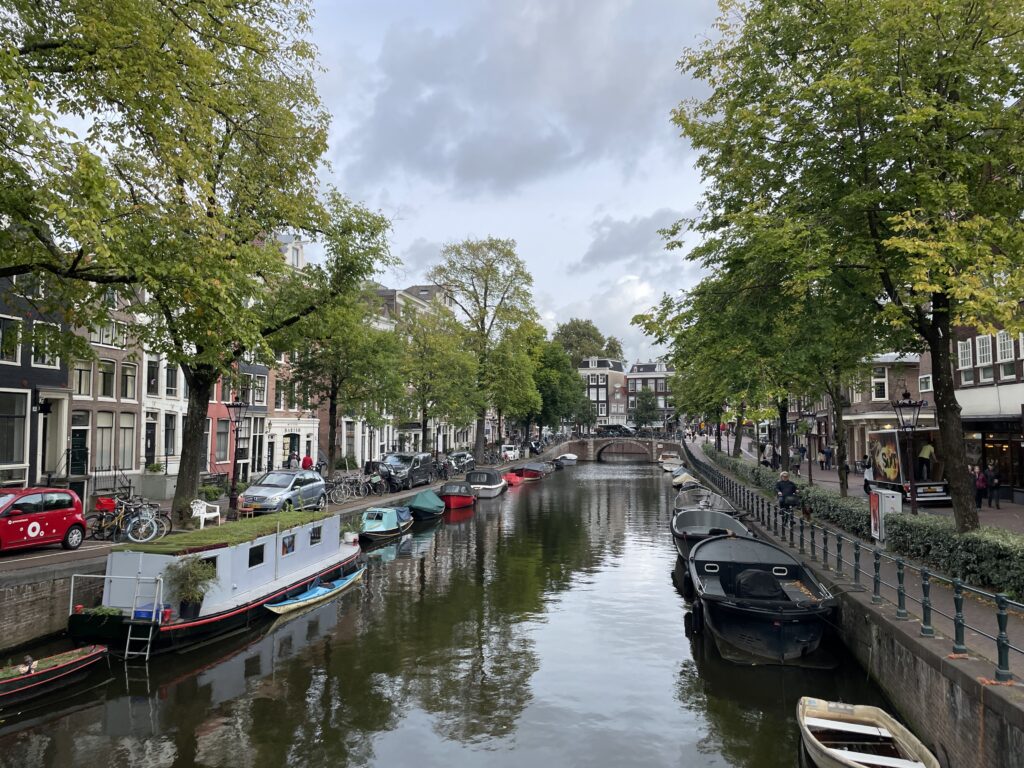
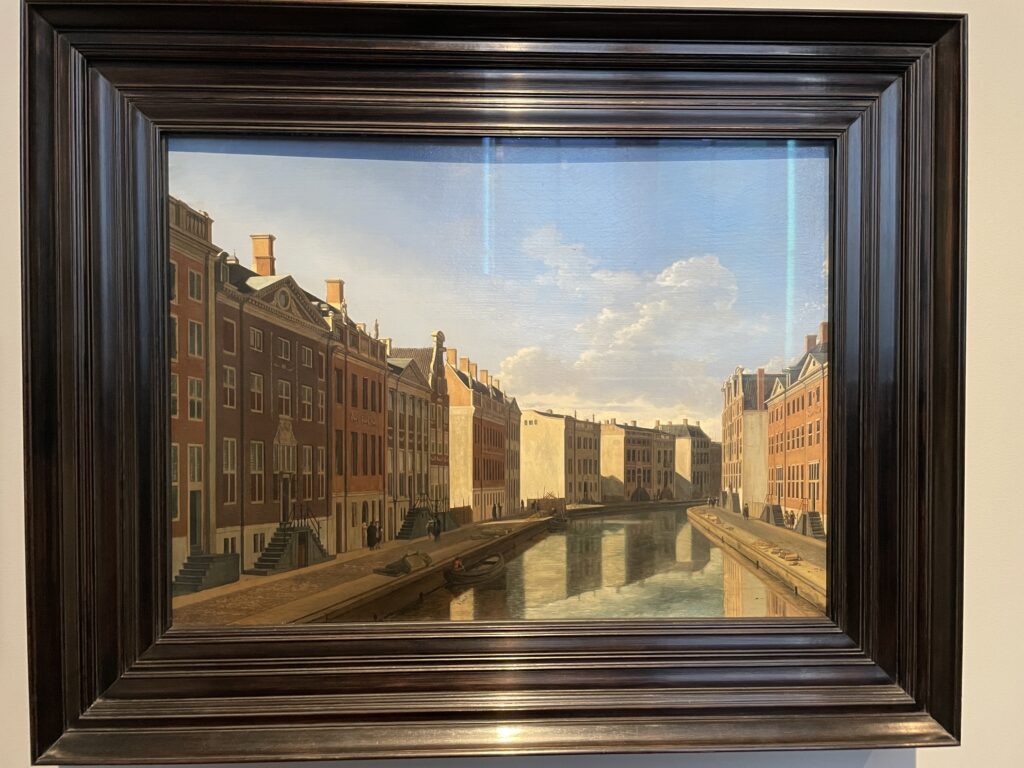
    Amsterdam is a city that enchants in various ways: with its typical gabled houses dating back to the Golden Age, with the shimmering canals dotted with boats, and even more so with the centuries-old and cozy bruin cafés (smoke-stained pubs) illuminated by candles, where beer flows freely. Art enthusiasts will find few other cities with such a variety of masterpieces: just think of the richness of the collections housed in the Rijksmuseum, the Van Gogh Museum, the Stedelijk Museum, and the Hermitage. For music lovers, there is a rich lineup of internationally acclaimed concerts, which invariably sell out. For those attracted to the more daring aspects, there are the women in the windows in the red-light district and the coffee shops selling cannabis. Amsterdam is an extremely compact and accessible city, with a limited center to explore on foot and characteristic alleys that always hide some surprises: a hidden garden, an antique book market, a seventeenth-century distillery – authentic microcosms where nothing ever presents itself the same way twice.

    Day 1

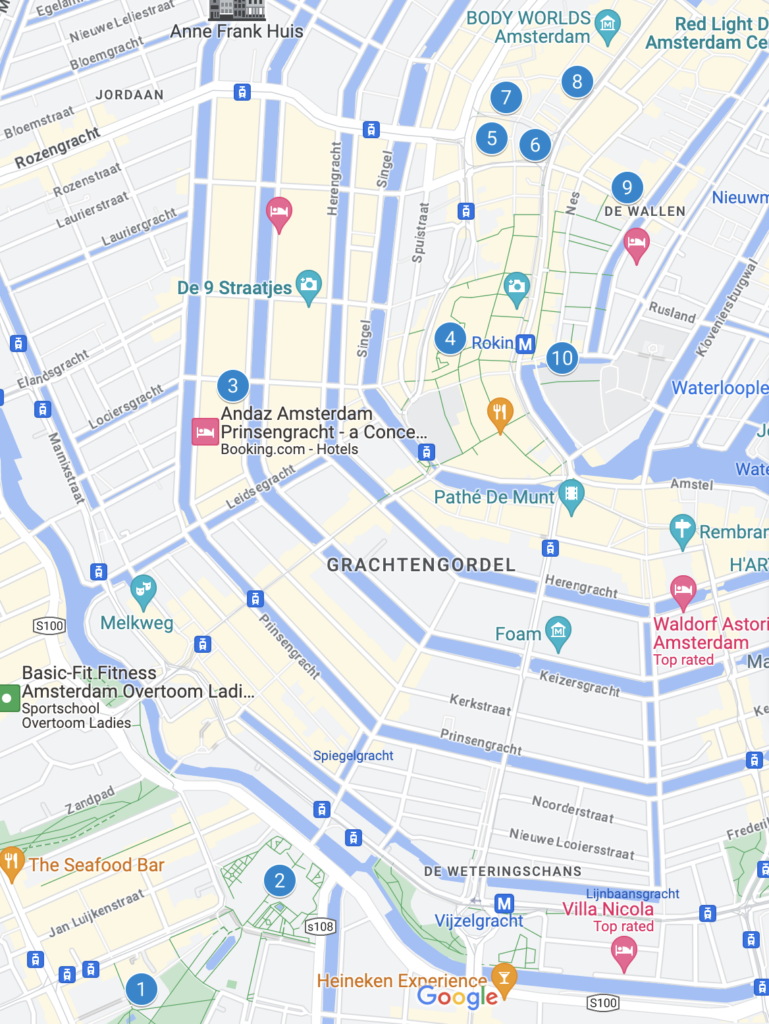
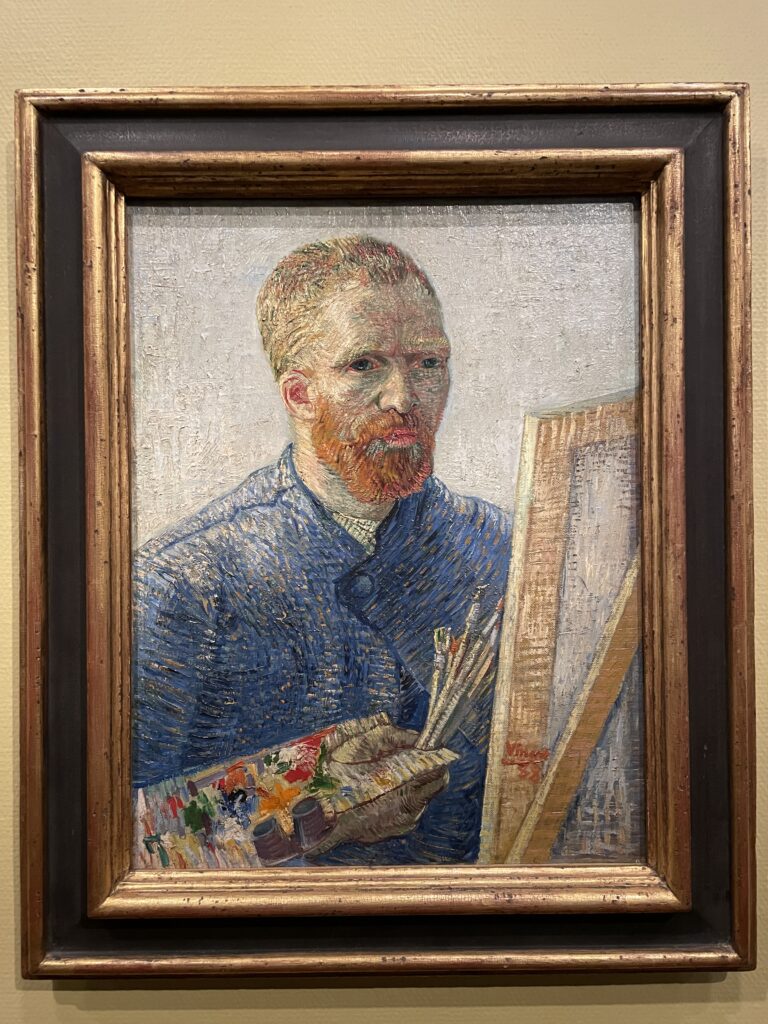
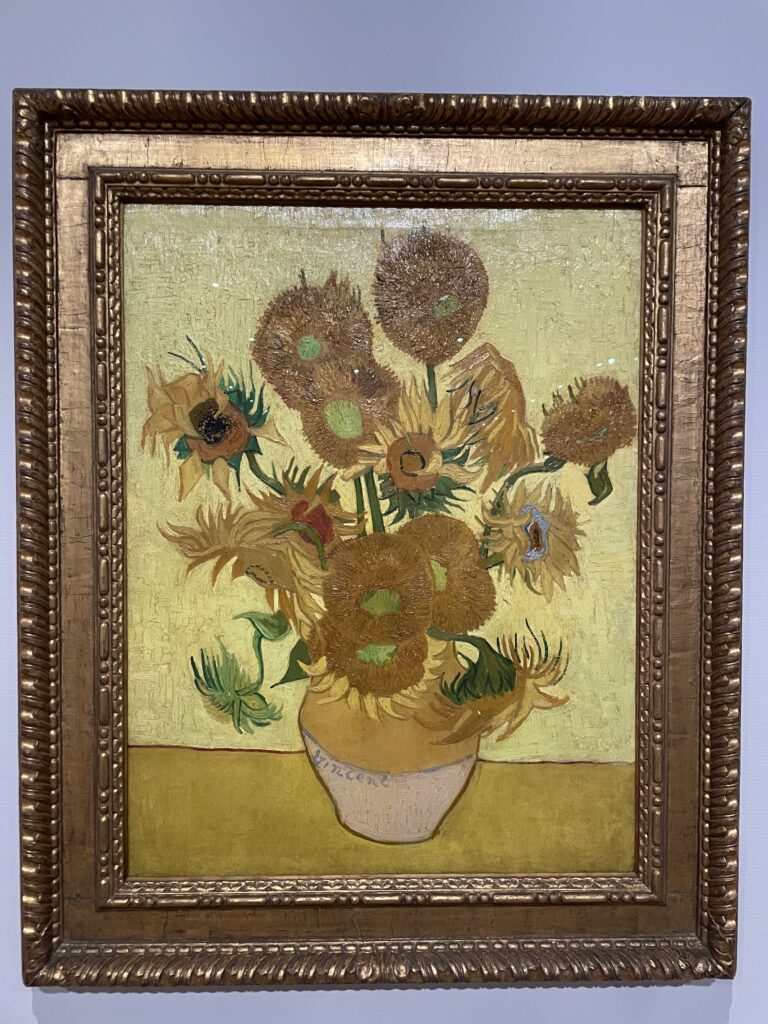
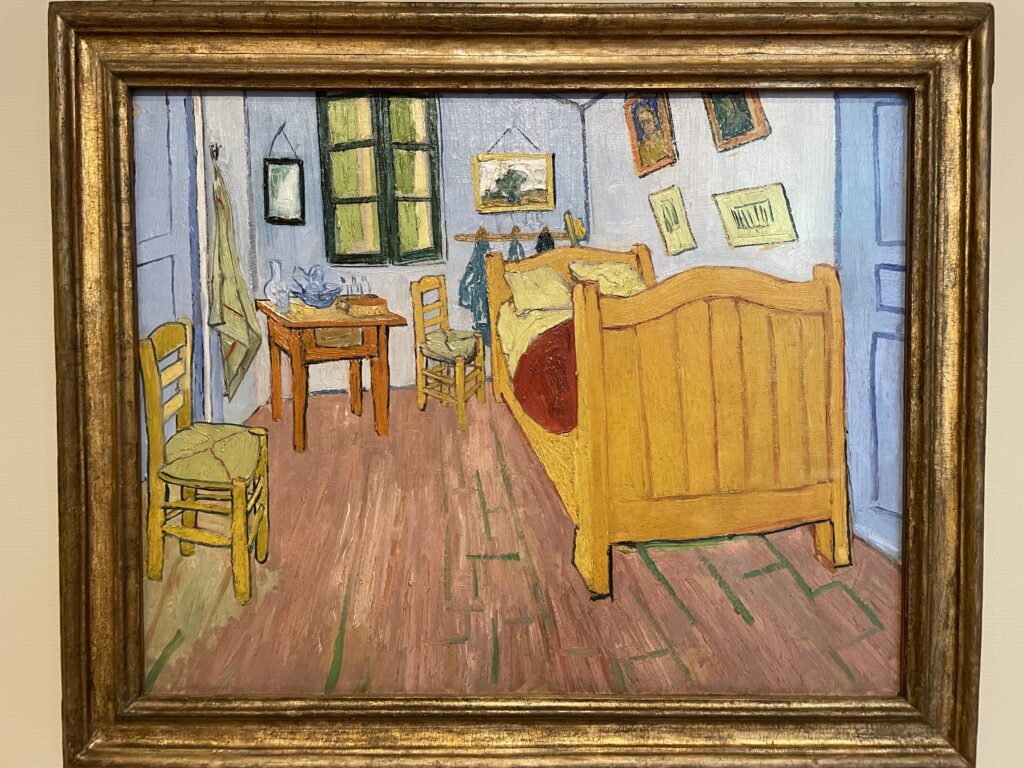
    Framed by a new, sparkling glass entrance, the museum housing the world’s most extensive collection of Van Gogh’s works encompasses a magnificent series of masterpieces. Starting from the artist’s early experimental canvases, the museum traces his life, from the phase dominated by the joyful hues of sunflowers to the dark cloud that later descended upon him and his works. The museum also houses paintings by contemporary artists to Van Gogh, such as Gauguin, Toulouse-Lautrec, Monet, and Bernard. The lines to enter can be endless; tickets purchased in advance online and discount cards allow access through separate entrances where the line moves faster.

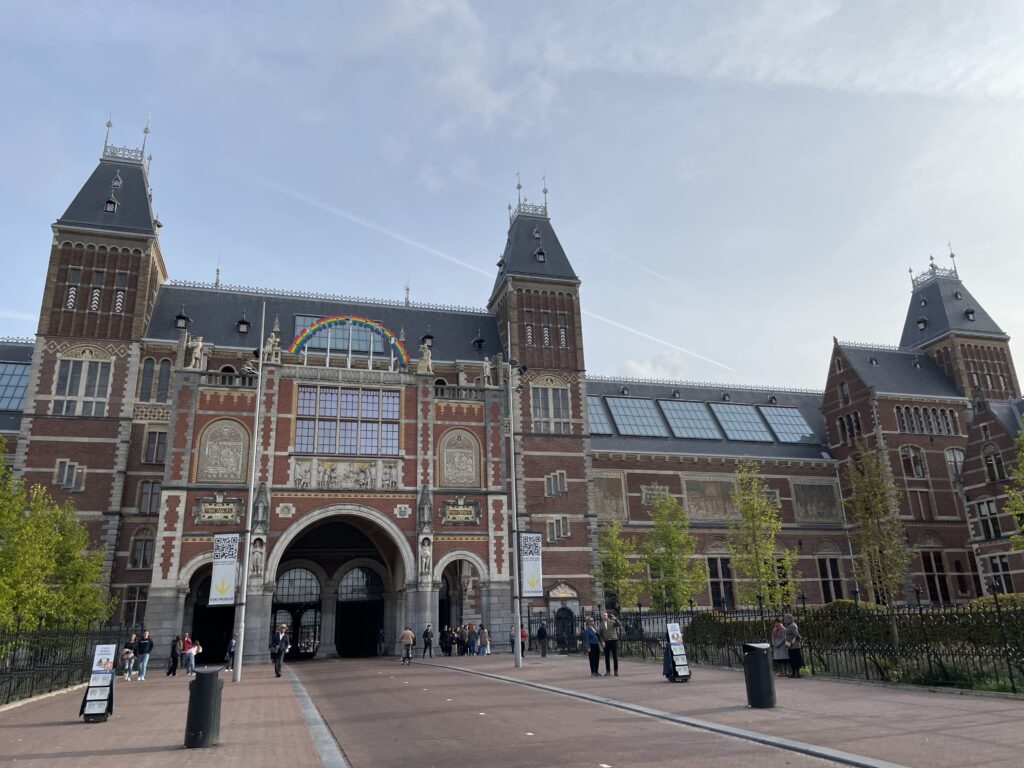
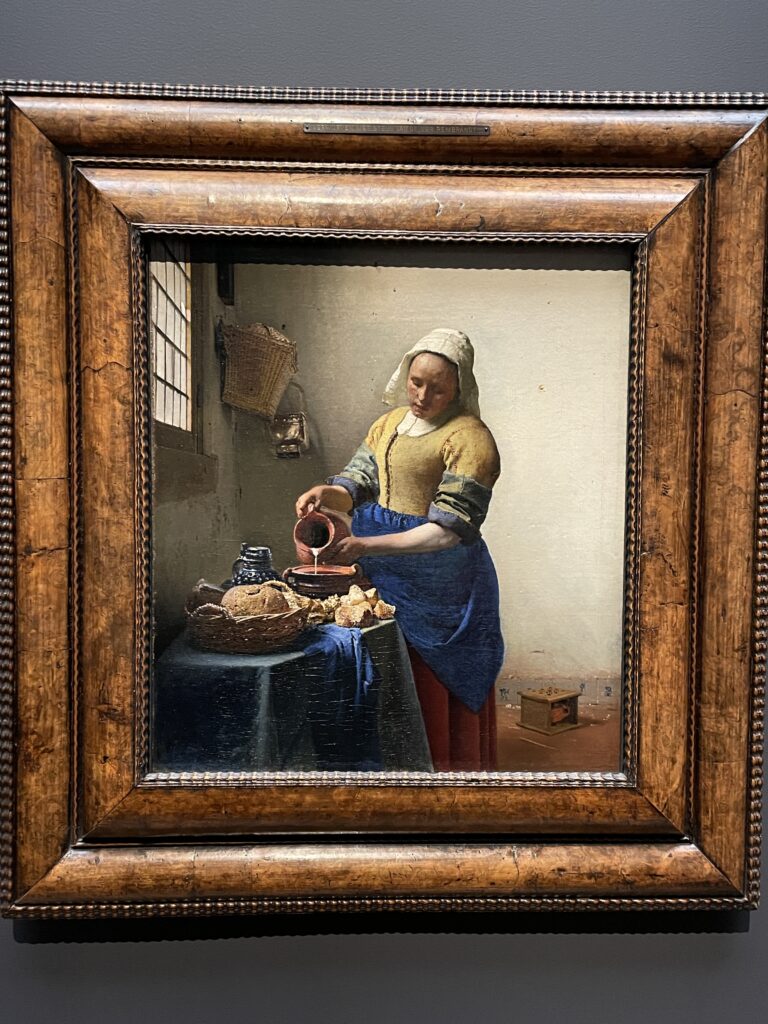
    The Rijksmuseum is the most important Dutch art museum: a heritage of works by Rembrandt, Vermeer, and 7,500 masterpieces by other artists spread along 1.5 km of galleries. If you want to avoid the peak of the crowd, we recommend arriving at the museum after 3 PM, or booking tickets online to access a separate entrance with a quicker flow. The highlight of the collection consists of works from the Golden Age: the subjects of still lifes, gentlemen with pleated collars, and landscapes suffused with a pale yellow light are a true feast for the eyes. The centerpiece of the exhibition is Rembrandt’s “The Night Watch” (1642). Initially titled “Company of Captain Frans Banning Cocq,” the painting assumed its current name only a few years later, after it darkened due to a layer of dirt that evoked the evening light. Don’t miss the blue and white Delft ceramics, the incredibly detailed dollhouses, and the brand-new Asian Pavilion. The sculpture garden surrounding the building is free to enter.

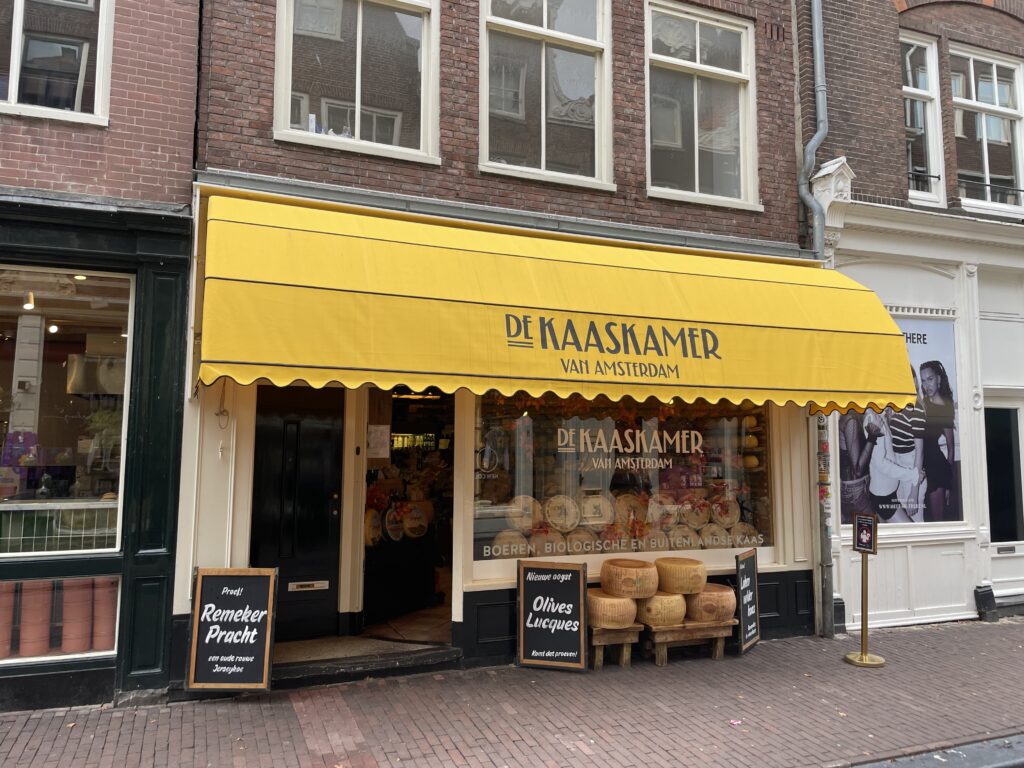
    The Dutch consume more than 14 kg of cheese per person every year, mostly sold by De Kaaskamer, where wheels of gouda, edam, and other local varieties form towering stacks that reach the ceiling. The name means “Cheese Room,” and indeed, the place seems to overflow with a wide variety of Dutch and organic cheeses, as well as olives, tapenade, salads, and other products perfect for a picnic. Before making a purchase, you can taste the products; if you can’t take home a wheel of Gouda, at least buy a baguette with cheese and/or deli meat for takeout.

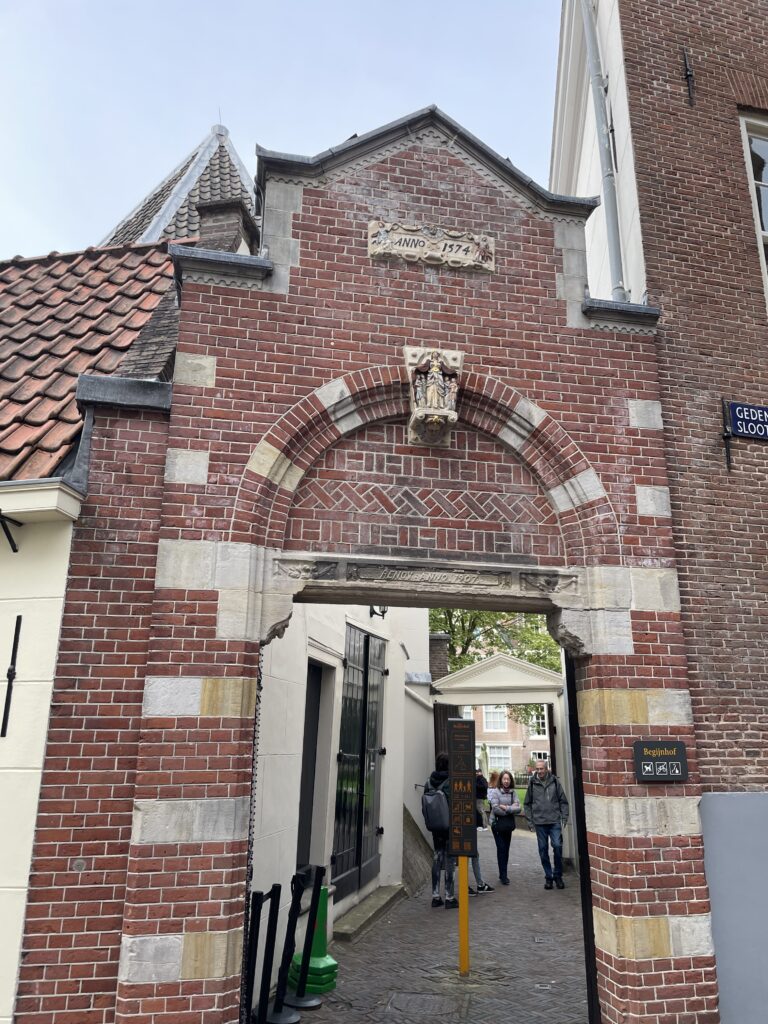
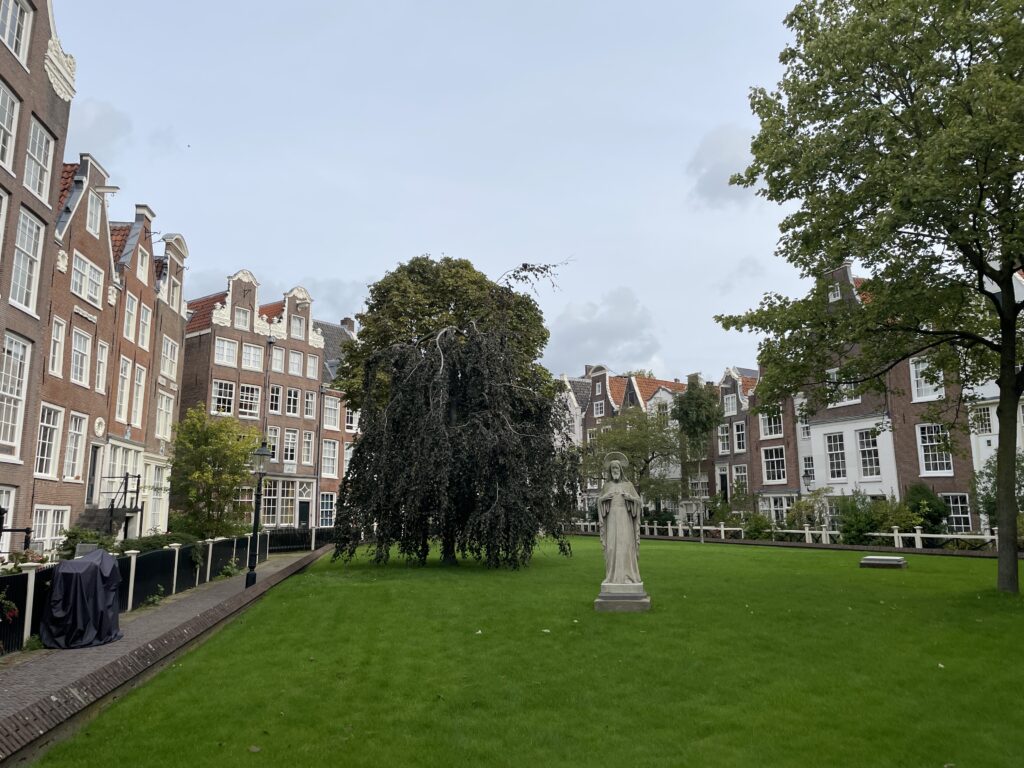
    Once you reach Spui Square, just after the American Book Center, you’ll notice a modest wooden door: open it and take a look at the hidden little village called Begijnhof (p44), with its two ancient churches and gardens. Cross the courtyard to the entrance on the opposite side.

    This sheltered complex of small houses and tiny gardens was built in the 14th century around the convent for the Beguines, a Catholic order of single or widowed women who cared for the elderly and led a religious life without taking monastic vows. The last true Beguine died in 1971.

    Cross the courtyard to the entrance on the opposite side. From Begijnhof, head north for a short distance to the Civic Guard Gallery, filled with portraits of men with pleated collars and stern expressions.

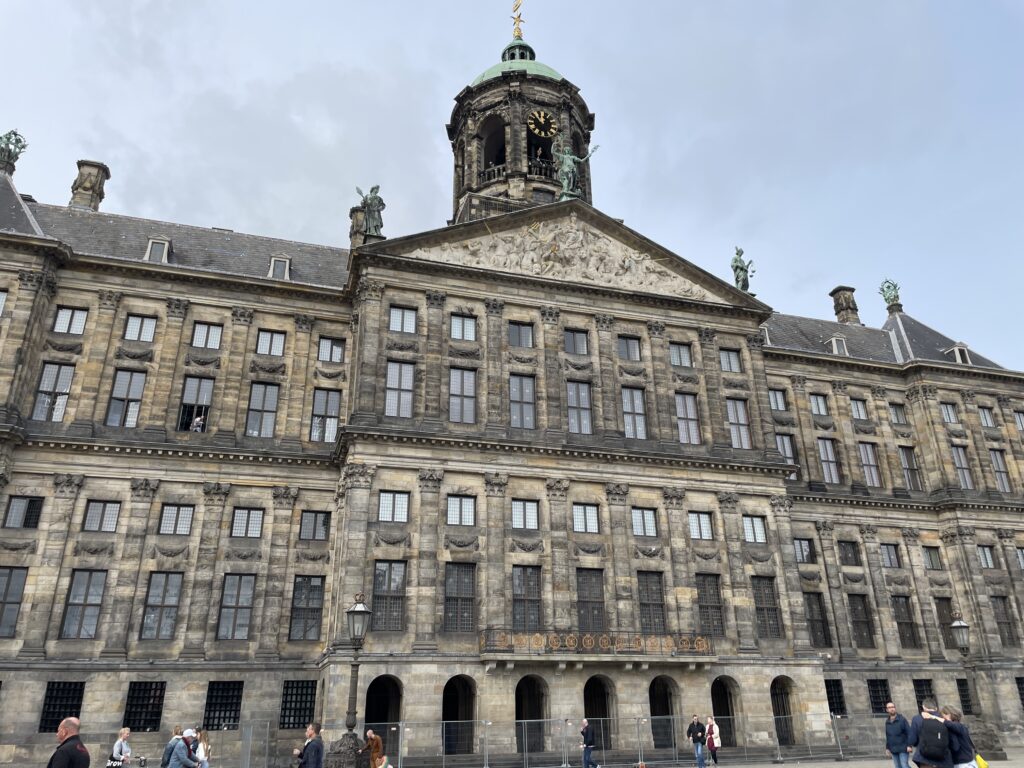
    Walk through the gallery and exit into the courtyard of the Amsterdam Museum on Kalverstraat. Continue down Kalverstraat to the Royal Palace, the residence of King Willem-Alexander and Queen Máxima; take a peek at the lavish interiors. Built in 1665 as a sumptuous town hall, in 1808 it became the residence of Napoleon’s brother, who was crowned the King of Holland. The imposing building boasts splendid interiors and magnificent marble decorations, including the inlaid floor with world maps in the grand burgerzaal (civic hall) at its center. At the entrance desk, you can obtain a free audio guide that explains in detail everything you will see. King Willem-Alexander only uses the Royal Palace for ceremonies; check the website for closing periods.

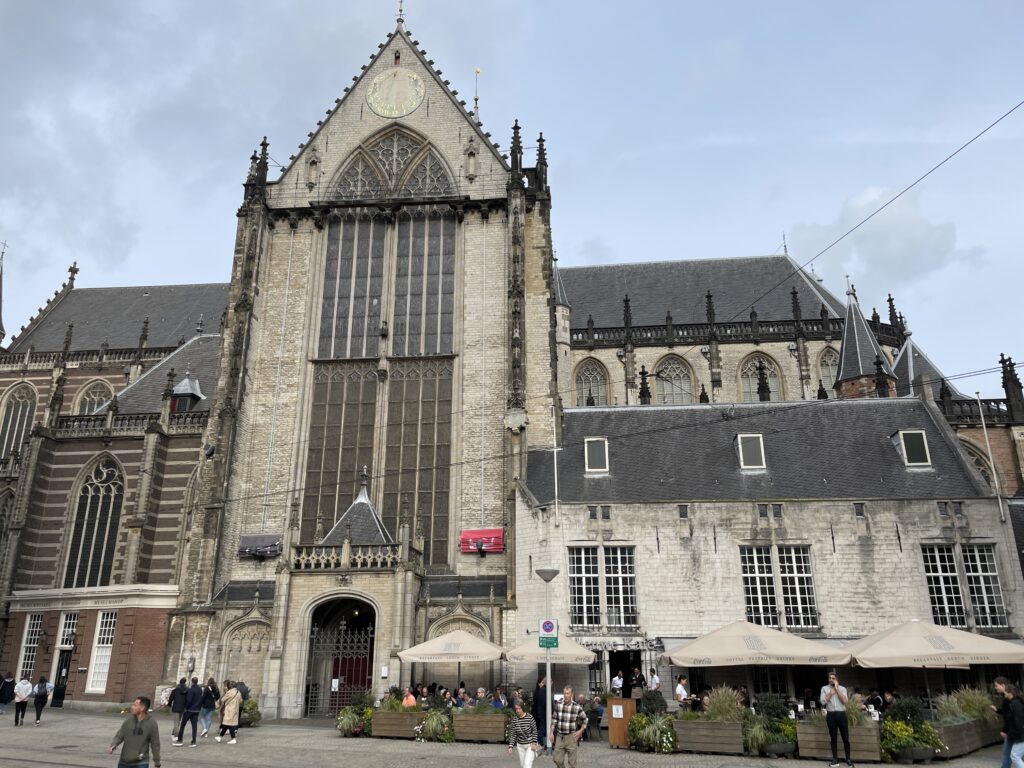
    Next door is the New Church, where the Dutch monarchs are crowned. This late Gothic basilica from the 15th century is the place where Dutch monarchs are traditionally crowned and is newer only compared to the Oude (Old) Kerk. Several monumental elements dominate the sparse interior of the church: a magnificent oak wood inlaid chancel, a choir screen in bronze, an imposing organ, and an immense stained glass window depicting historical scenes. The building is also used to host exhibitions and organ concerts. Opening hours and ticket prices vary depending on the ongoing event.

    Then, follow the bustling Nieuwendiik and walk to Zoutsteeg. At this point, try to overcome your aversion to raw fish and taste the famous Dutch herring at Rob Wigboldus Vishandel, a tiny place with only three tables. Leave Zoutsteeg and continue on Damrak. Cross Damrak and reach the side of Dam Square where the Nationaal Monument stands. Walk amidst the sea of bicycles, positioning yourself behind the monument to see the urns containing soil from World War II cemeteries. 

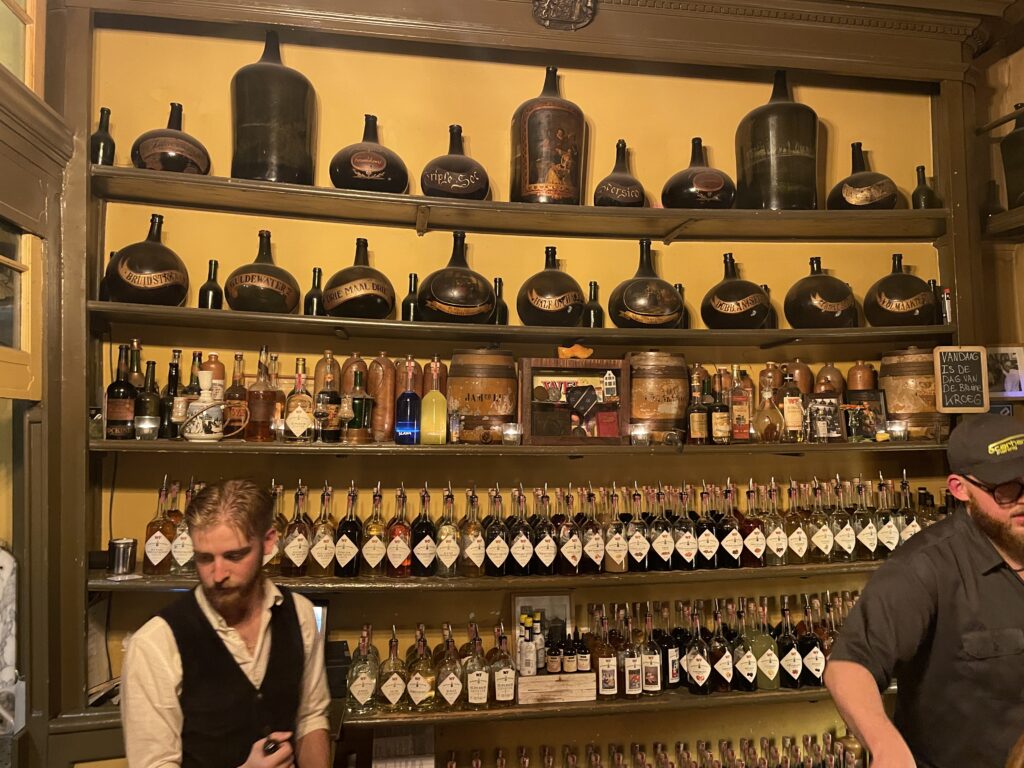
    Follow the road behind the NH Grand Hotel Krasnapolsky that leads to Wynand Fockink, a Dutch gin distillery dating back to 1679. This small tasting room, located in a covered gallery behind the Grand Hotel Krasnapolsky, has been serving rivers of jenever and liqueurs since 1679. It doesn’t have chairs or stools, but it’s a pleasant and intimate place to have a drink or two with friends. On weekends (at 3 PM, 4:30 PM, 6 PM, and 7:30 PM), a guided tour of the distillery takes place; conducted in English, it includes six tastings (€17.50, no reservation required).

    The bartender will fill your glass to the brim, so follow the Dutch way and lean down to take the first sip: this way, you’ll avoid spilling any drops.

    Day 2

    In the former Heineken brewery, you can now take part in a self-guided tour, the highlight of which (aside from the tastings included in the price) is the multimedia area where visitors are shaken, sprayed with water, and finally subjected to heat, mimicking the process the beer undergoes. True beer enthusiasts might find it horrifying, but it’s a very fun experience. The entrance ticket includes a 15-minute boat ride that shuttles between the Heineken Brand Store, near Rembrandtplein.

  • Berlin

    Berlin

    Day 1 - Mitte

    Berlin is an ideal city for those who love walking because, despite its considerable size, it is compact and divided into well-defined neighborhoods, each with its own points of interest and attractions easily reachable on foot. “Day 1- Mitte” is a perfect walk if you are visiting the city for the first time, as it covers the main monuments and famous places in the capital. To understand how the urban landscape has changed since reunification, follow the “Day 2 – Contemporary Architecture” itinerary. Enjoy your walks!

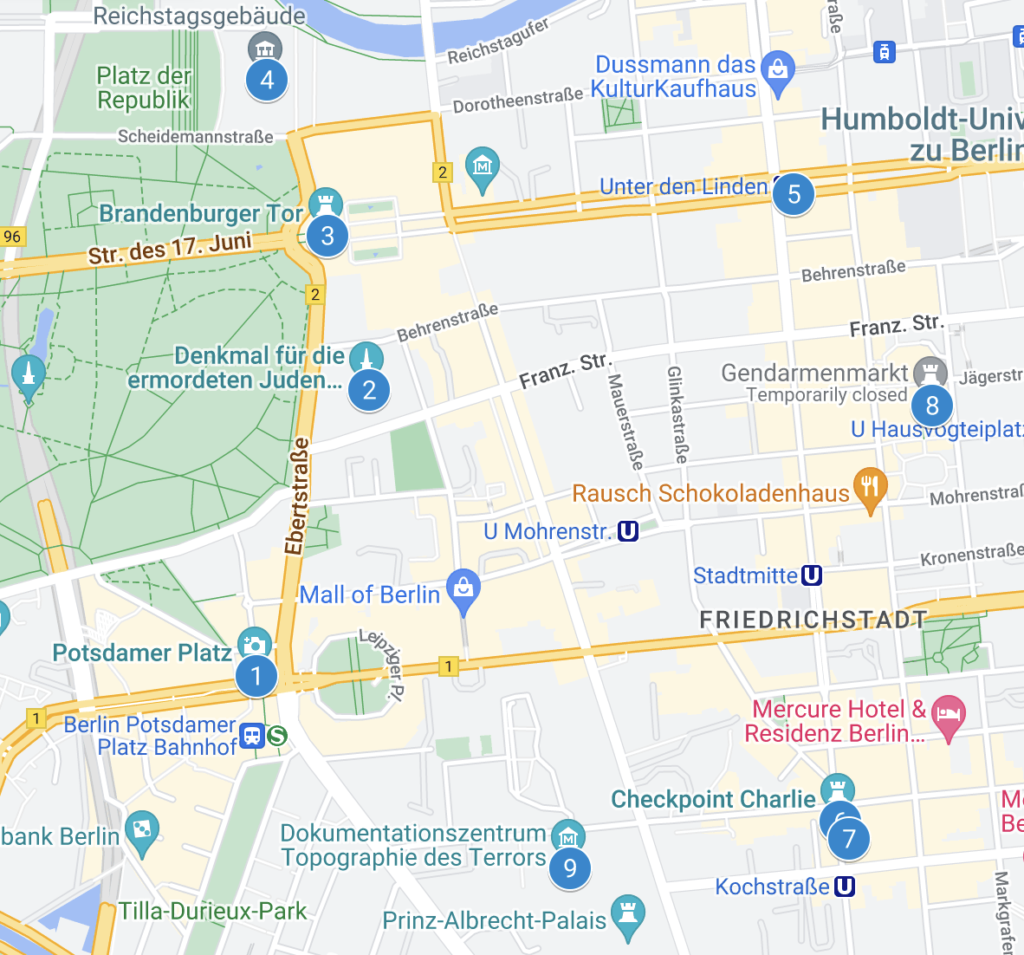
    This itinerary, which requires a full day, covers all the classic monuments of Berlin and some fabulous spots in the city that are less known. Along the way, you will see picturesque views, impressive architecture, inviting local eateries to grab a bite, and numerous places you probably know from history books. The itinerary starts from Potsdamer Platz and winds through the new ministerial quarter, reaches Unter den Linden, and then continues through the historic center, ending in Scheunenviertel.

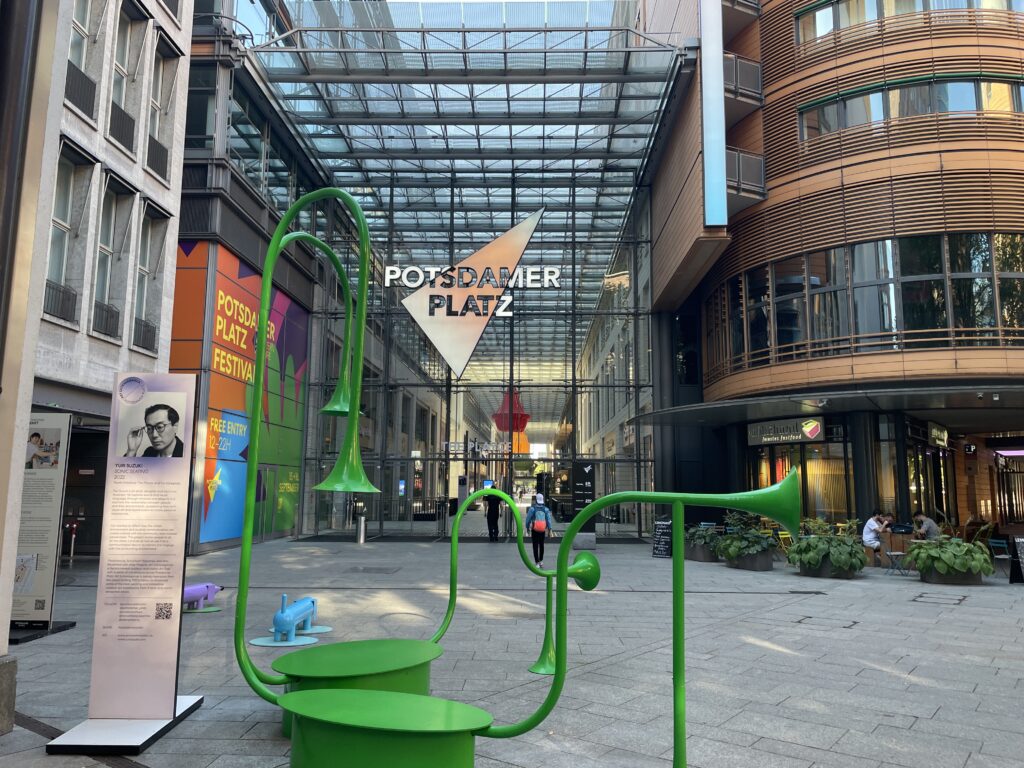
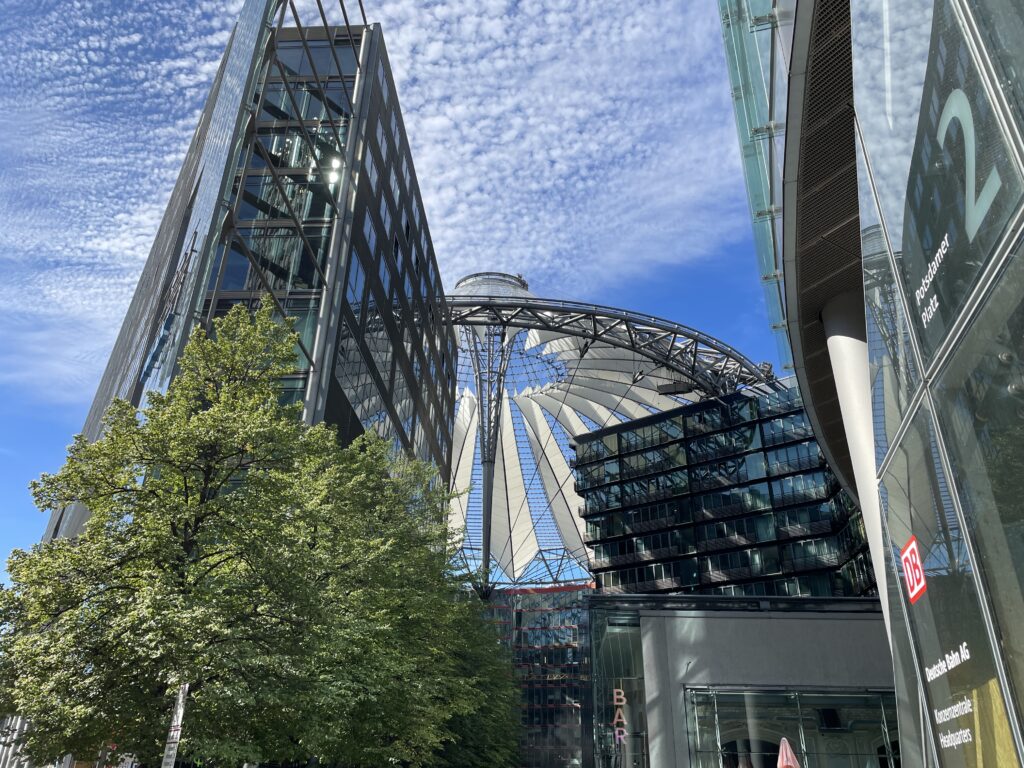
    So, start from Potsdamer Platz, the newest area of Berlin, a true showcase of contemporary architecture. Storefront of urban renewal, Potsdamer Platz is perhaps the most visible symbol of the “new Berlin” and a major tourist attraction. This historic square was once a bustling crossroads that became synonymous with metropolitan life and entertainment in the early 20th century. In 1924, Europe’s first traffic light (which operated manually) was installed here, a copy of which has recently been placed in its original location. World War II drained all life from Potsdamer Platz, and the entire area was frozen, cut in two by the Wall, until reunification. In the 1990s, the city administration engaged the best international talents in contemporary architecture, including Arata Isozaki, Rafael Moneo, Richard Rogers, and Helmut Jahn, to realize ‘Potsdamer Platz – Part Two’ as part of architect Renzo Piano’s overall project. Constrained by the city’s zoning regulations, the final result cannot be described as avant-garde, but it is pleasant and, above all, human-scale. 

    Berliners and visitors have warmly embraced this new urban development, which is divided into three parts: DaimlerCity, the Sony Center, and the Beisheim Center. DaimlerCity, which extends south of Potsdamer Strasse, was the first project to be completed in 1998. The Sony Center, nestled between Potsdamer Strasse, Ben-Gurion-Strasse, and Bellevuestrasse, was inaugurated in 2000. The last of the three projects, the Beisheim Center, is the most recent, opened in 2004, and occupies the triangle formed by Lenné-, Bellevue-, and Ebertstrasse. If you want to get a bird’s-eye view of the area, you can take what is considered the ‘fastest elevator in the world’ at Panorama Punkt

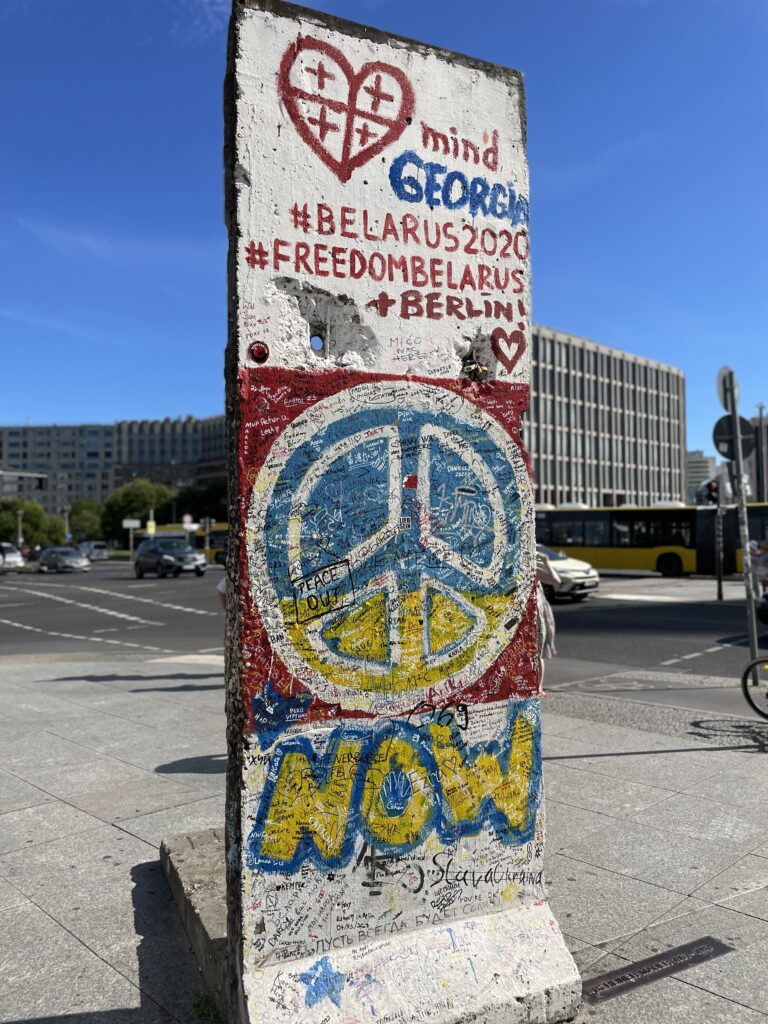
    Take a look at the stretches of the Berlin Wall. The word “wall” does not describe the full extent of the barrier which cut Berlin into two halves from 1961 to 1989. The Berlin Wall was, in fact, a wide corridor between two walls. One wall marked the actual border on the west side of the corridor, while a second wall closed off the corridor to the east. The death strip, which included a narrow sentry path for the border guards of the GDR, lay in between. In the inner city, the corridor separated the old city centre along its northern, western and southern boundaries from the West-Berlin districts of Wedding, Tier-garten and Kreuzberg. Today a twin row of cobble-stones stretching several kilometres marks the exact location of the former border wall, and is being gradually extended. The Wall that encircled West-Berlin for almost thirty years had a total length of 160 kilometres. Of these, 45 kilometres separated the west from the east part of the city, while a stretch of 115 kilometres cut it off completely from the neighbouring Land of Brandenburg. More than 100 sites commemorating the victims and particular Wall-related incidents are spread along this route today. In 2001, the Berlin Senate launched its “Berlin Wall Trail” project with the aim of gradually making the entire 160 kilometers of the former Wall accessible to pedestrians and cyclists. Signs indicate the direction, aerial views afford an overall perspective, and information points highlight historically significant sites, thereby complementing the information boards installed by the Geschichtsmeile Berliner Mauer (Berlin Wall History Mile) initiative.

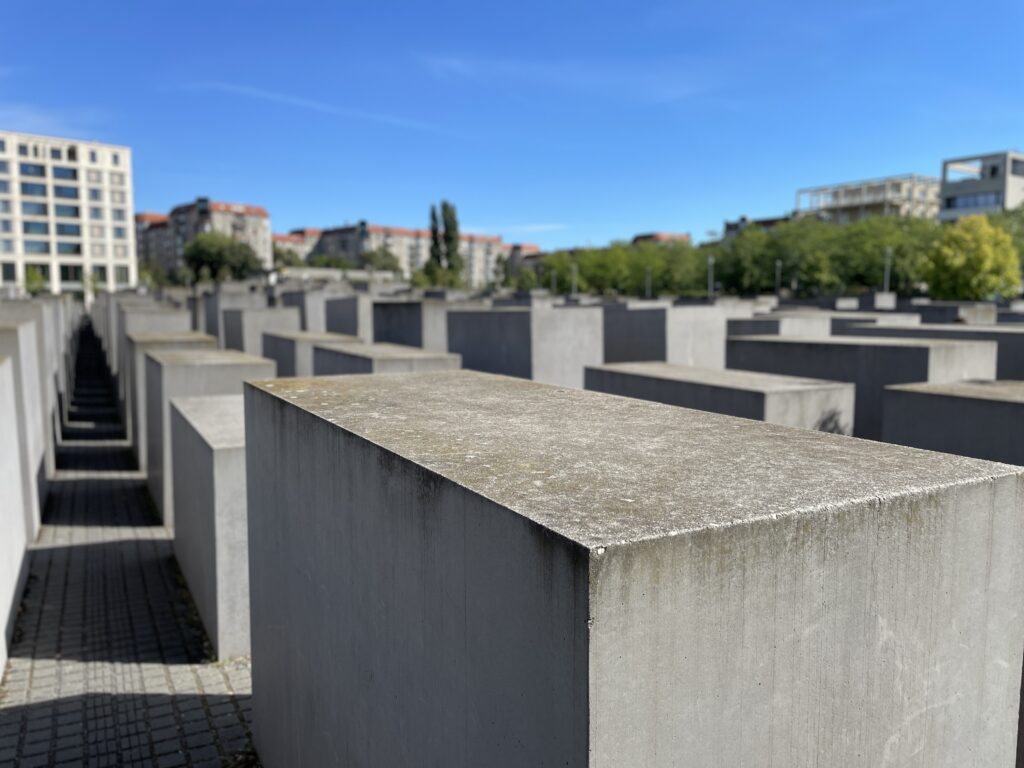
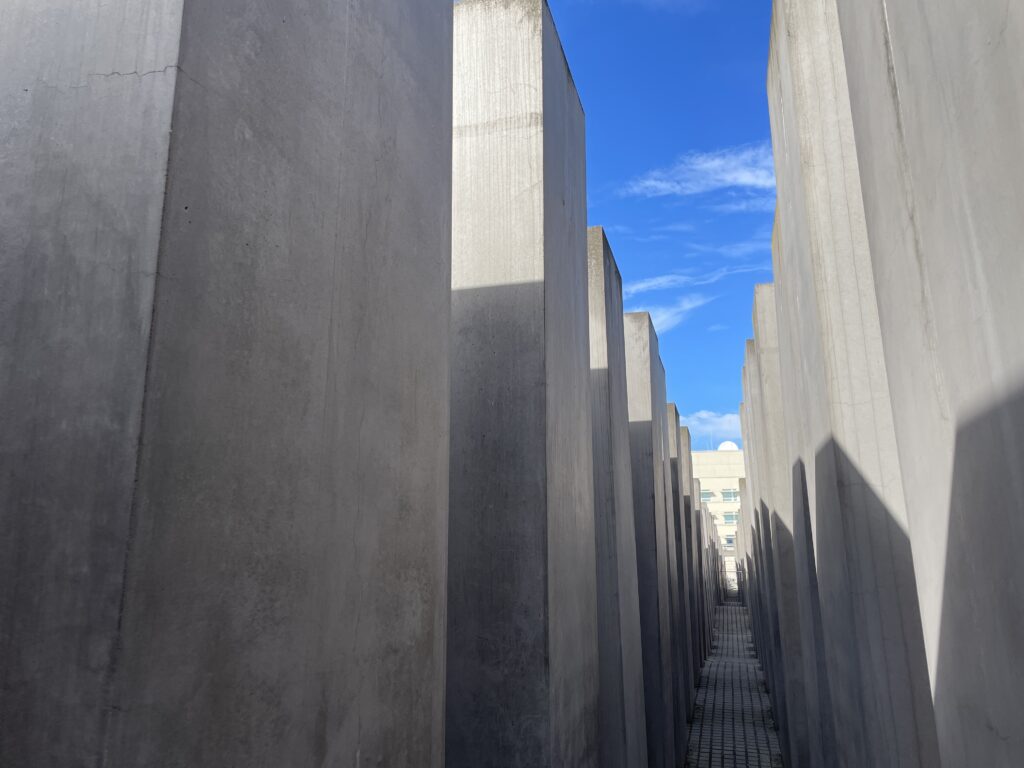
    Continue north along Ebertstrasse to the Holocaust Mahnmal 5 (p83), the memorial for the victims of the Holocaust, a visually and emotionally impactful work, especially if you take the time to wander among the tall concrete blocks, appreciating their expressive power.

    It took 17 years of discussions, planning, and construction, but finally, on May 8, 2005, the Monument to the Jewish victims of the Nazi genocide during the Second World War was inaugurated. Generally known as the Holocaust Memorial, it occupies a space comparable to a soccer field immediately south of the Brandenburg Gate. The New York architect Peter Eisenmann conceived a vast grid of 2,711 rectangular concrete blocks of varying heights placed on undulating terrain, resembling a kind of giant cemetery. Visitors have unrestricted access to this labyrinth from any point and can move independently.

    At first glance, the monument may appear sober and emotionally detached, but give yourself time to appreciate the complexity of the project, to experience the coldness of the stone structures, and to observe the play of light and shadow. To learn more about the tragic historical period to which the monument refers, visit the underground Information Center (Ort der Information), whose entrance is on the eastern side. The timeline graph of the persecution of Jews during the Third Reich is followed by rooms that document the personal history of some victims and entire families through documents.

    In a darkened room, the names of the victims and their dates of birth and death are projected onto the four walls, while a low voice reads their brief biographies. It takes nearly seven years of uninterrupted reading to honor the memory of the victims of the extermination.

    Continuing north along Karl-Liebknecht-Str and Ebertstrasse, you will arrive at the moving Monument to the Victims of the Wall, erected in memory of those who died trying to escape from the DDR. Just a few steps from the monument stands the imposing Reichstag, the seat of the German parliament.

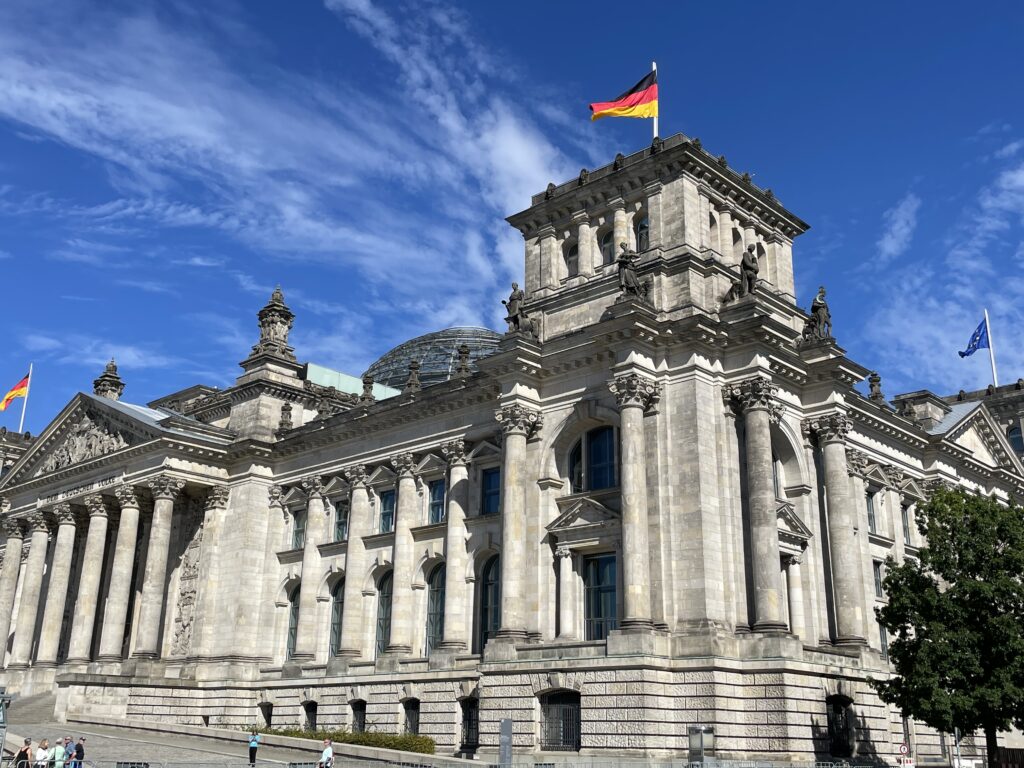
    The Reichstag became the seat of the Bundestag, the German Parliament, in 1999 when the restoration overseen by Lord Norman Foster was completed. The renowned English architect transformed the 1894 building, designed by Paul Wallot, into a state-of-the-art complex, preserving only the original external structure and adding extraordinary contemporary elements, such as the sparkling glass dome. The rapid elevator ascent to the top is a must for anyone visiting Berlin, offering a 360° panorama of the city and stunning close-up views of the dome and the mirrored funneled center. The elevator delivers visitors to a panoramic terrace where there is also an expensive restaurant. From here, you can ascend a spiral staircase inside the dome itself, located right above the Plenary Hall. At the top, there are also explanations about the building’s history.  

    The Reichstag has been at the center of numerous crucial events in German history. After World War I, Philipp Scheidemann proclaimed the republic from one of its windows. The Reichstag fire on February 27, 1933, allowed Hitler to blame the Communists and seize power. A dozen years later, the victorious Soviet army nearly destroyed the building. Restoration, except for the dome, was not completed until 1972. On October 2, 1990, at midnight, the reunification of Germany was proclaimed from here. In the summer of 1995, the Reichstag once again made headlines worldwide when Christo (the famous Bulgarian artist known for ‘wrapping’ public monuments) and his wife Jeanne-Claude wrapped the building in plastic sheets. Lord Norman got to work shortly after.

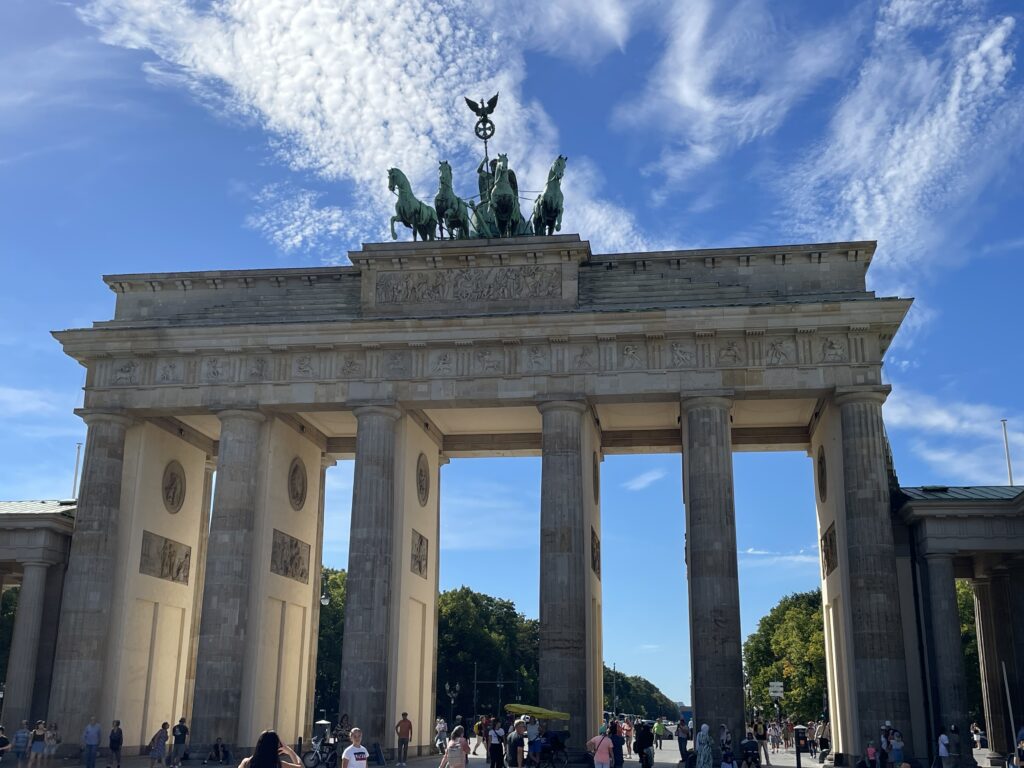
    As you continue on, prepare your camera to capture the majestic Brandenburg Gate, the ultimate symbol of German reunification. The famous Brandenburg Gate, recently restored and a symbol of the division between the two Berlins during the Cold War, now stands as a guardian of embassies, an icon of reunified Germany. It was here, in front of this gate, that in 1987 the then-President of the United States, Ronald Reagan, uttered the now-famous words: “Mr. Gorbachev, tear down this wall.” Two years later, the Wall would become a thing of the past. The structure, designed by Carl Gotthard Langhans in 1791, is the only gate that has survived out of the 18 city gates. The Quadriga by Johann Gottfried Schadow, the sculpture of the winged goddess of victory guiding a horse-drawn chariot, proudly stands atop a backdrop of Doric columns. Napoleon seized the sculpture in 1806 and kept it in Paris for years. However, with Napoleon’s defeat, the winged goddess was liberated from a gallant prussian general.

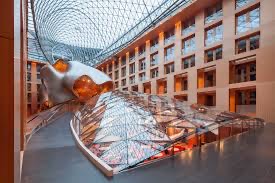
    The gate leads to Pariser Platz, a harmoniously proportioned square where you could visit the DZ Bank and ask for permission to take a look at the stunning atrium designed by Frank Gehry.

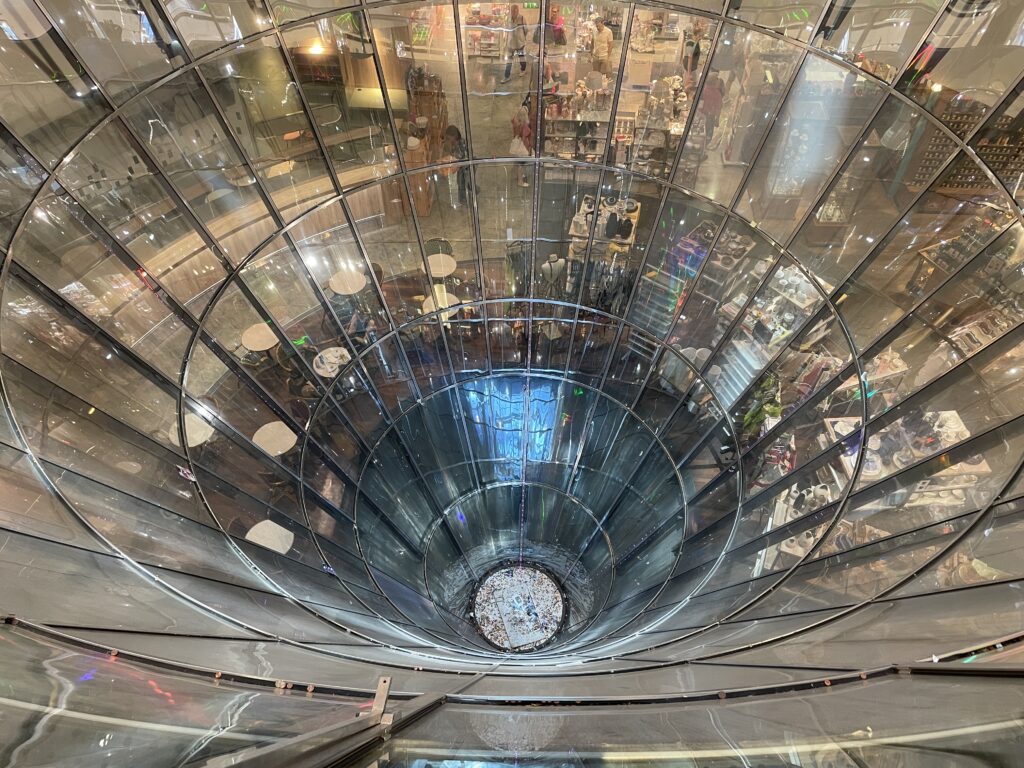
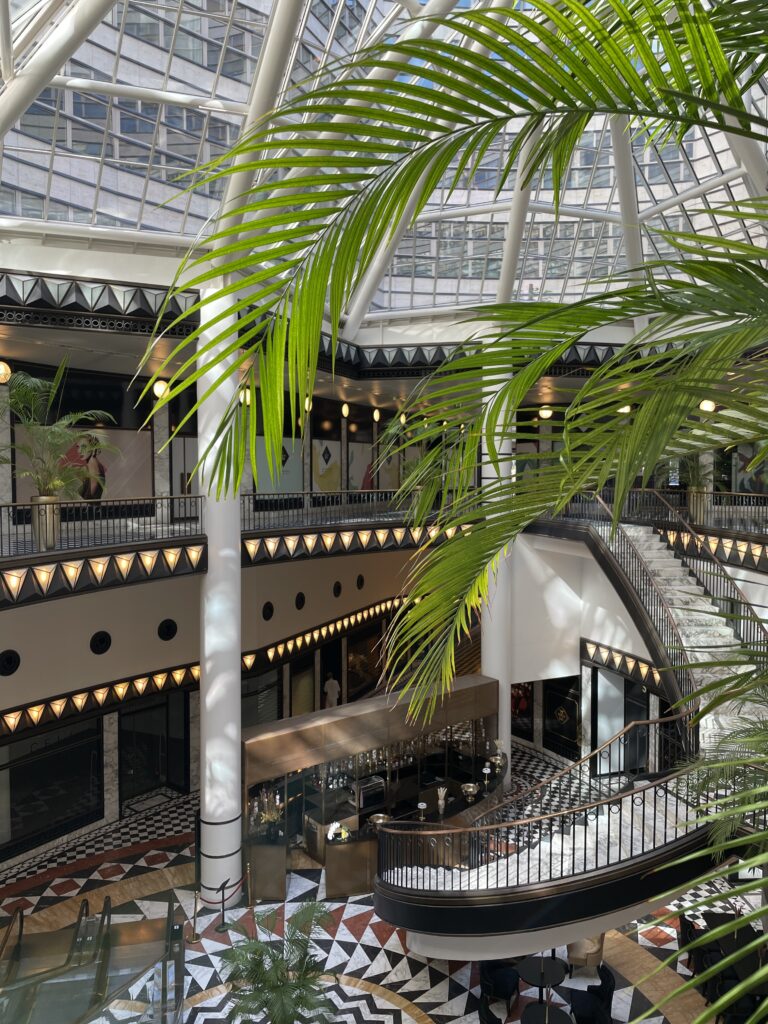
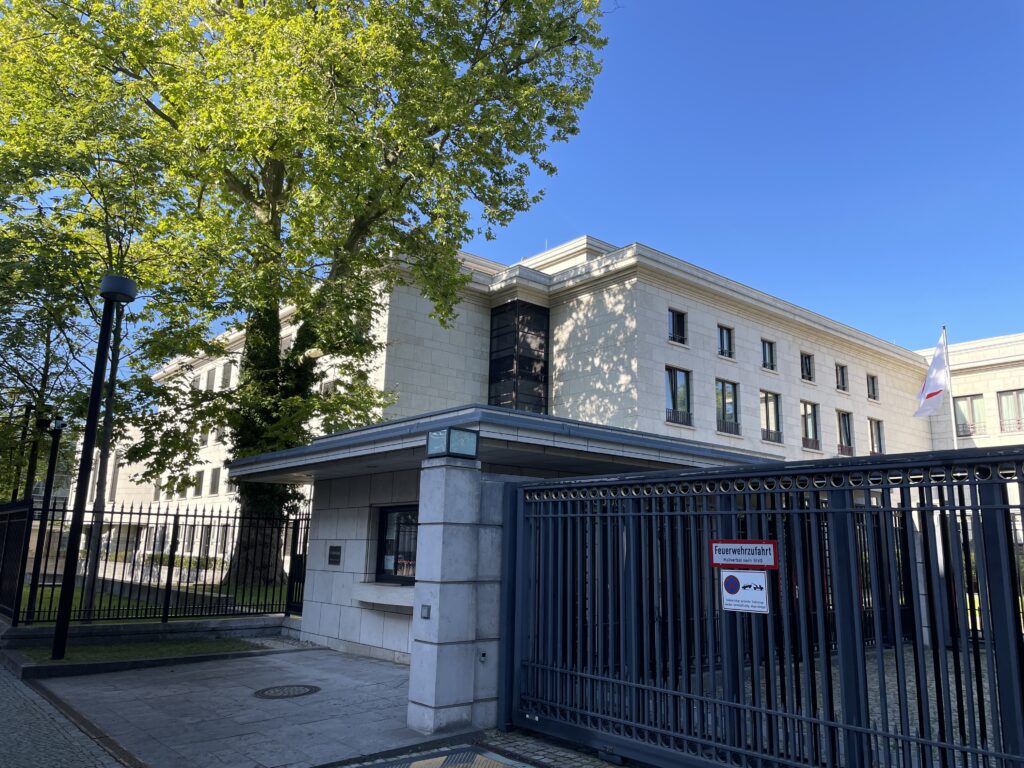
    From here you reach Unterden Lunden, Berlin’s historic grand boulevard. As you walk east, you’ll soon spot, on your right, the Russian Embassy, housed in a monumental white marble building. Nearby, you’ll find the elegant Café Einstein, perfect for a refined break. Turning right at Friedrichstrasse, you’ll reach the luxurious Friedrichstadt area. Inside the Galeries Lafayette, designed by architect Jean Nouvel, you can admire the striking glass cone. Remarkable also are the marble decorations by Fienry Cobb and I.M. Pei in Quartier 206. The dining options in Quartier 205 offer various ways to satisfy your hunger.


    Just 500 meters from here, you’ll find Checkpoint Charlie, the most famous border crossing between East and West Berlin throughout the Cold War.

    Alpha, Bravo, Charlie… The American phonetic alphabet inspired the name of the third Allied checkpoint in post-World War II Berlin. A symbol of the Cold War, Checkpoint Charlie was the primary crossing point for Allies, diplomats, and other foreigners who were permitted to travel between the two Berlins from 1961 to 1990. It was here that American and Soviet tanks faced off in October 1961, bringing the world to the brink of a third world war. To commemorate this historic site, Checkpoint Charlie has been partially reconstructed. There’s a guardhouse from the American military (the original is at the Allierten Museum,) and a replica of the famous sign that warned ‘You are leaving the American sector’ in English, Russian, French, and German. The original sign is now located immediately next door, in the Haus am Checkpoint Charlie Museum. A new office district – with buildings designed by Philip Johnson and other international architects – has arisen around what was once a restricted area.


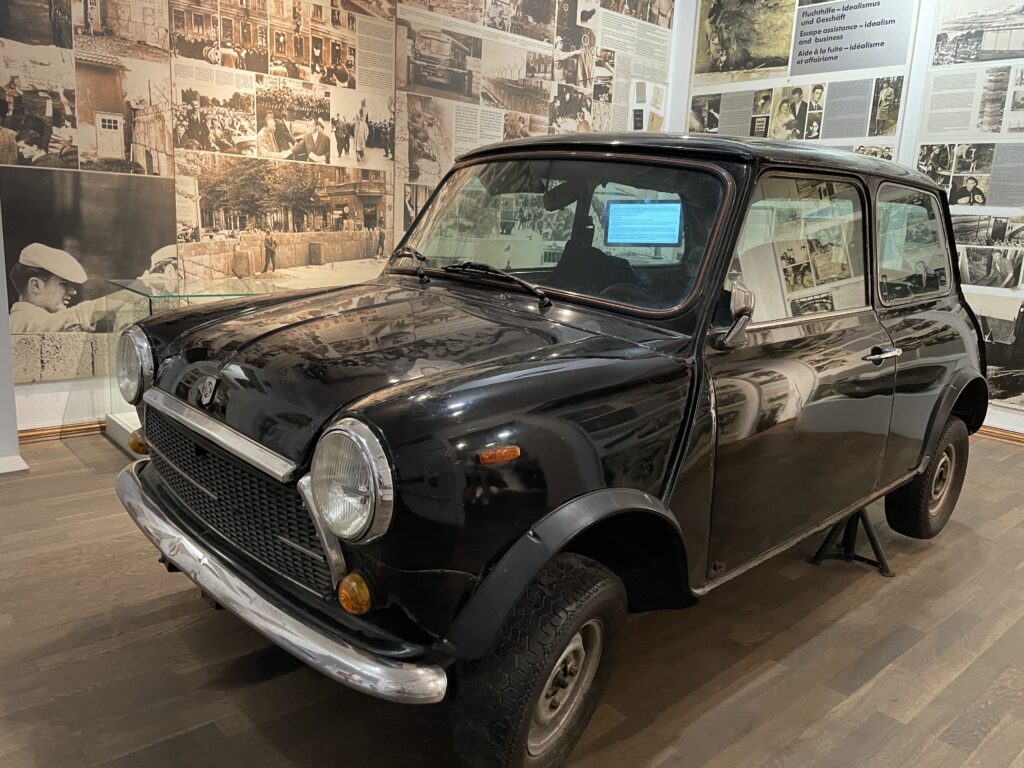
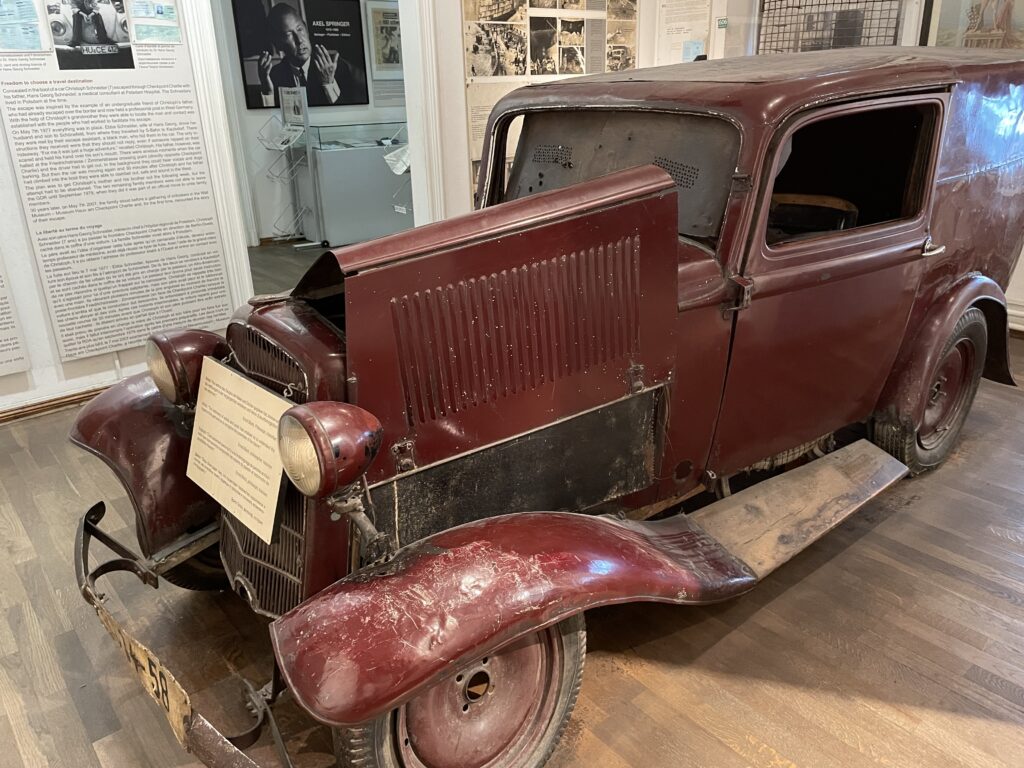
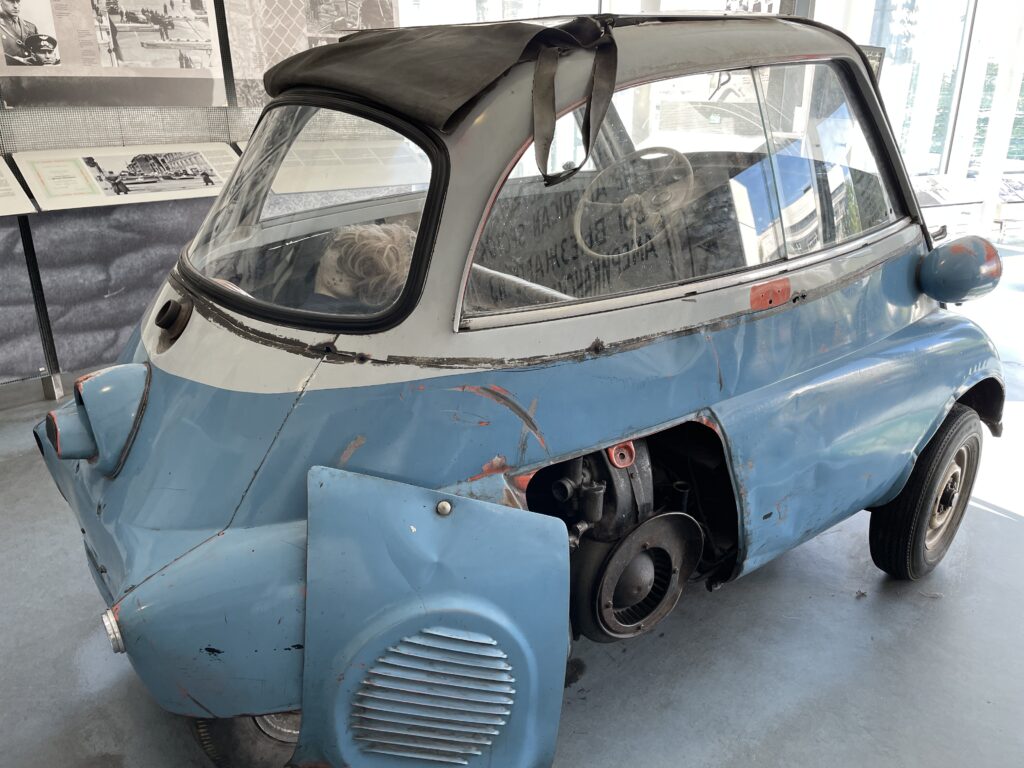
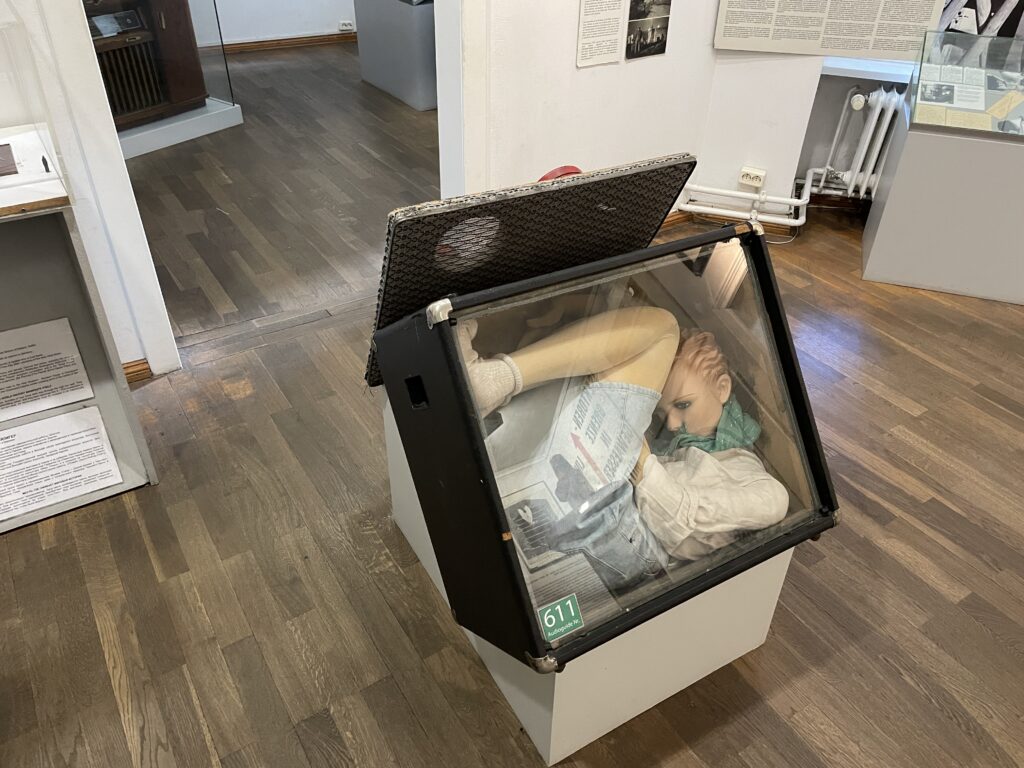
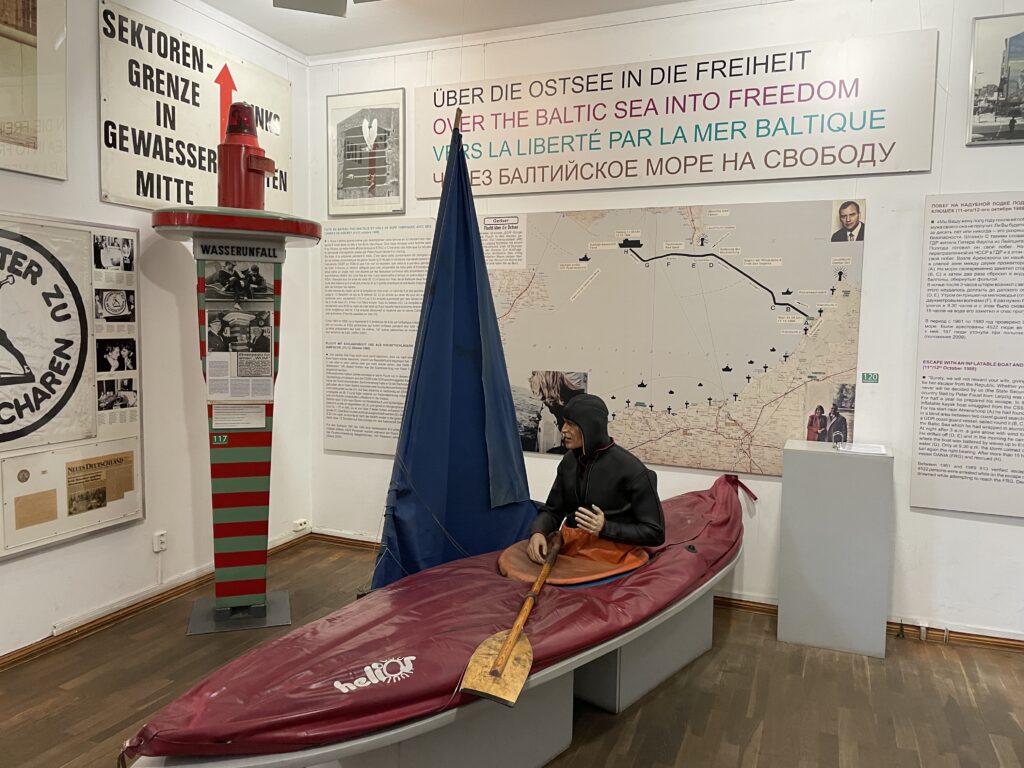
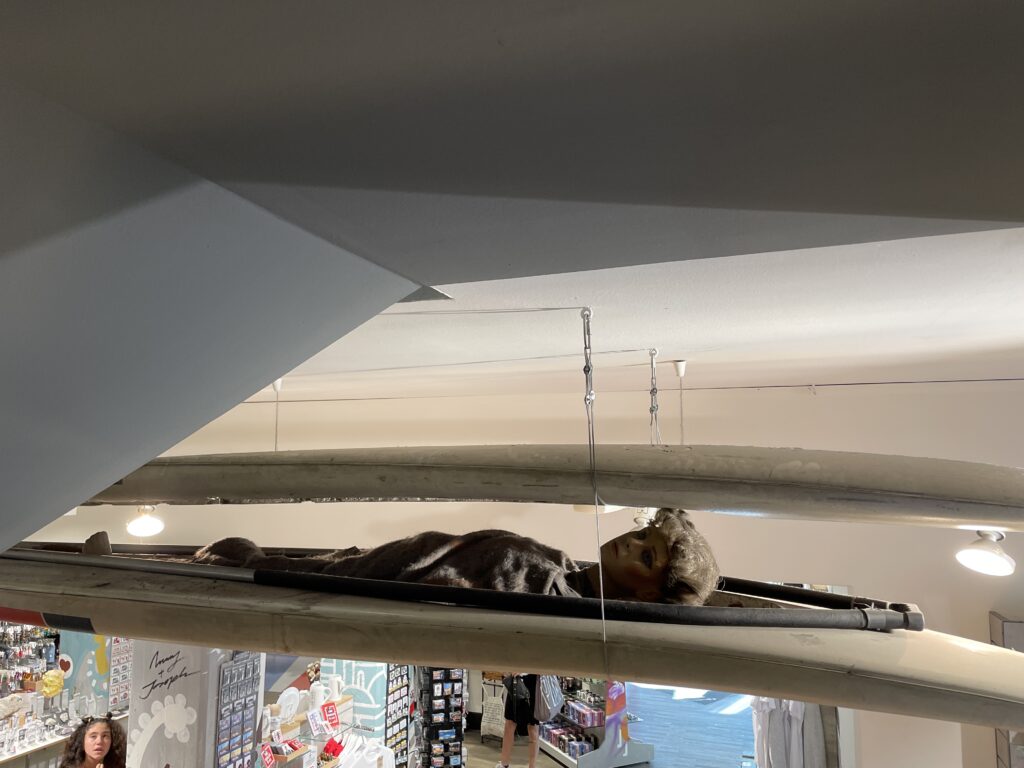
    In the nearby Haus am Checkpoint Charlie you’ll find a captivating account of the years of the Cold War, with a strong emphasis on the history and horrors related to the Berlin Wall. Moving is the section that narrates the courage and ingenuity of some citizens of East Germany who attempted to escape to the West using hot air balloons, tunnels, hidden car compartments, and even a submarine with a single crew member. The rest of the museum focuses on the historical events that marked the city’s life, including the Berlin Airlift, the 1953 workers’ uprising in East Berlin, the construction of the Wall, and the reunification. There is also an original section of the white line that marked the border, where American and Soviet tanks faced off at Checkpoint Charlie in 1961. Other rooms are dedicated to human rights heroes (Gandhi, Lech Walesa, and others) and the world’s major religions. Explanatory panels are in various languages, and the museum also features a café and a shop. 

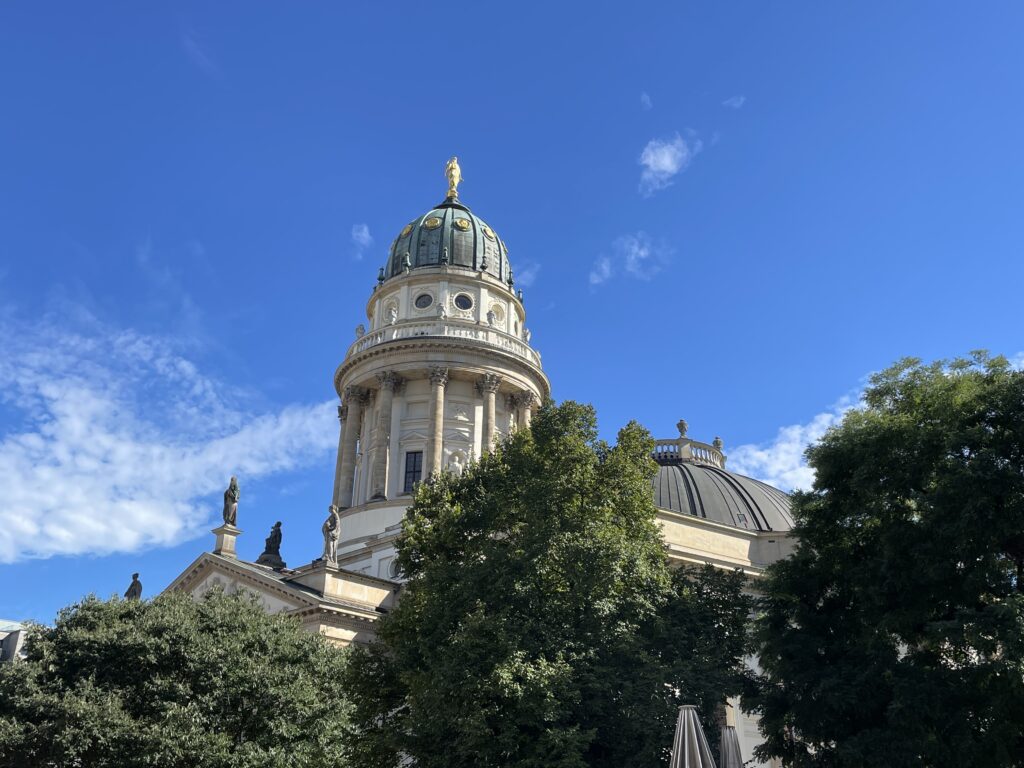
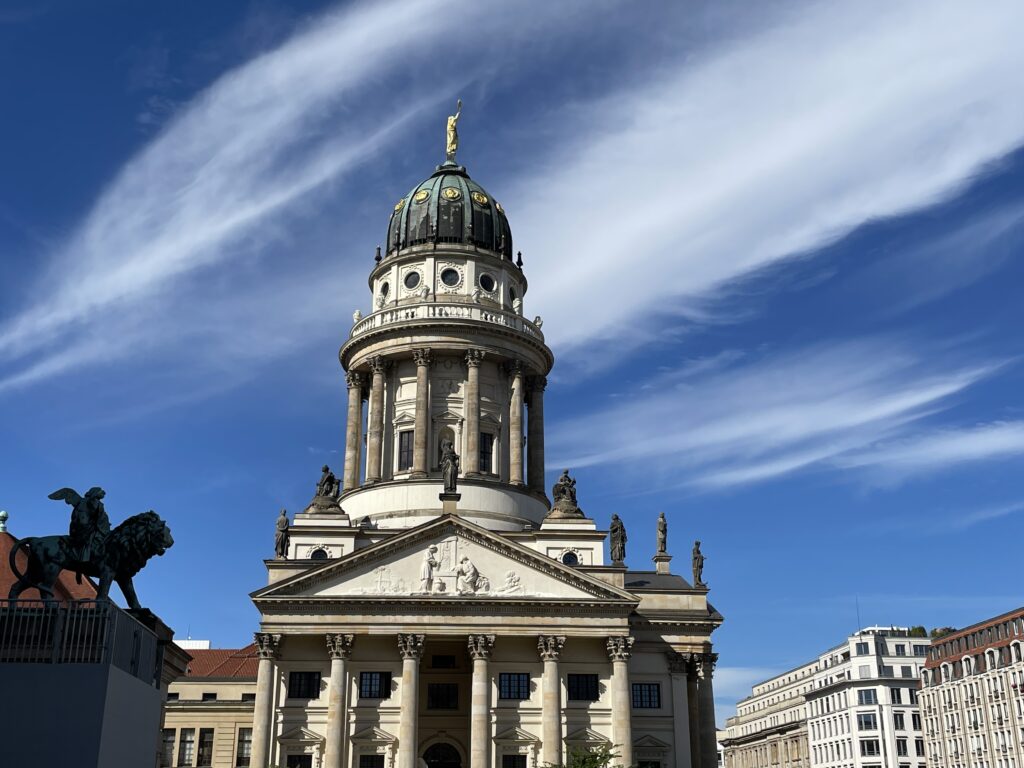
    If you’re not interested in the Wall’s history, you can continue your journey directly from Quartier 205 by turning left onto Mohrenstrasse, which will lead you to Gendarmenmarkt, Berlin’s most beautiful square, featuring the Konzerthaus  designed by Schinkel and the towering Deutscher Dom and Französischer Dom cathedrals.

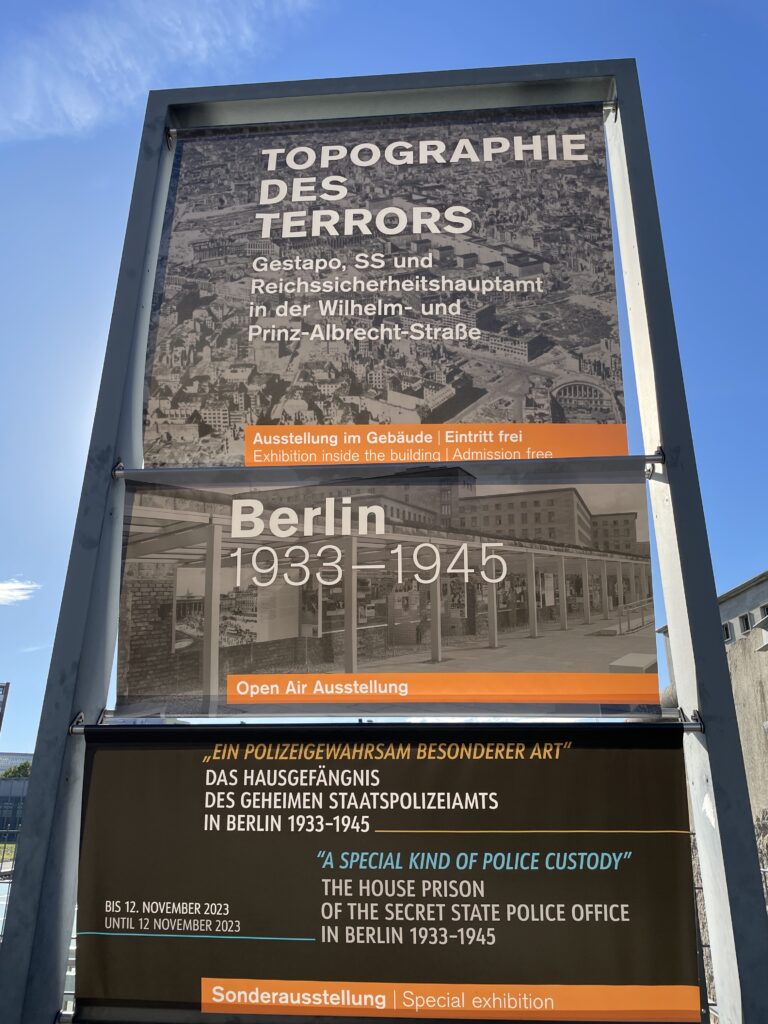
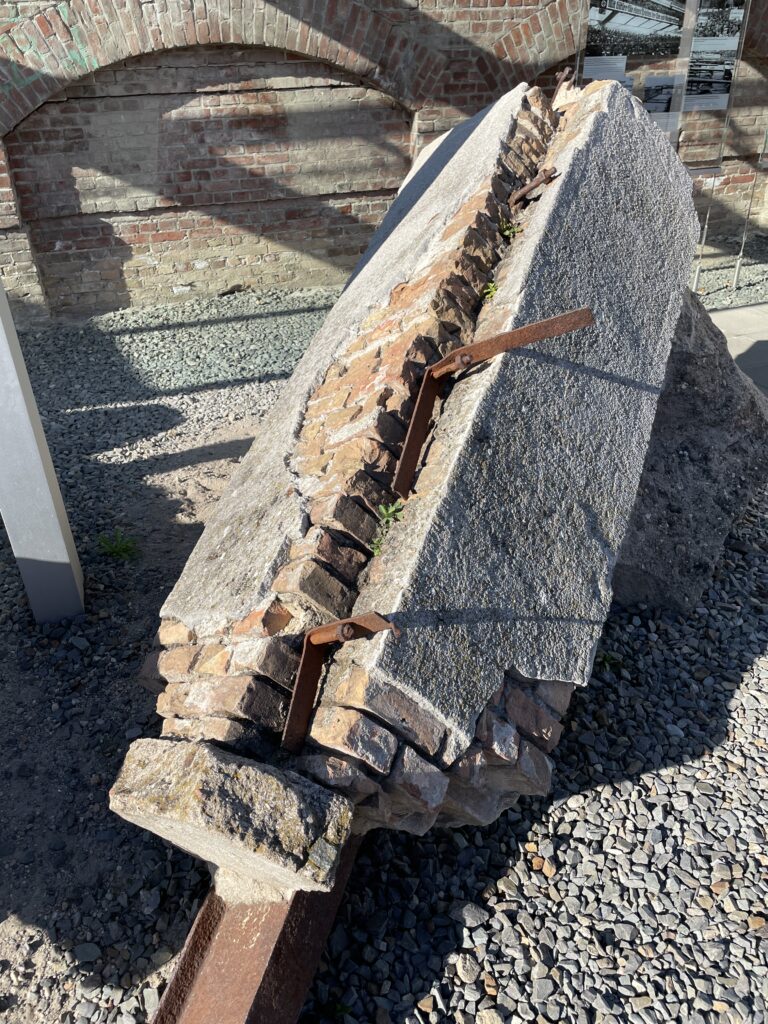
    Finish your walk in the abandoned area along Niederkirchner Strasse, the most feared institutions of the Third Reich once stood: the Gestapo headquarters, the central command of the SS, the SS security service, and, after 1939, the central office of Reich security. From their desks, Nazi leaders planned the Holocaust and issued arrest warrants for political opponents, many of whom were tortured and killed in the infamous Gestapo prison. Today, the buildings have been demolished (there are signs indicating their layout), and a eerie atmosphere lingers over the abandoned grounds, whose sinister appearance is accentuated by a short section of the Berlin Wall that still stands. Since 1997, this has been the site of a poignant outdoor exhibition called “Topographie des Terrors” (Topography of Terror), primarily dedicated to the years of the Third Reich, with a particular focus on the historical significance of this site and the brutal institutions that occupied it. 

    Lorem ipsum dolor sit amet, consectetur adipiscing elit. Ut elit tellus, luctus nec ullamcorper mattis, pulvinar dapibus leo.

    Day 2- Contemporary architecture

    Berlin has always been a testing ground for avant-garde architects, but never more so than during the post-reunification building boom. The fall of the Wall made vast empty spaces available, offering the city an opportunity to reshape its image in stone, steel, and glass. The itinerary that follows covers three main areas: the government district, the diplomatic quarter, and Potsdamer Platz.

    Start at the Reichstag, the historic seat of the German parliament and the heart of the new Band des Bundes (federal ribbon), as the new urban complex of ministerial and parliamentary buildings is called.

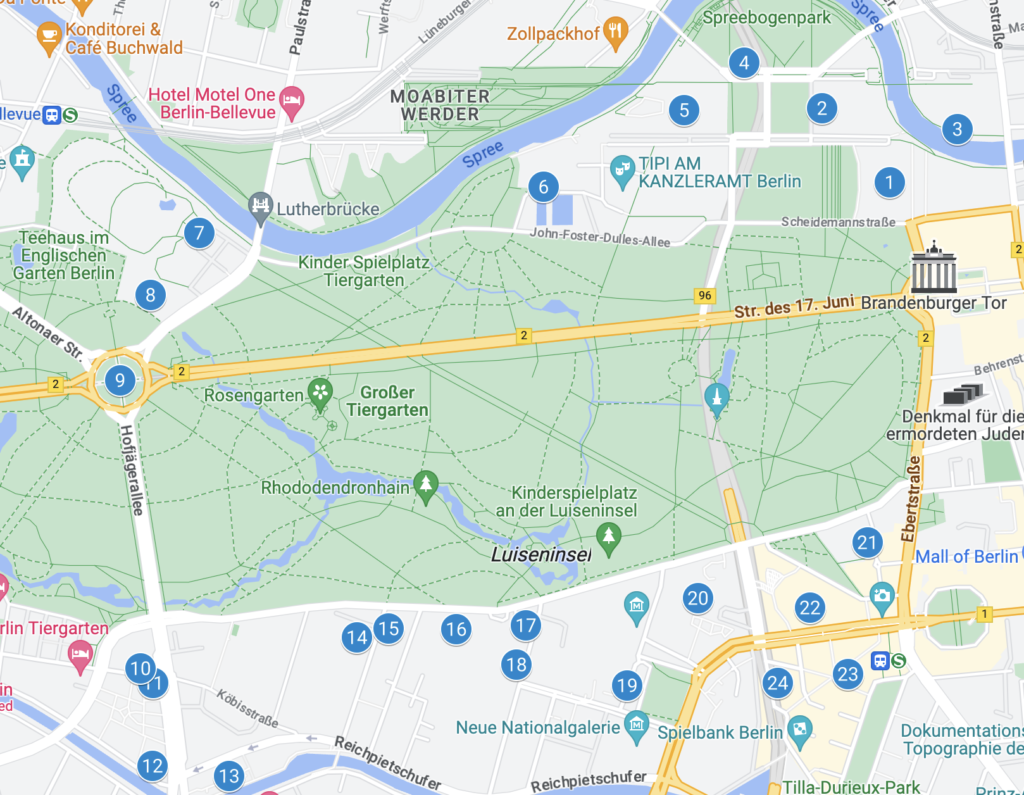
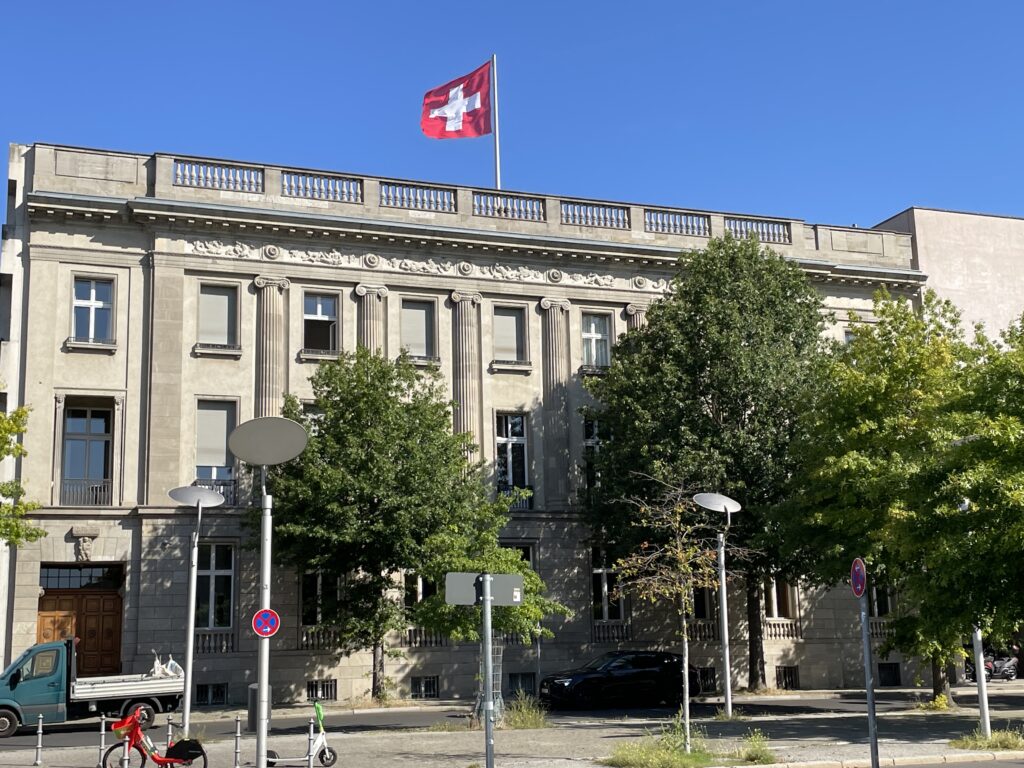
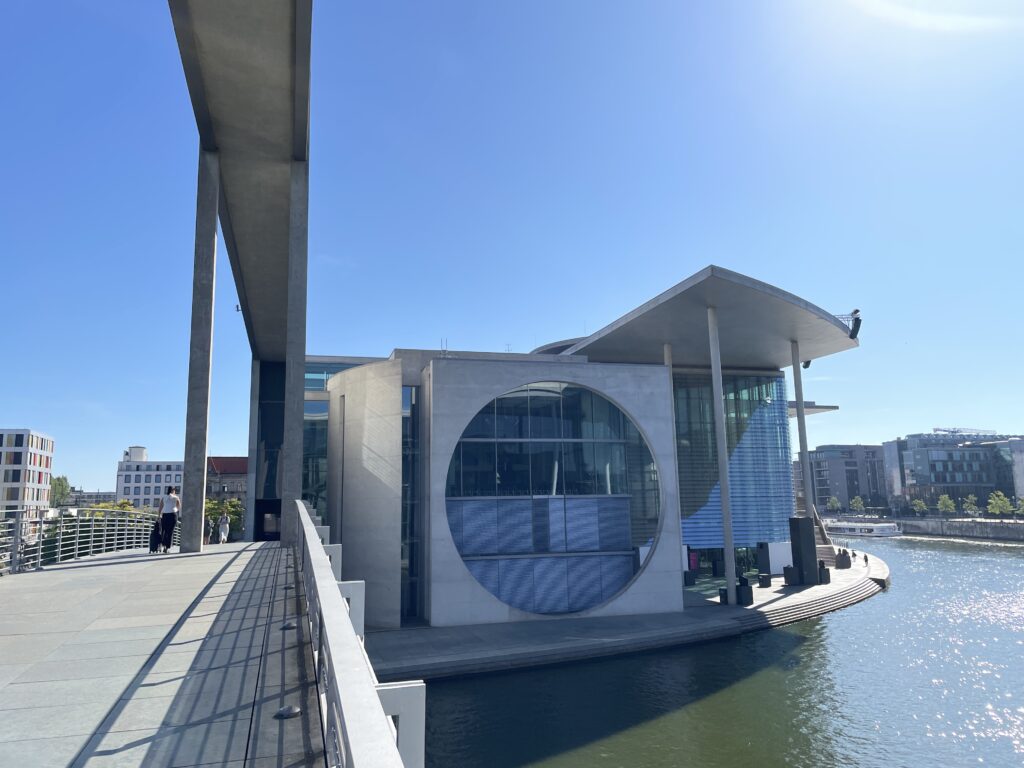
    To the north of the Reichstag, turn right onto Paul-Löbe-Allee, pass by the ultramodern Paul-Löbe-Haus (p104), and continue to the Spree River. Following the riverside promenade northward, you’ll spot the futuristic Marie-Elisabeth-Lüders-Haus on the opposite bank. If you want to get a closer look at the building, you can cross the pedestrian bridge, or you can turn west, first skirting the north side of the Paul-Löbe-Haus and later the Swiss Embassy, which has added a postmodern wing to its historic headquarters.

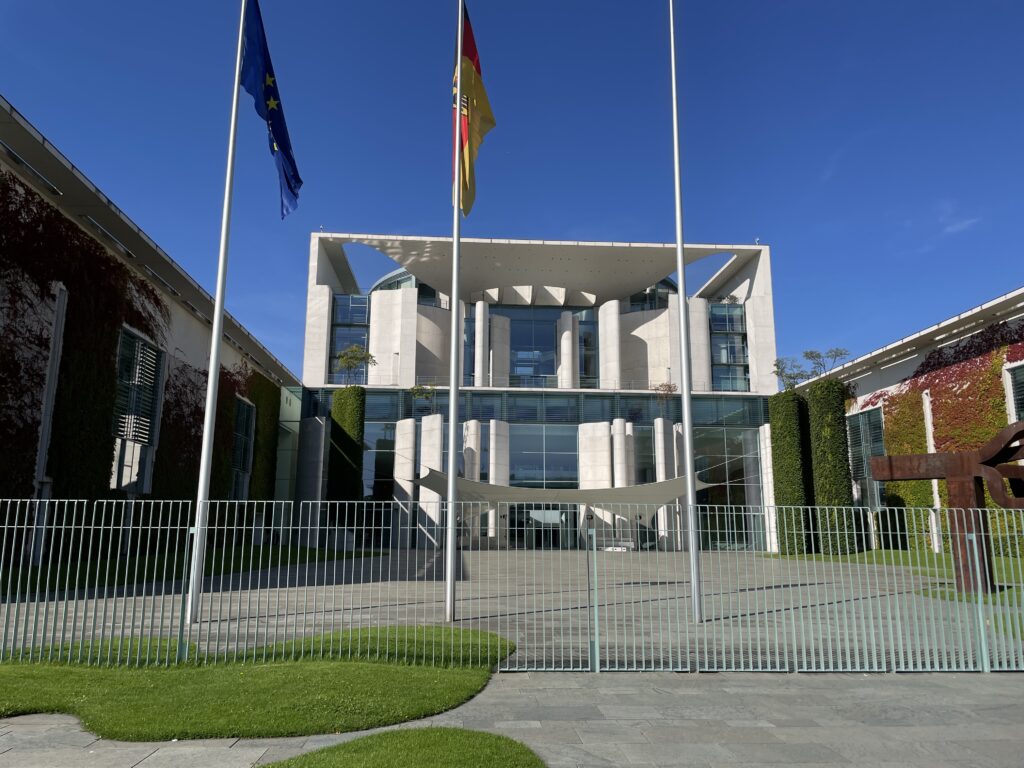
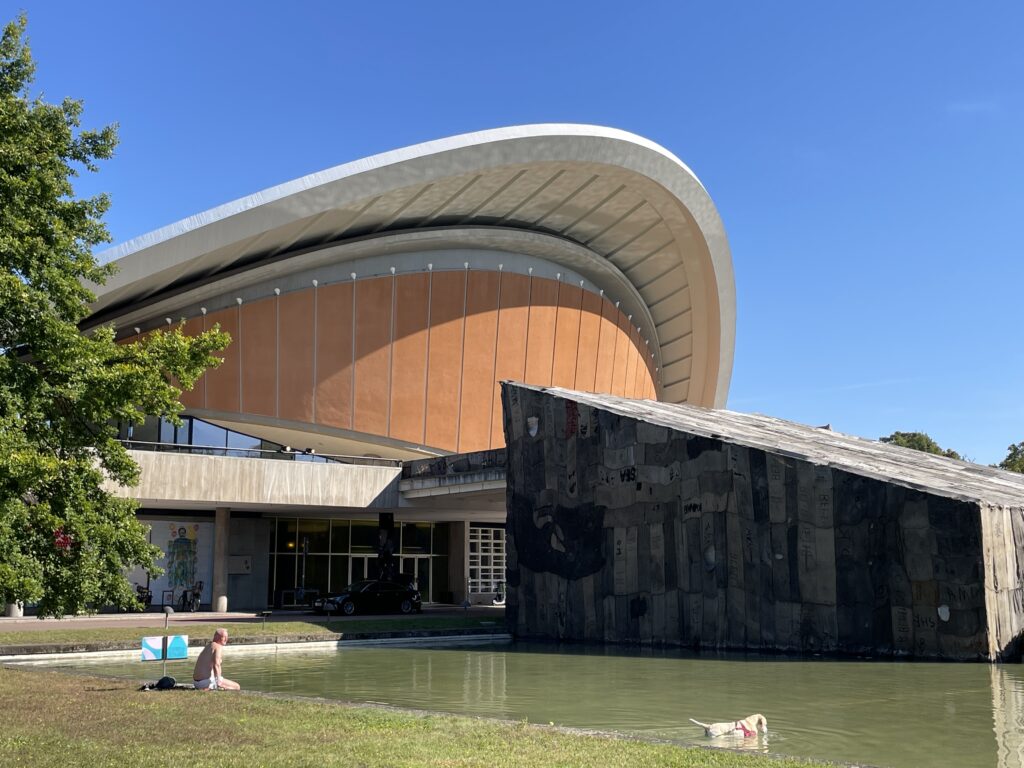
    In the meantime, though, your gaze will likely be drawn to the enormous Bundeskanzleramt (Federal Chancellery), where the Chancellor holds cabinet meetings. Heading south on John-Foster-Dulles-Allee, you’ll pass the Haus der Kulturen der Welt.

    The extravagant House of World Cultures (Haus der Kulturen der Welt) by Hugh Stubbins represented the American contribution to the 1957 Interbau, an architecture exhibition that brought together the most esteemed international talents in Berlin. Originally designed as a congress hall, its most distinctive design element is the parabolic roof that defies gravity and covers the building like a gigantic shell. Berliners affectionately nicknamed it the ‘pregnant oyster.’ Unfortunately, the architect’s vision was too ahead of its time compared to the technological means available at the time, and the roof partially collapsed in 1980. After reconstruction in 1989, the complex became a cultural center with a rich program of art exhibitions, conferences, seminars, concerts, and other world-class events.

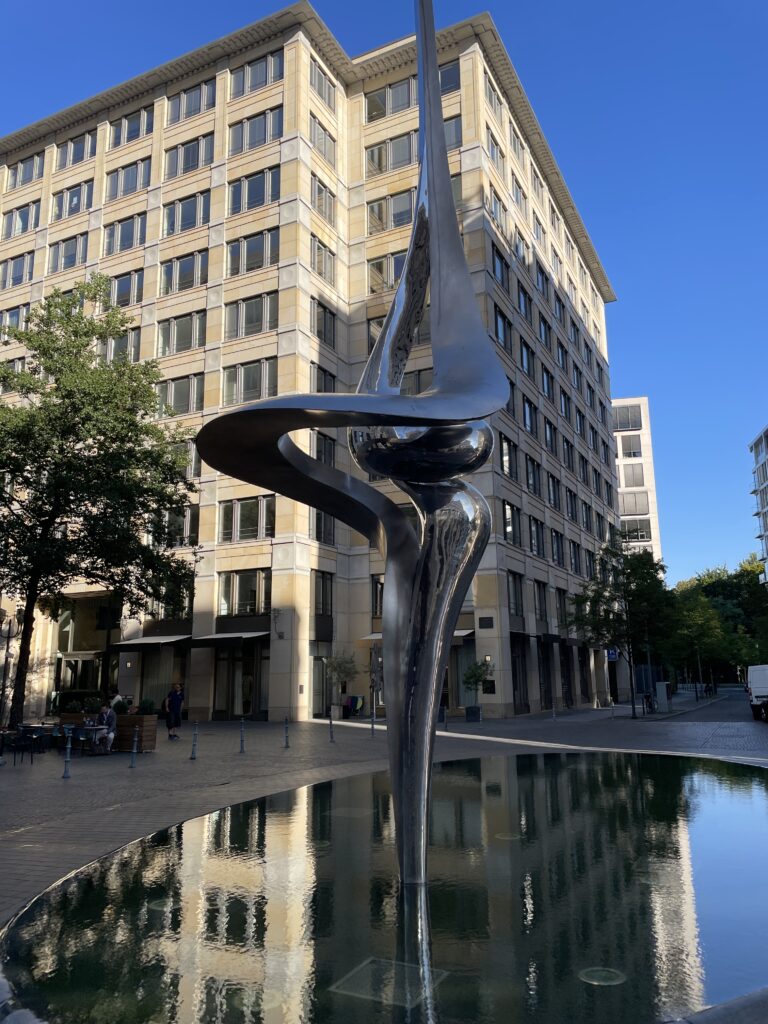
    The pond reflects the lines of Henry Moore’s sculpture “Divided Oval: Butterfly,” whose curved profile echoes the building’s design. The 68 bells of the marble and bronze carillon – the largest in Europe – chime at 12 and 18 o’clock every day. On Sundays at 3 o’clock from May to September, a carillonneur performs live concerts, followed by guided tours of the tower.

    Continuing west, look across the Spree to where a new residential mega-complex for government employees called Die Schlange, the snake, due to its undulating shape, is taking shape.

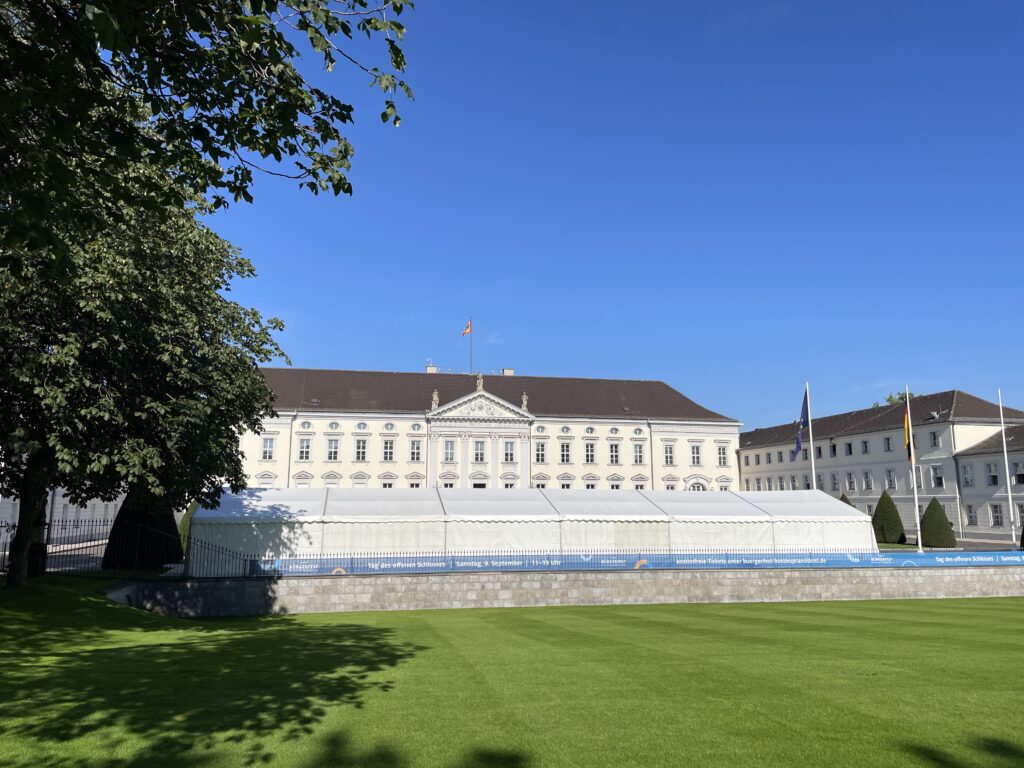
    Turning left onto Spreeweg, you’ll pass Schloss Bellevue, the presidential residence. This neoclassical white stucco palace, recently renovated, is located on the northwestern edge of Tiergarten and serves as the official residence of the President of the Republic (at the time of writing this guide, Horst Köhler held the position). It was built in 1785 by Philipp Daniel Boumann for the younger brother of Frederick the Great, then later became a school under Emperor Wilhelm II and an ethnology museum during the Nazi era. The President and their staff have their offices in the Bundespräsidialamt building from 1998, just south of the palace. This essentially is the German version of the ‘Oval Office’ of the American White House, referring in this case to the elliptical shape of the entire building, covered in glass and polished black granite. Architecture enthusiasts might want to take a look at a wavy residential complex that stretches 300 meters called “Die Schlange” (the snake), located northeast of the palace on the other side of the Spree River.

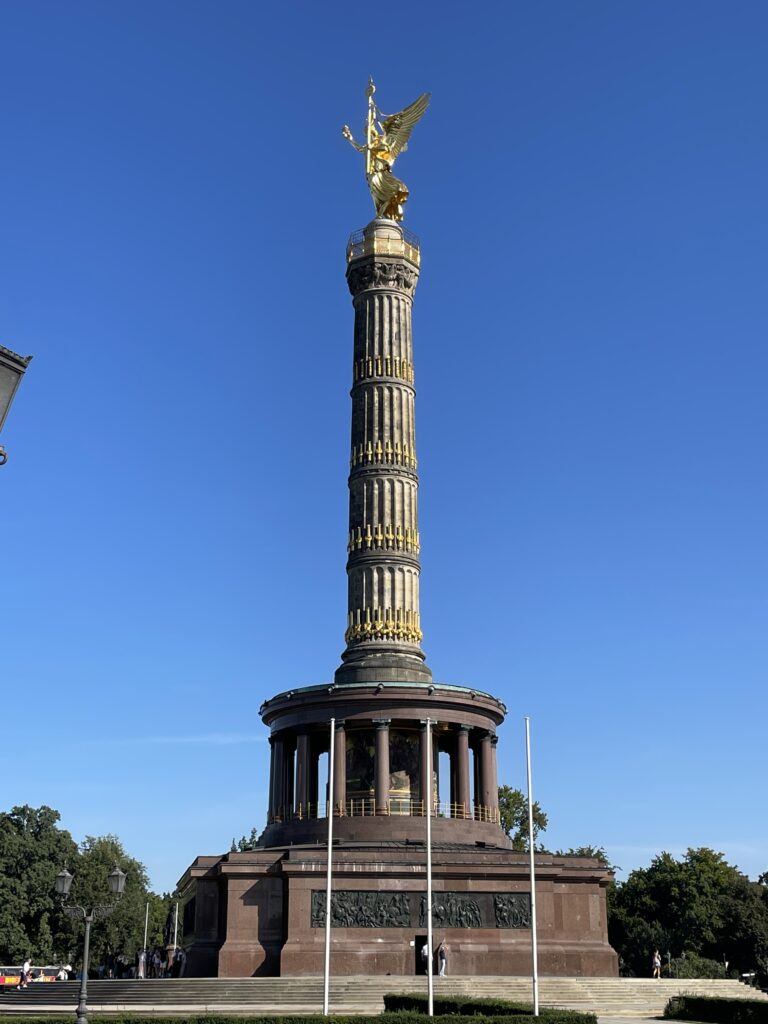
    Dominating the landscape is the Siegessäule (Victory Column), a triumphal column commemorating Prussian military victories in the 19th century, particularly against Denmark (1864), Austria (1866), and France (1871). The large golden lady on top (standing at a height of 8.3 meters) represents the goddess of Victory, although locals simply refer to her as ‘Golden Elsa.’ Film enthusiasts may remember her in the iconic scene from Wim Wenders’ 1987 film “Wings of Desire” (Himmel über Berlin). The Nazis relocated it here from its previous location in front of the Reichstag in 1938 and added an extra tier to the column, making it an impressive 67 meters tall. You can climb to the top of the column; admission tickets also allow you to visit the small museum and enjoy discounts at the adjacent café and Biergarten. The Siegessäule has become a symbol of Berlin’s gay community (the city’s most prominent gay publication is named after it) and marks the endpoint of the annual Christopher Street Parade. The park around the column is a popular gathering spot for the LGBTQ+ community, especially around the Löwenbrücke area.

    Then proceed along Hofjägerallee.

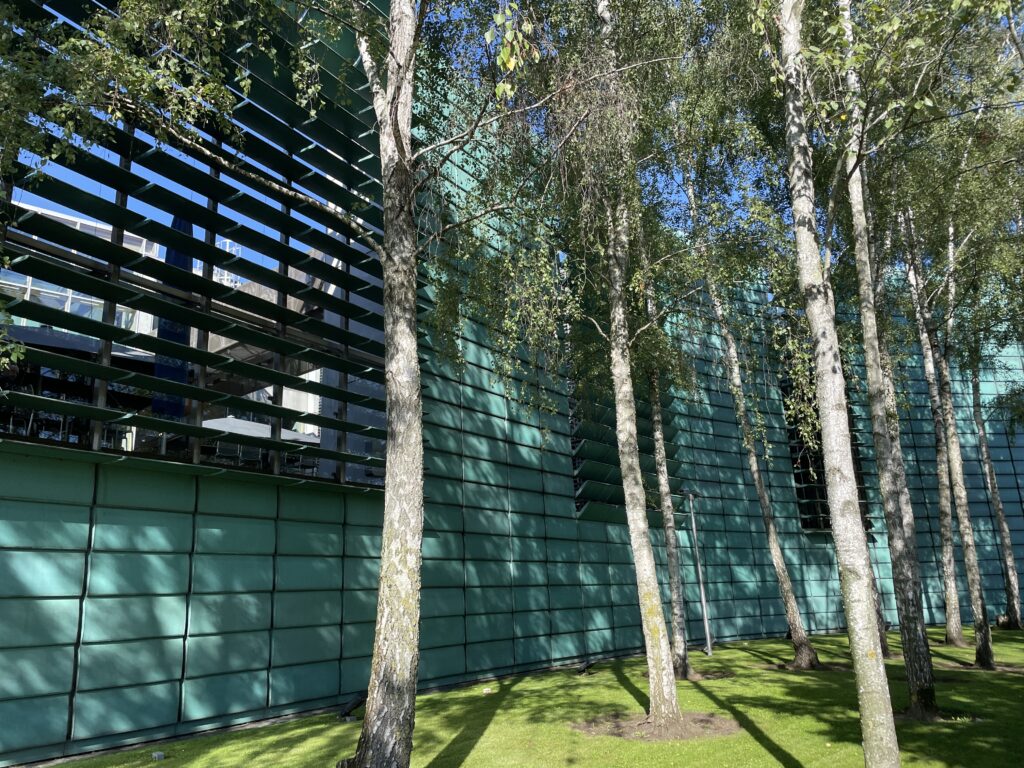
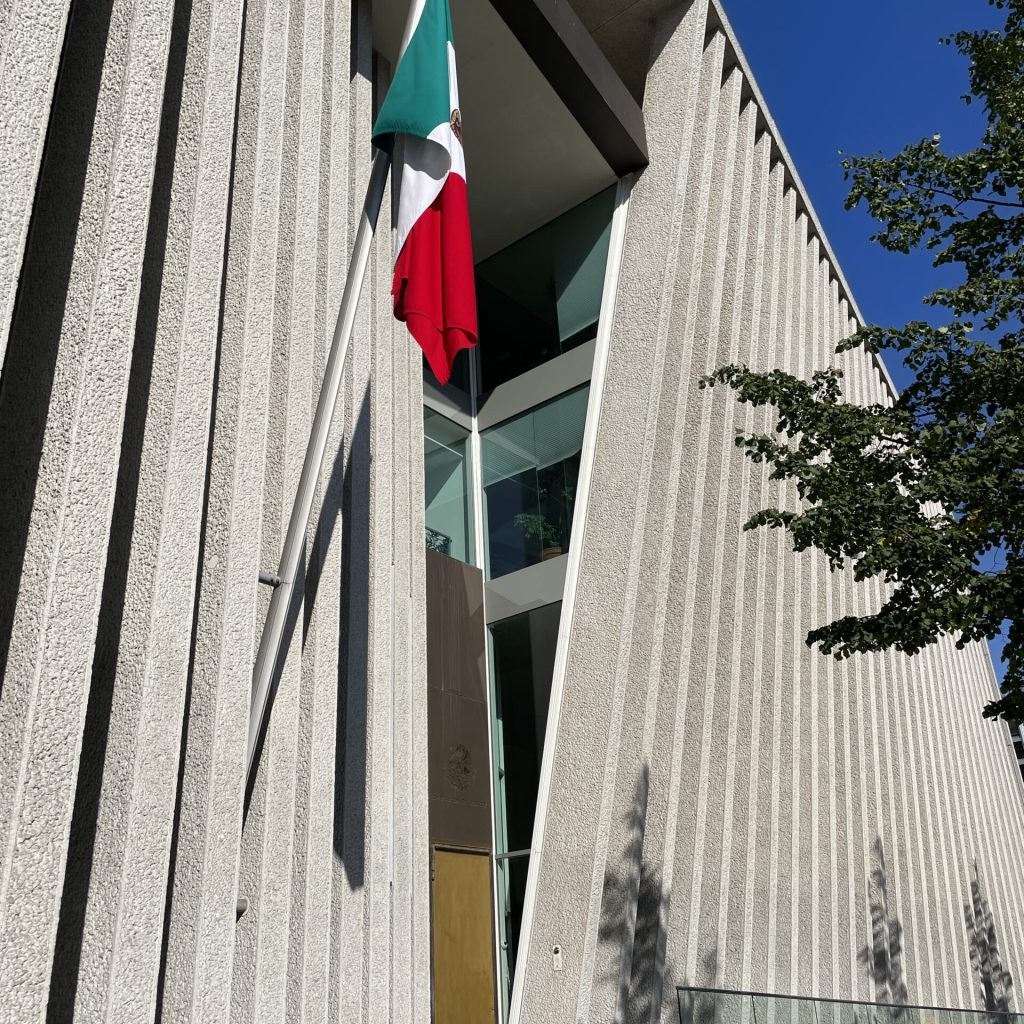
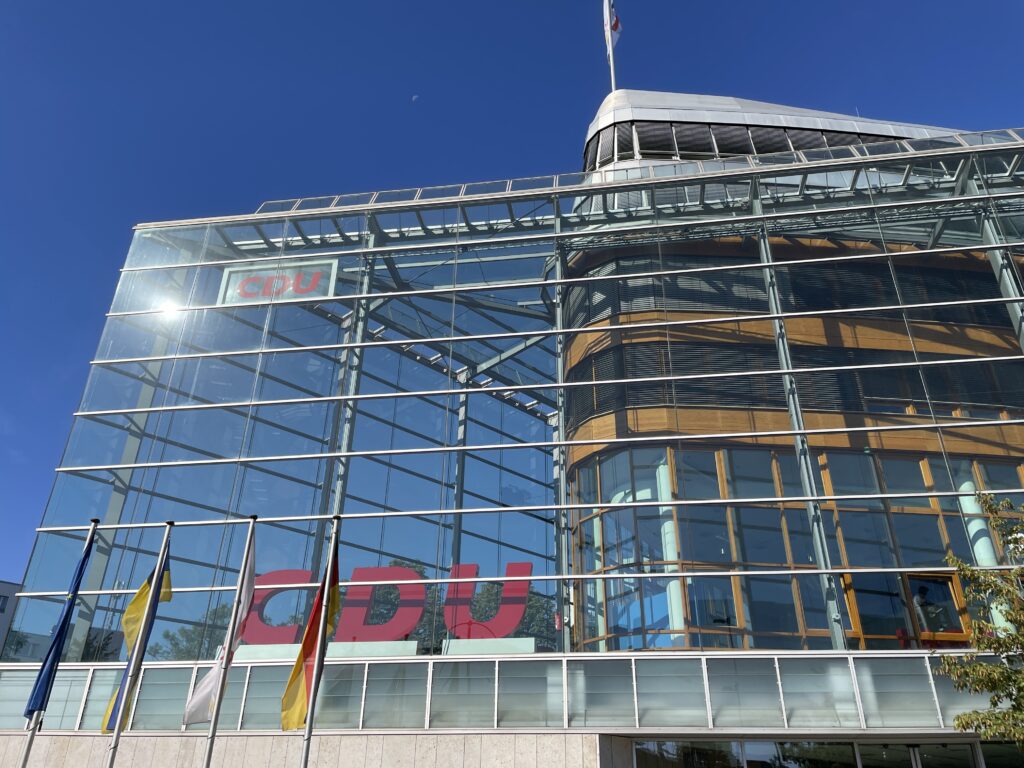
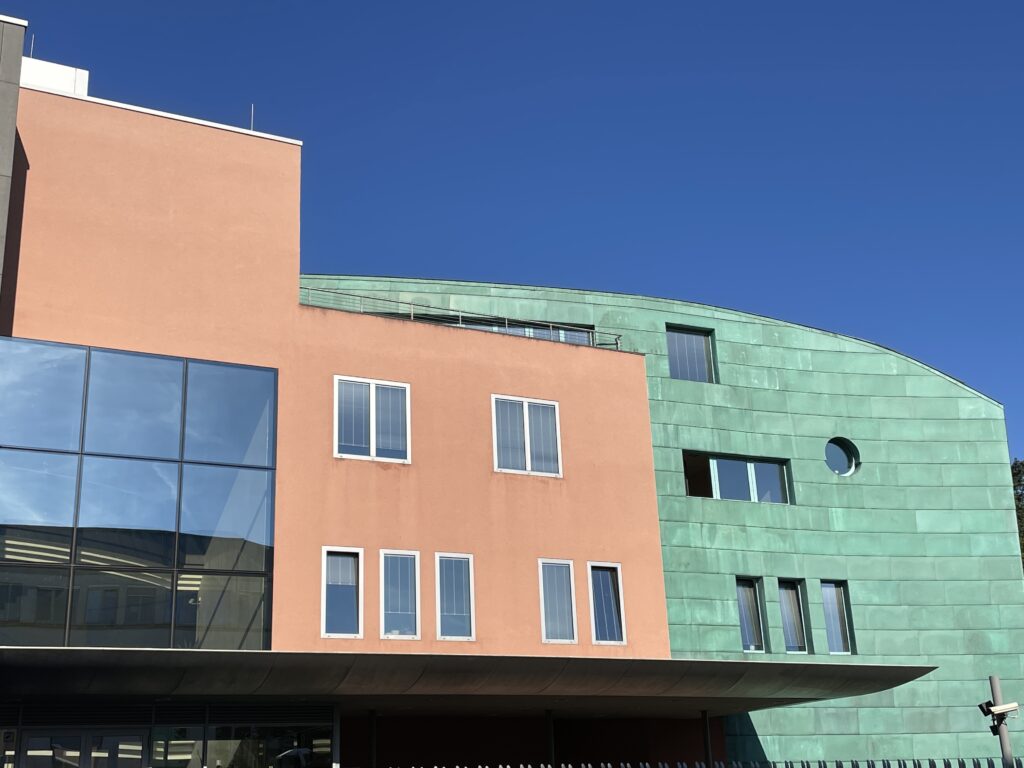
    Before long, you’ll see the turquoise façade of the Nordic Embassies (p55) on the other side of the Spree. The complex is very striking at night when it appears as a giant illuminated crystal. Next to it is the equally remarkable Mexican Embassy (p55), preceded by a row of inclined concrete columns. Following the new main quarter of the CDU, one of Germany’s main political parties. The extravagant building resembles a transatlantic liner enclosed in an anvil-shaped glass shell.

    IMG_0270

    On the opposite side of the street is the Bauhaus Archiv, designed by the godfather of modern architecture, Walter Gropius. It’s worth taking a look inside the museum and perhaps stopping for a drink in its café before continuing east along Von-der-Heydt-Strasse and then turning north onto Hiroshimastrasse.

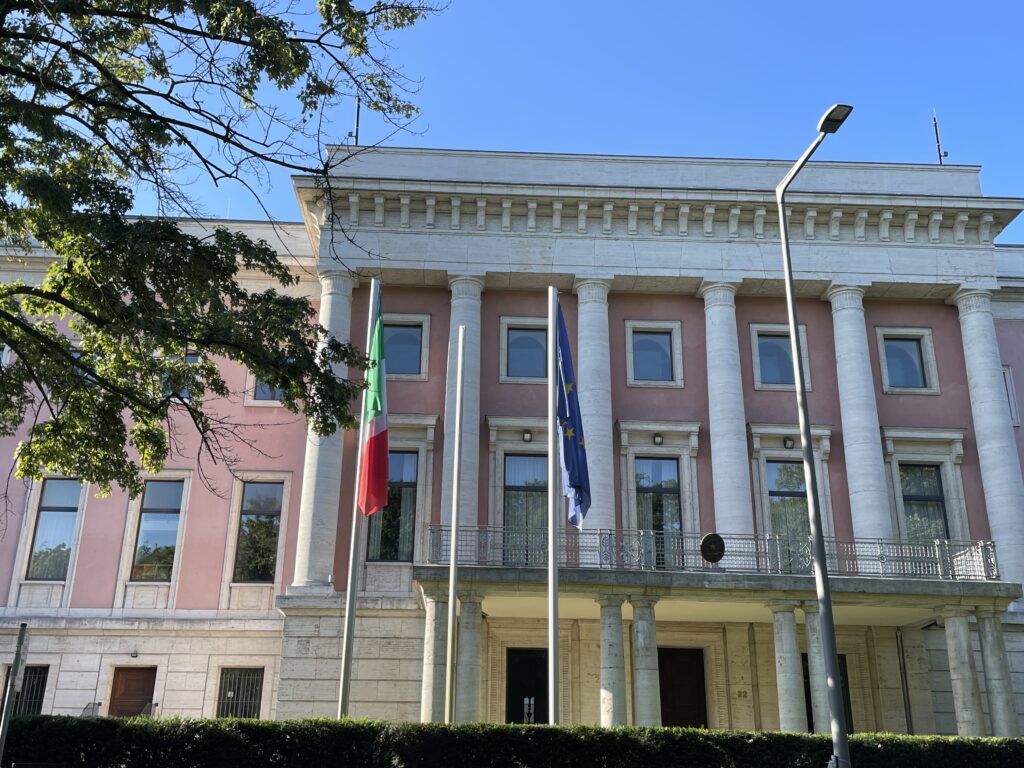
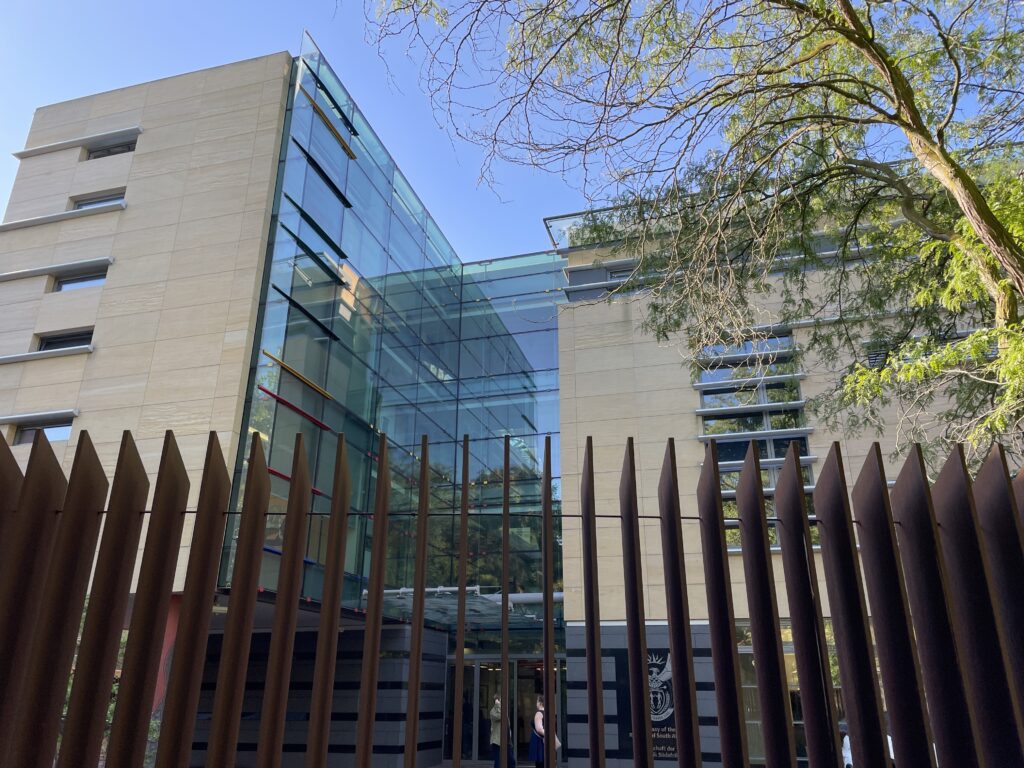
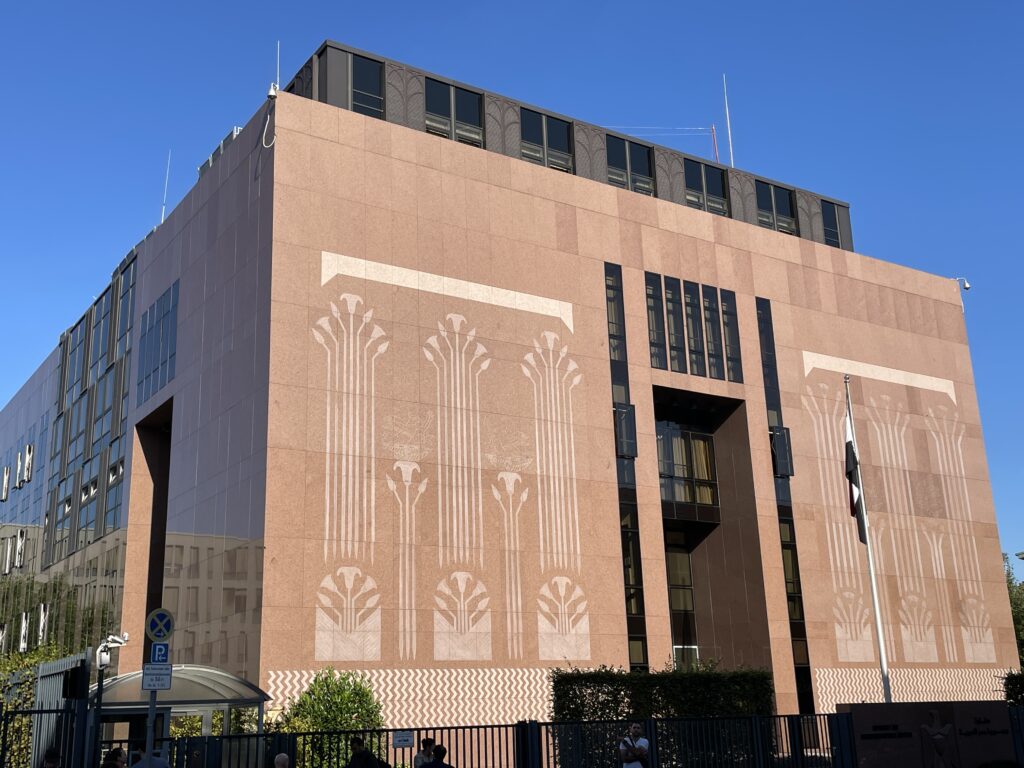
    This street features the beige building of the Japanese Embassy M (p51) and the pink one of the Italian Embassy 1 (p50). Both date back to the Nazi era, which explains their pompous style and large size. Continuing east along Tiergartenstrasse, you’ll pass the new South African Embassy V at No. 18, and then turning onto Stauffenbergstrasse, you’ll see the Austrian Embassy (p55). Immediately south of this is the Egyptian Embassy 9 (p55), easily recognizable by the inscriptions decorating its reddish-brown façade.

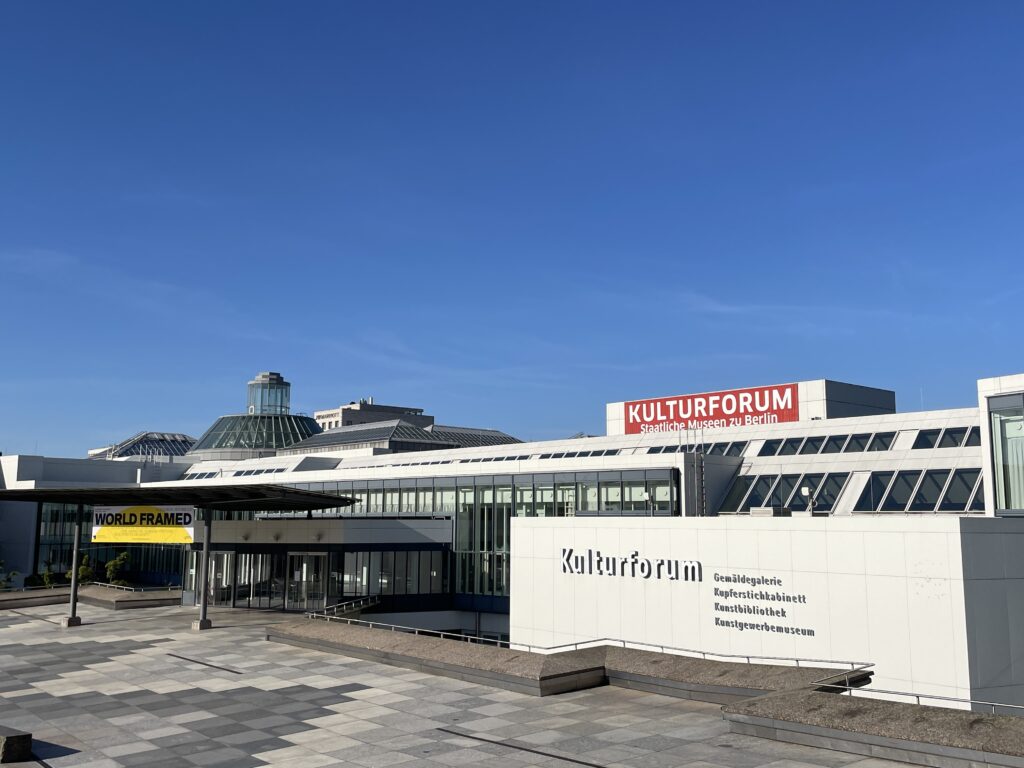
    Further on, the diplomatic quarter gives way to the Kulturforum 20, an architectural showcase created between 1961 and 1987. The most eye-catching building here, especially due to its unique roof, is the Philharmonie 2, completed in 1963 by Hans Scharoun.

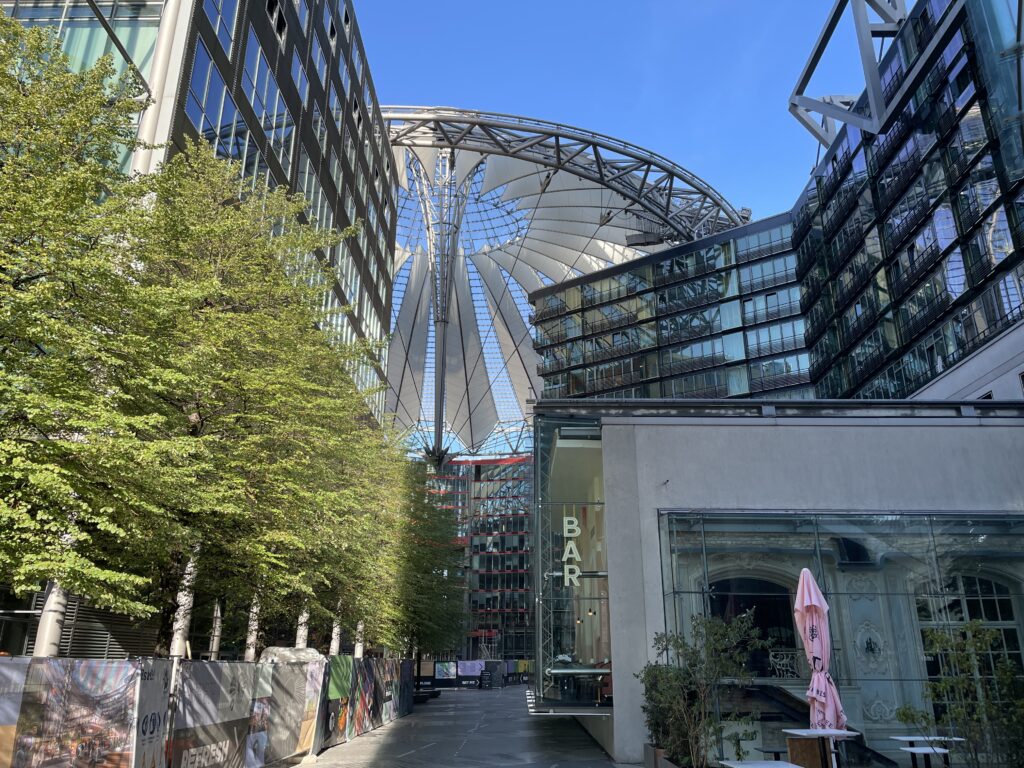
    From here, our itinerary continues towards Potsdamer Platz, a true treasure trove of contemporary architecture. Arriving from Bellevuestrasse, you’ll see the Beisheim Center 0D on your left, a building inspired by American skyscrapers from the 1950s. To your right, you’ll spot the Sony Center (p108) with its spectacular covered square and the soaring glass skyscraper of the talented Helmut Jahn. South of Potsdamer Strasse stands the Daimlercity Complex (p107), an expression of the creative talent of various architects from around the world. RafaelMonser Bulato c (so-called io (49363), Renzo Piano’s design for the Daimlerchester Building © (p1OTe deritalporaente, and Kolhoff & Kolhoff Haus @, with its distinctive Volksbank & i brickwork, are worth a visit. If you’re in need of a refreshment, you’ll have plenty of restaurants and cafes to choose from in Potsdamer Platz.

    South of Potsdamer Strasse stands the Daimlercity Complex (p107), an expression of the creative talent of various architects from around the world. RafaelMonser Bulato c (so-called io (49363), Renzo Piano’s design for the Daimlerchester Building © (p1OTe deritalporaente, and Kolhoff & Kolhoff Haus @, with its distinctive Volksbank & i brickwork, are worth a visit. If you’re in need of a refreshment, you’ll have plenty of restaurants and cafes to choose from in Potsdamer Platz.

    Day 3 - Hamburger Bahnhof

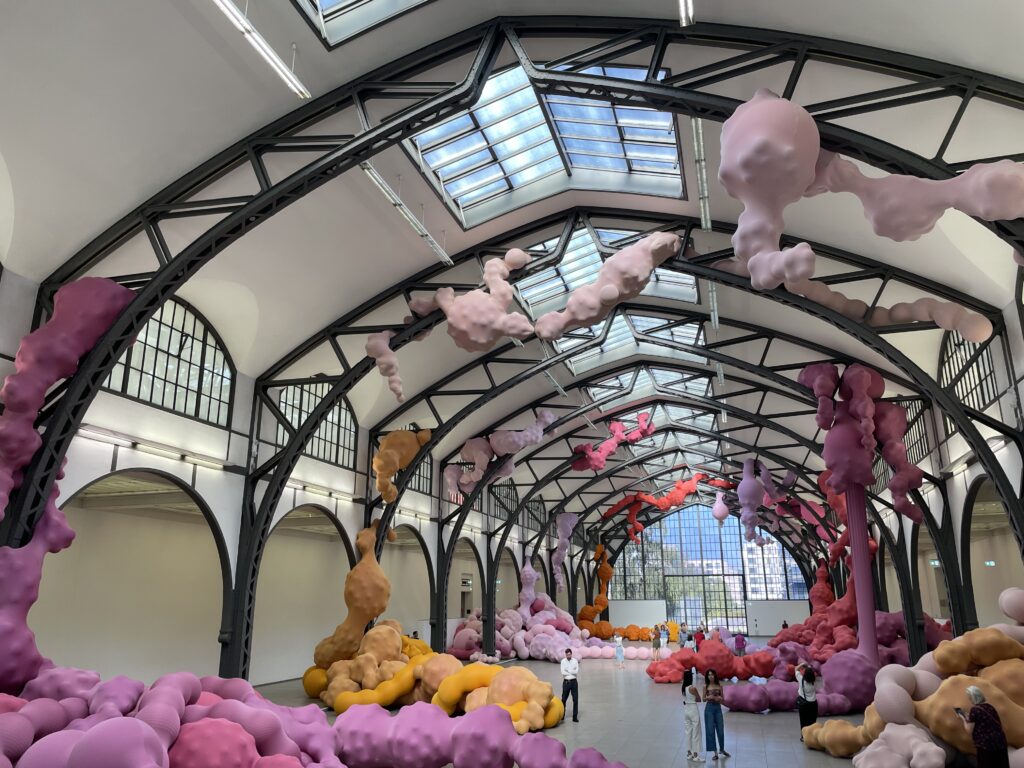
    The smiling Mao by Andy Warhol, the luminous abstractions of Cy Twombly, and the provocative installations by Joseph Beuys are part of the collection of Berlin’s most important contemporary art museum, which picks up where the Neue Nationalgalerie (p111) leaves off (around 1950). Beuys enthusiasts will be satisfied, as the entire western wing is dedicated to the enfant terrible of late 20th-century German art. The other exhibitions change periodically, but you’ll probably be able to admire works by Robert Rauschenberg, Roy Lichtenstein, Keith Haring, Duane Hanson, and Cindy Sherman. Just as interesting as the artworks contained here (according to some, even more so) is the architecture of the building, a late Neoclassical-era former train station transformed by Josef Paul Kleihues. The main atrium, a spacious area adorned with iron structures, is the perfect setting for large paintings, installations, and sculptures: Richard Long’s Berlin Circle, Mario Merz’s igloo, Anselm Kiefer’s Blei Bibliothek (iron library). The sparkling white façade exudes great elegance and grandeur, especially at night when a luminous installation by the late Dan Flavin bathes the building in kaleidoscopic shades of blue and green. In 2004, the museum spaces were expanded into the adjacent Rieckhallen, a series of interconnected industrial structures previously used by a transport company. Set within corrugated metal panels resembling a giant container, they house works from the prestigious collection of Friedrich Christian Flick, a German industrialist with a passion for modern and contemporary art. The exhibitions change periodically but often include masterpieces by prominent contemporary artists such as Bruce Naumann, Paul McCarthy, Rodney Graham, and Jason Rhoades, along with notable figures from early 20th-century art, including Sol LeWitt, Marcel Duchamp, Nam June Paik, and Sigmar Polke. The museum lives up to its title of “Museum für Gegenwart” (museum of the present) by also presenting a packed calendar of concerts, readings, films, and meetings with artists.

    Day 4-

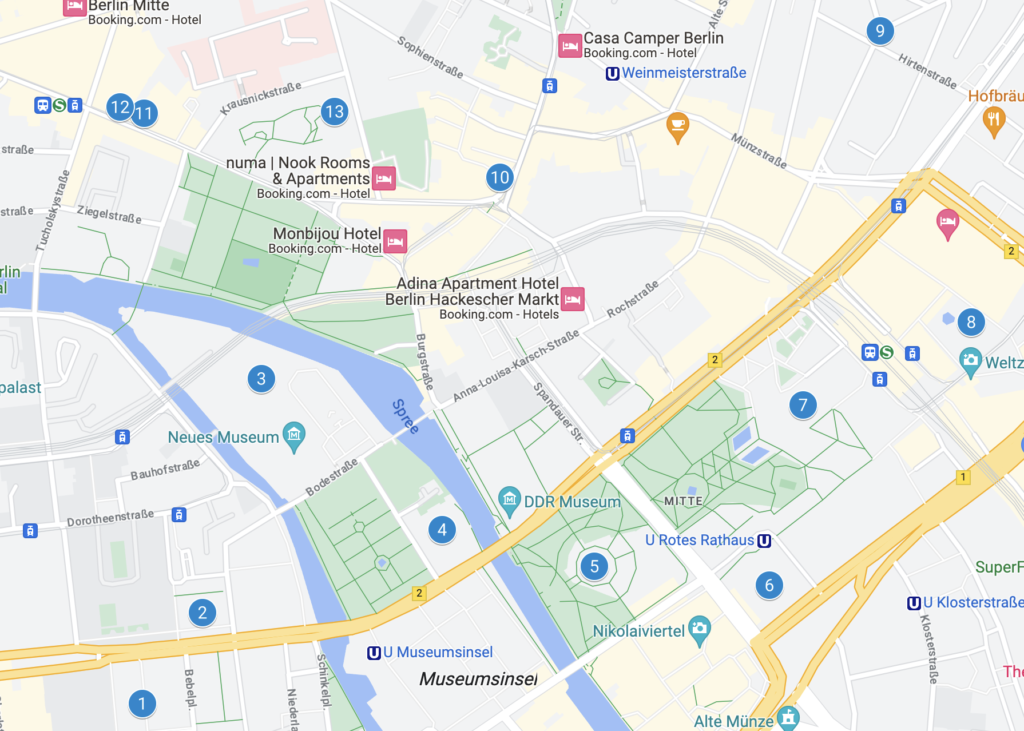
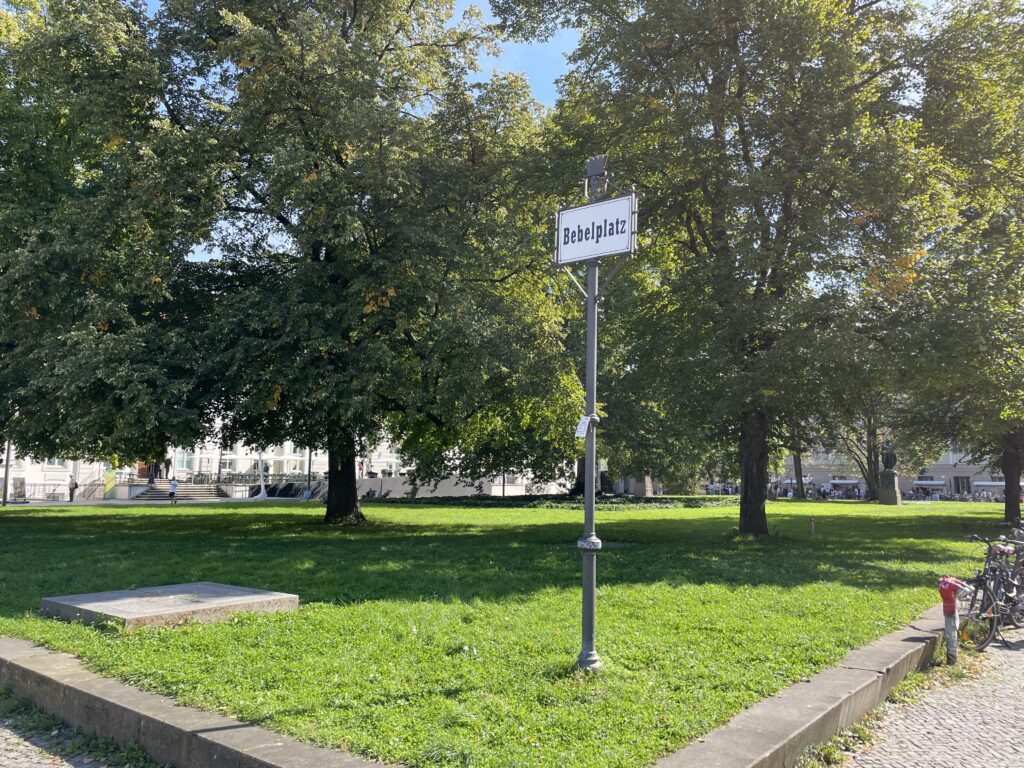
    Start your walk from Bebelplatz. This square is named after August Bebel, co-founder of the Social Democratic Party (SPD), and is primarily known because the Nazis organized their first official book burning here on May 10, 1933. During this event, the works of authors considered subversive, including Bertolt Brecht, Thomas Mann, Karl Marx, and others, were set ablaze. It was a terrifying event that marked the end of the cultural greatness that Berlin had acquired in the preceding two centuries. A moving memorial to Micha Ullmann, consisting of an underground library with empty shelves, keeps the memory of this tragic event alive.

    Bebelplatz was conceived as the focal point of the Forum Fridericianum, Frederick the Great’s project to create an intellectual and artistic center inspired by ancient Rome. Unfortunately, the king’s costly military ventures depleted the state’s coffers and made it impossible to complete such a grand endeavor. 

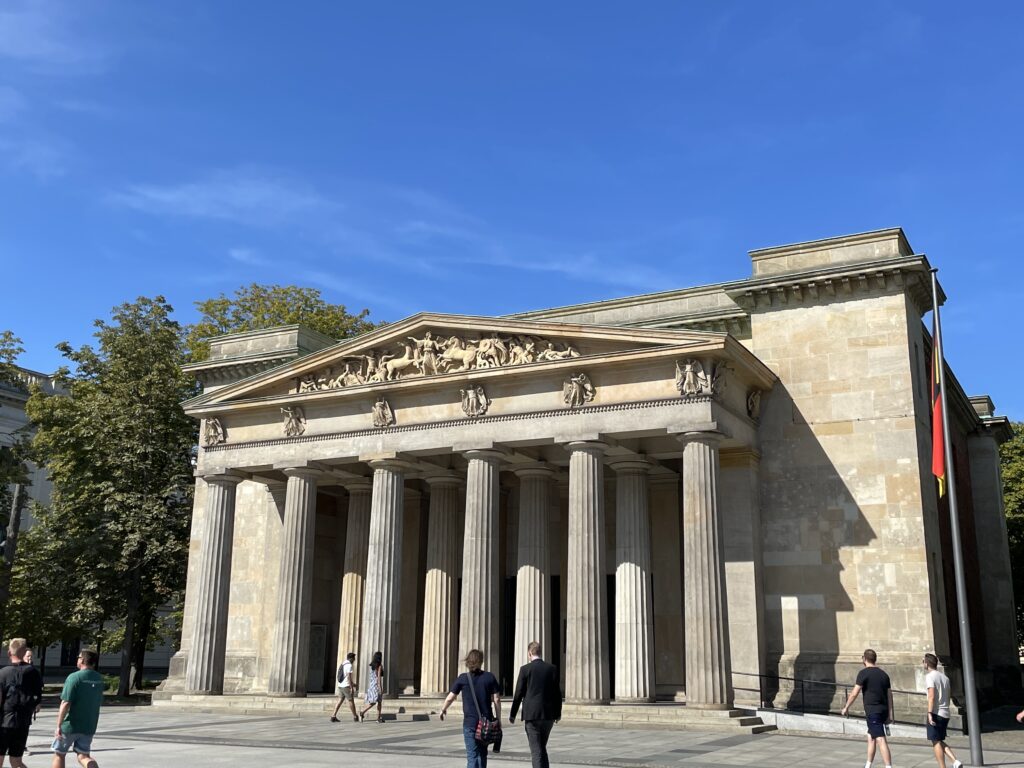
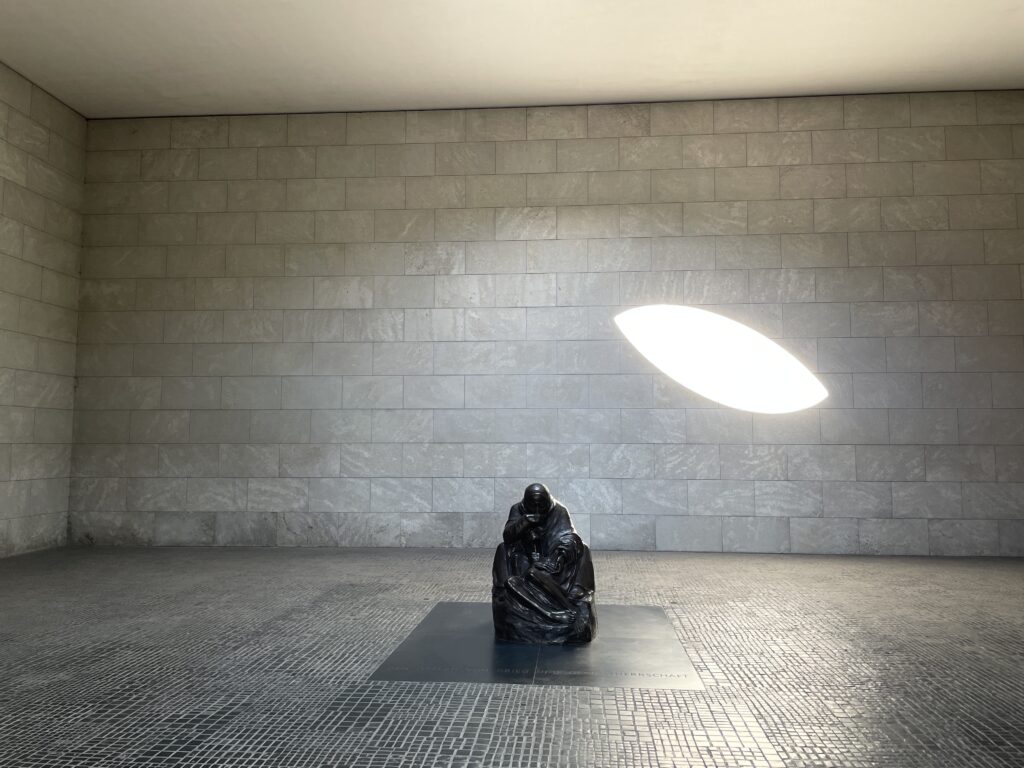
    Nevertheless, several of the planned buildings were constructed, including the Alte Königliche Bibliothek on the western side of the square, and across from it, the Staatsoper Unter den Linden and the Sankt-Hedwigs-Kathedrale in the southeast corner. Next to the church stands the new Grand Hotel de Rome, a temple of luxury hospitality in a prestigious location, housed in a building from that was previously occupied by the state bank of the GDR. The hotel is part of a building development project called Operncarré, which also includes residences, offices, and shops. Along Bebelplatz, Unter den Linden also runs, which at this point is flanked by beautiful historical buildings, including Humboldt University and the Neue Wache by Schinkel. Built in 1818, the neoclassical Neue Wache (New Guardhouse) was Schinkel’s first significant commission in Berlin and is now a monument in memory of ‘the victims of war and tyranny.’ Inspired by a classical Roman fortress, it features a double row of columns supporting a pediment adorned with allegorical war scenes, giving it a certain authority. The original inner courtyard was covered in 1931, and the shaft of light that penetrates it strikes the moving sculpture by Käthe Kollwitz, “Mutter mit totem Sohn” (Mother with Dead Son), also known as Pietà. Beneath the austere hall lie the remains of an unknown soldier, a resistance fighter, and soil from nine European theaters of war and concentration camps.

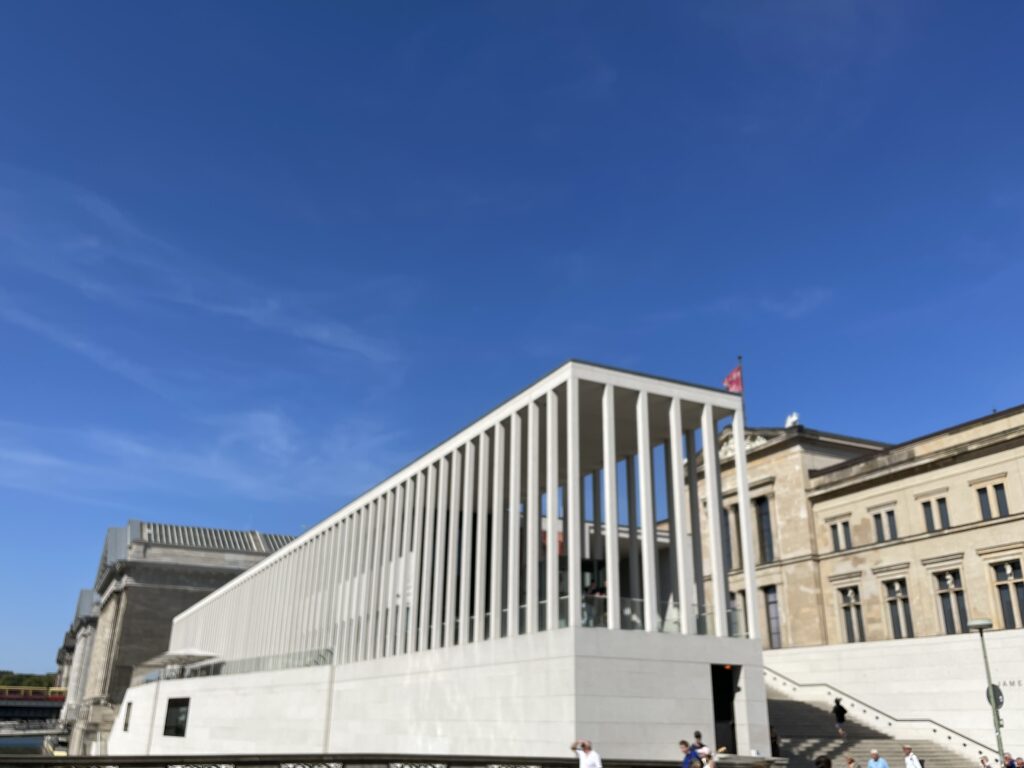
    Take a look at the Reiterdenkmal Friedrich des Grossen  (statue of Frederick the Great), a western sculpture by Christian Daniel Rauch. The elaborate building you can see a little further ahead on the south side of Unter Den Linden is the Kronprinzenpalais, the former residence of the crown princes, while the pink palace opposite it is the Zeughaus, the old arsenal that now houses the Deutsches Historisches Museum (German Historical Museum). It’s also worth taking a look at the new wing designed by I.M. Pei. Continue to Bodestrasse, then turn east and cross the bridge leading to the Museumsinsel, an exceptional complex of museums with a rich heritage of painting and sculpture.

    If you have limited time and need to visit only one of the museums in Berlin, undoubtedly choose the Pergamon Museum. It is a true triumph of classical Greek, Babylonian, Roman, Islamic, and Middle Eastern art and architecture, originating from excavations conducted by German archaeologists in the early 20th century. This gigantic complex, which was only completed in 1930, actually houses three significant collections under the same roof: the Collection of Classical Antiquities, the Museum of the Ancient Near East, and the Museum of Islamic Art. Each one is worth visiting at a leisurely pace, but if you have limited time, focus on the following highlights.

    The main artifact from which the museum takes its name is the reconstruction of the Pergamon Altar (165 BC) from Asia Minor (in Bergama, modern-day Turkey). It is a colossal sanctuary dedicated to Zeus, with a staircase leading to a U-shaped colonnade. Incredibly vivid friezes depicting episodes of the Gigantomachy, the battle of the gods against the giants, are carved along the entire base. Ascend the steps of the altar to closely admire the Telephus frieze, which narrates the myth of the founder of Pergamon, the son of Heracles.

    The next hall contains another important artifact: the immense Market Gate of Miletus (1st century AD), a masterpiece of Roman architecture. The Museum of Ancient Middle Eastern Antiquities presents a completely different culture: that of Babylon during the time of King Nebuchadnezzar II (604-562 BC).

    It is impossible not to feel awe in front of the reconstructions of the Ishtar Gate, the ‘processional way’ leading to the gate, and the façade of the throne room. They are all adorned with bricks painted in cobalt blue and ochre. The rampant lions, horses, and dragons representing the main deities of the Babylonians are so impressive that you can almost hear their roar and the fanfare. Another wonder in the collection is the intricate façades of the Temple of Uruk, decorated with colored clay inserts and highly detailed bas-reliefs. Finally, in the Museum of Islamic Art, don’t miss the palace of the caliph of Mshatta from the 8th century in present-day Jordan, resembling a fortress. Also, highly visited is the Aleppo Room from the 17th century, originating from a Syrian merchant’s house, where the walls are entirely covered with painted and richly decorated wooden panels. Try to allocate at least two hours to this incredible museum.

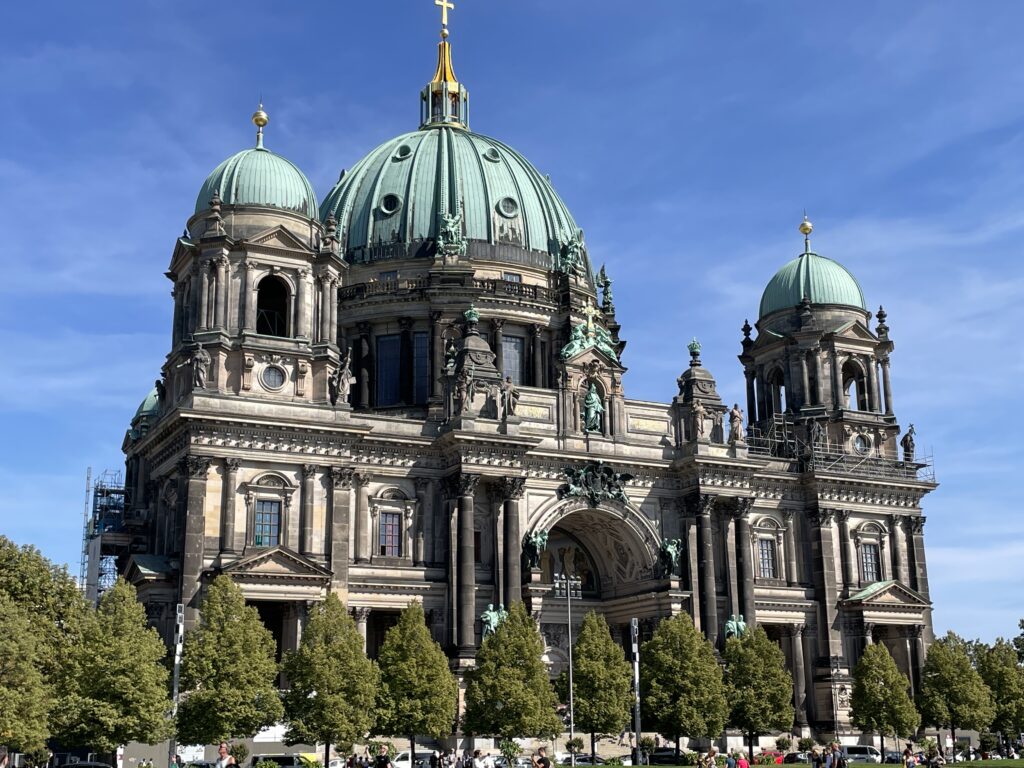
    Dominating the island is the silhouette of the magnificent Berliner Dom, where many members of the Hohenzollern dynasty are buried; the cathedral’s gallery offers a splendid panoramic view of the city. Overlooking the cathedral stood the now-demolished Palast der Repubik, demolished in 2007 by the DDR government. They plan to build a replica of the royal palace that originally stood in its place.

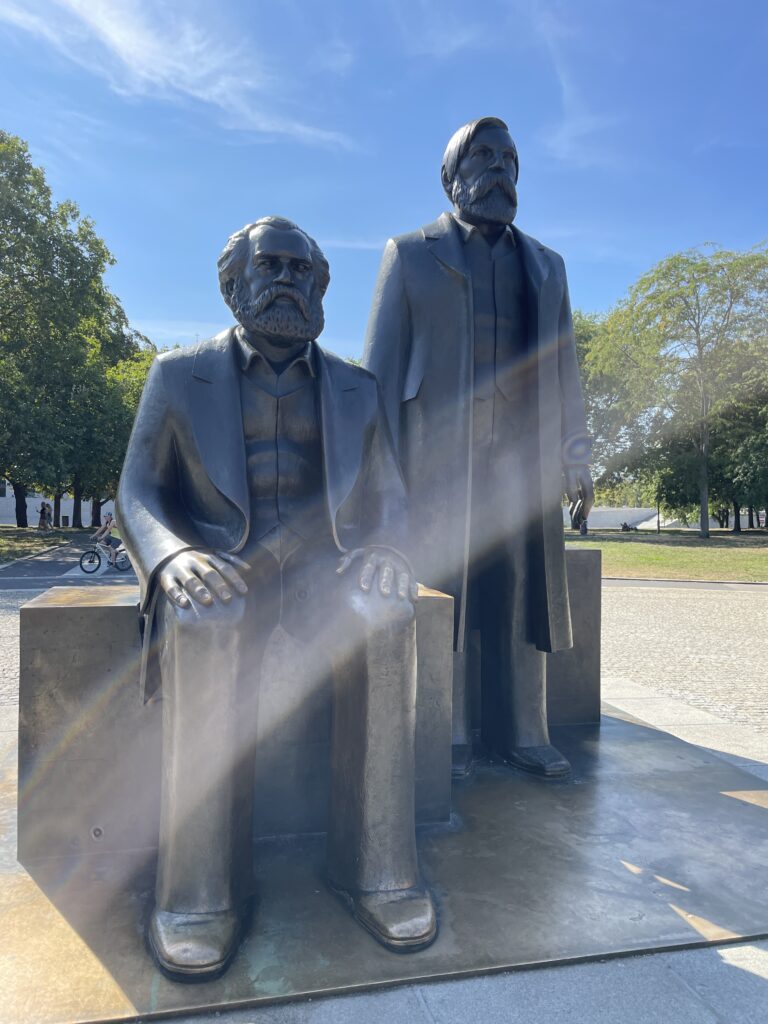
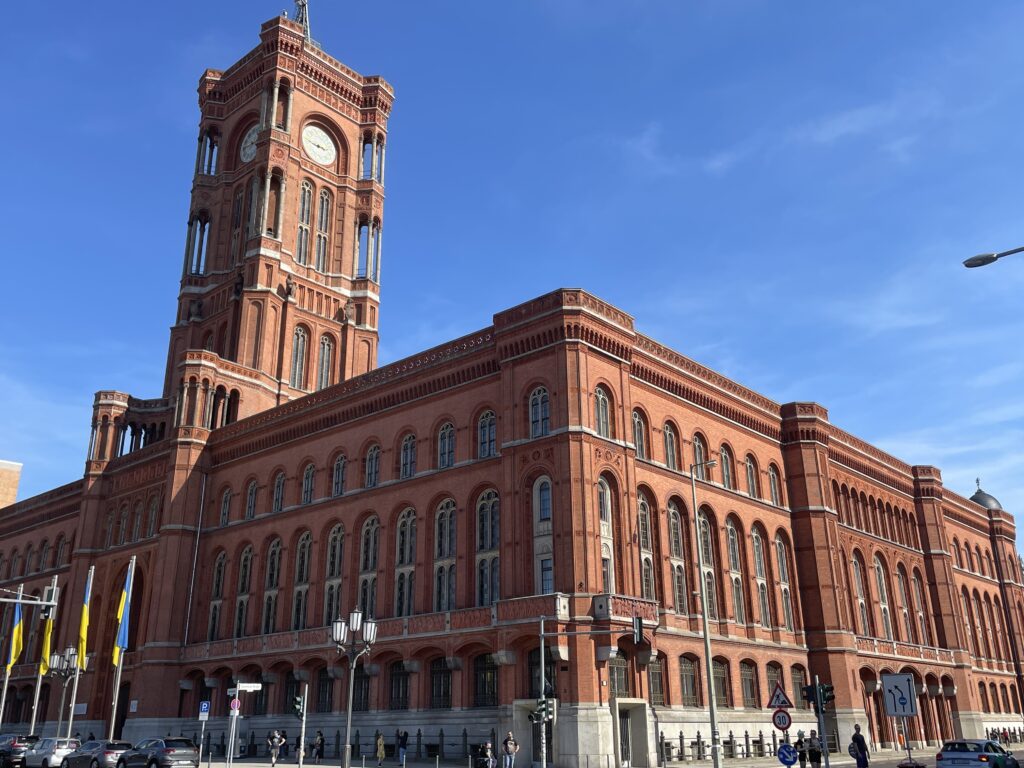
    After passing the cathedral, turn right and reach the Mark-Engels Forum, alongside statues of Karl Marx and Friedrich Engels, and continue to the nearby Rotes Rathaus (Red City Hall), the seat of the municipal administration

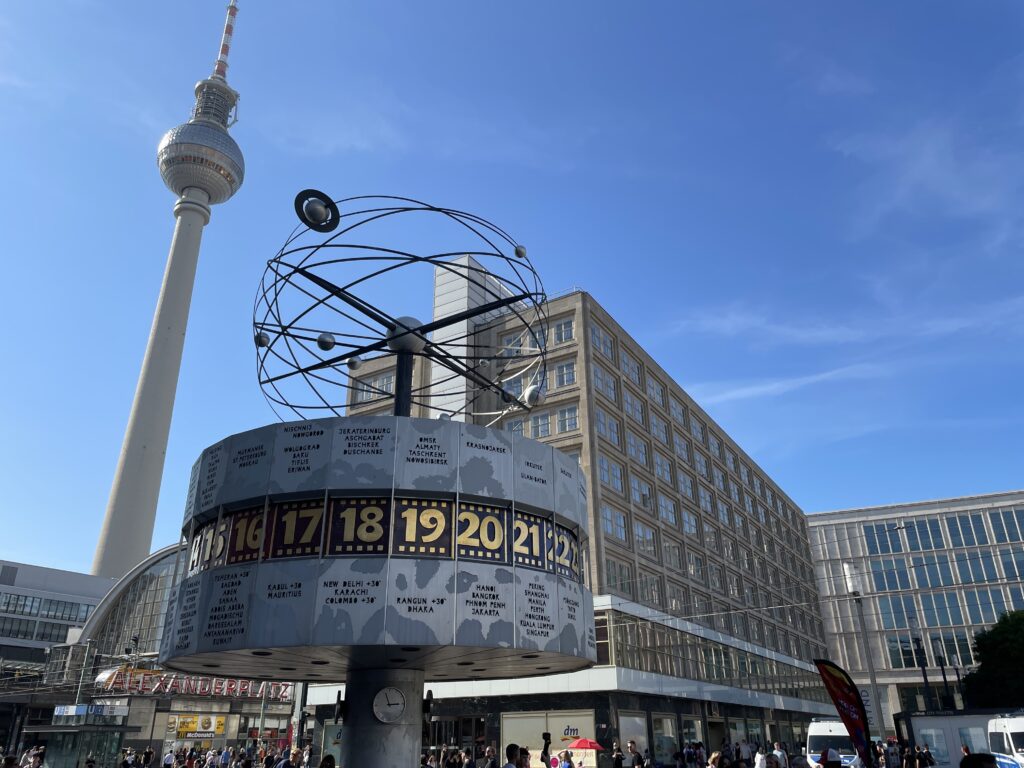
    Continue eastward, and if you have time, ascend the Fernsehturm (Television Tower), the tallest building in Berlin, soars to 368 meters towards the sky. From the panoramic platform, located at a dizzying height of 203 meters, you can distinguish the city’s main monuments and points of interest, admire the size of Tiergarten Park, and compare the urban layout of what used to be East and West Berlin. At the top, you’ll find the Telecafé, which serves coffee, snacks, and full meals while completing a full 360° rotation in 30 minutes. Built in 1969, the tower was supposed to showcase the technological superiority of East Germany (DDR), but instead became a source of embarrassment. When illuminated by the sun, the steel sphere beneath the antenna produces a reflection resembling a giant cross – certainly not a welcomed sight in an atheist country where crosses were even removed from church rooftops. Western Berliners wittily nicknamed the phenomenon ‘the Pope’s revenge.’

    Head then to Alexanderplatz. Once the hub of commercial activities in East Berlin, Alexanderplatz – often abbreviated as “Alex” – was originally called Ochsenmarkt (Oxen Market), but it later changed its name in honor of Tsar Alexander I, who visited Berlin in 1805. Today, it’s just a shadow of the vibrant neighborhood that Alfred Döblin described as the pulsating heart of a cosmopolitan city in his 1929 novel, “Berlin Alexanderplatz.” Severely damaged during the bombings of World War II, it acquired its current appearance, strictly adhering to socialist principles, in the 1960s thanks to the urban planners of the German Democratic Republic (DDR). The Fernsehturm (TV Tower), the Interhotel Stadt Berlin standing at 123 meters, and the Centrum Warenhaus (now Kaufhof), which was once the DDR’s most important department store, all date back to that era.

    Among other famous landmarks are the Brunnen der Völkerfreundschaft (Fountain of Friendship among Peoples) and the Weltzeituhr (World Time Clock). Adjacent to these is the Haus des Lehrers (House of the Teacher) with a frieze by Walter Womacka, which is now part of the nearby Hig Berlin Congress Centre.

    Although there are plans to transform Alexanderplatz into a mini-Manhattan dotted with skyscrapers, the program (for now) remains on hold due to a lack of funds and investments. Nevertheless, the square is gradually changing its appearance. In 2005/06, the Kaufhof department store underwent a complete overhaul according to the design of Josef Paul Kleihues. The traditional honeycomb façade was replaced with a sleek glass and travertine covering, along with the addition of a bright central courtyard with a glass dome.

    Not far away, the 1929 Berolinahaus by Peter Behrens is being transformed into a branch of the C&A clothing store chain, which opened its first store in Alexanderplatz in 1911. And not too distant, in an area bounded by Alexanderstrasse, Dircksenstrasse, and Grunerstrasse, the new Alexa Shopping Mall is taking shape. The Franco-Portuguese investors hope to be active there by early 2007 with approximately 200 shops and a large fitness center, as well as dining options.

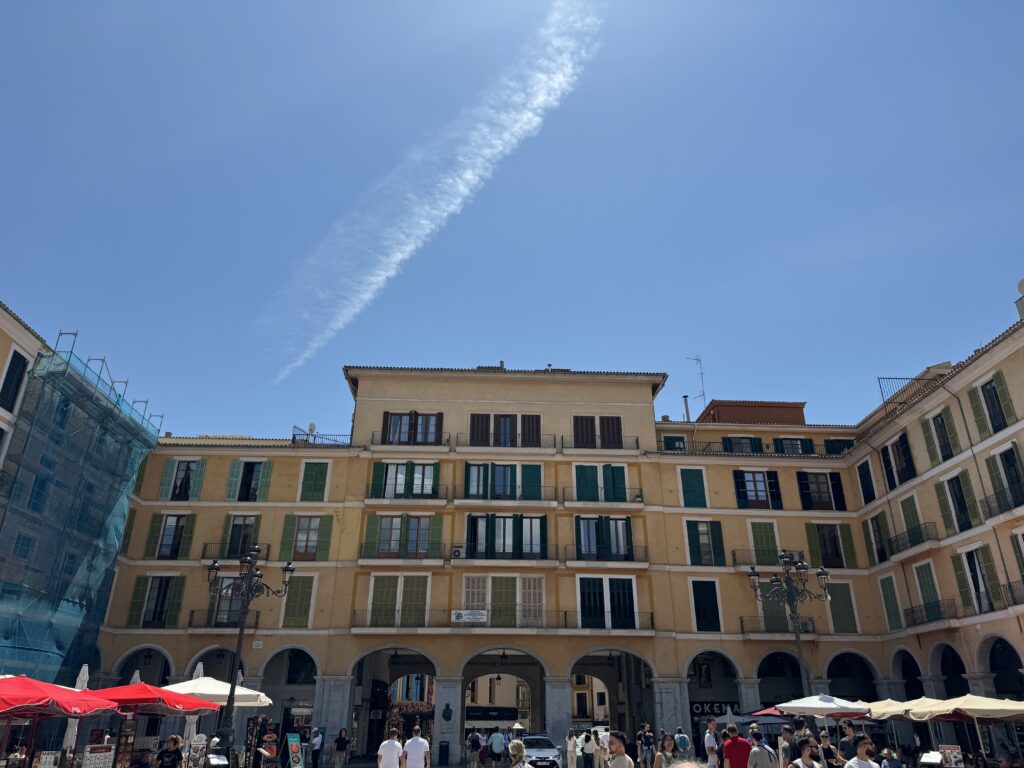
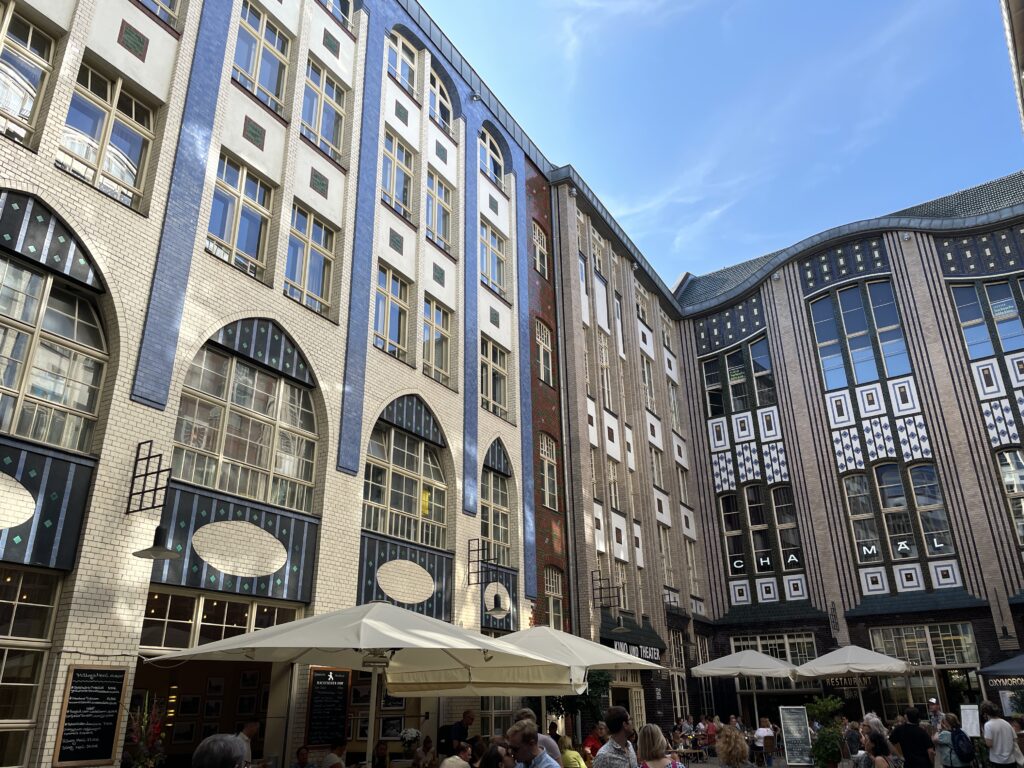
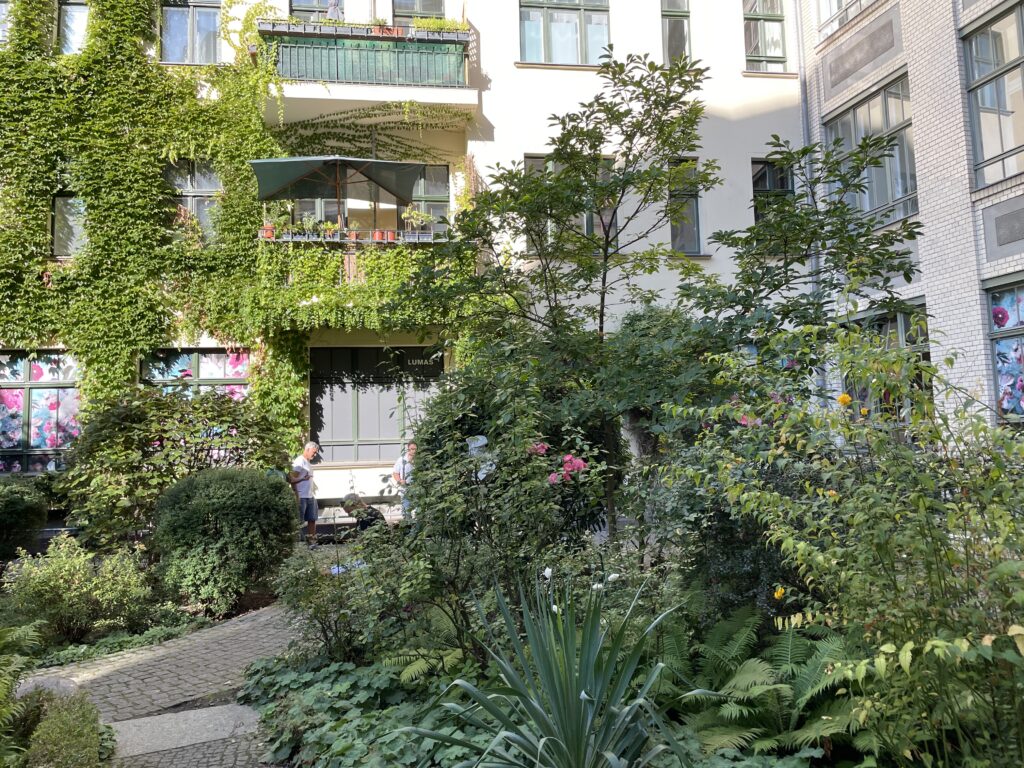
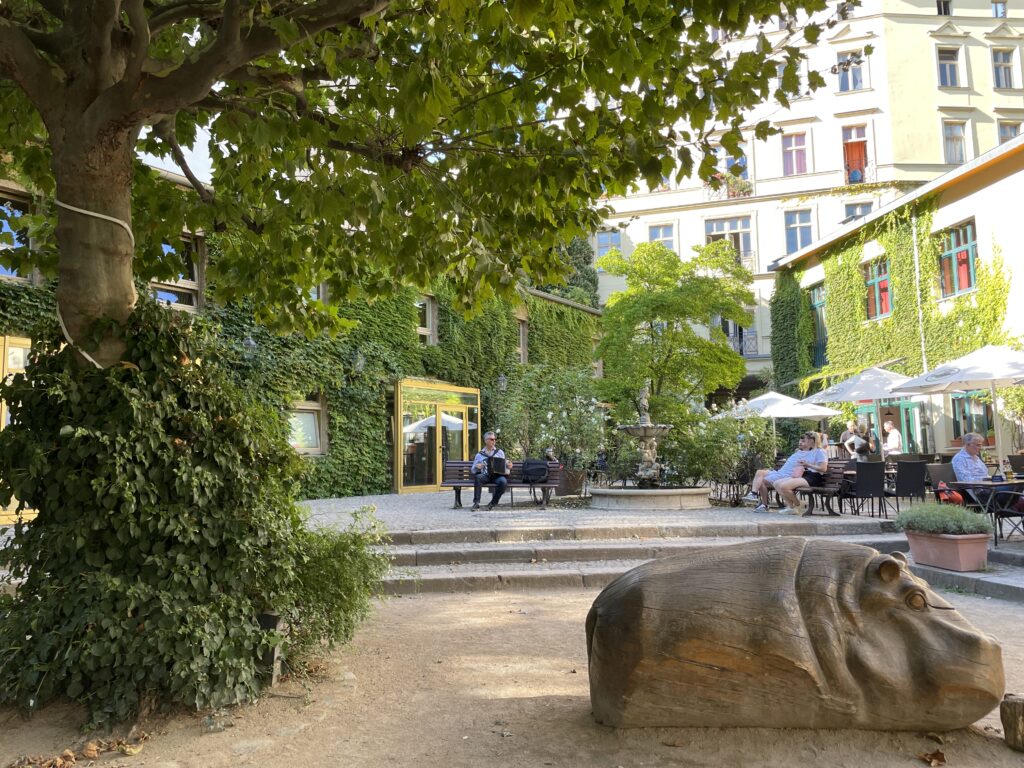
    Leave the square and proceed along Münzstrasse, a street leading to Scheunenviertel, the historic Jewish quarter of Berlin, now one of the liveliest areas in the city, filled with excellent restaurants, shops, and nightspots. Turn left at the intersection with Neue Schönhauser Strasse, a street brimming with boutiques and shops offering the most original creations, and then turn left again on Rosenthaler Strasse, arriving at the Hackesche Höfe, a series of beautifully restored interconnected courtyards filled with bars, shops, and entertainment venue. One of the most well-known tourist attractions in Berlin, the Hackesche Höfe (1907), is a complex of eight beautifully restored courtyards filled with cafes, art galleries, fashionable boutiques, and entertainment venues. The most charming is Hof I (entrance from Rosen-thaler Strasse), whose facades are adorned with rich Art Nouveau tiles designed by the artist August Endell. From Hof VII, you can access the Rosenhöfe, a small single courtyard with a rose garden lower than street level. The metal balustrades with intricate flower and branch motifs create a quirky ensemble.

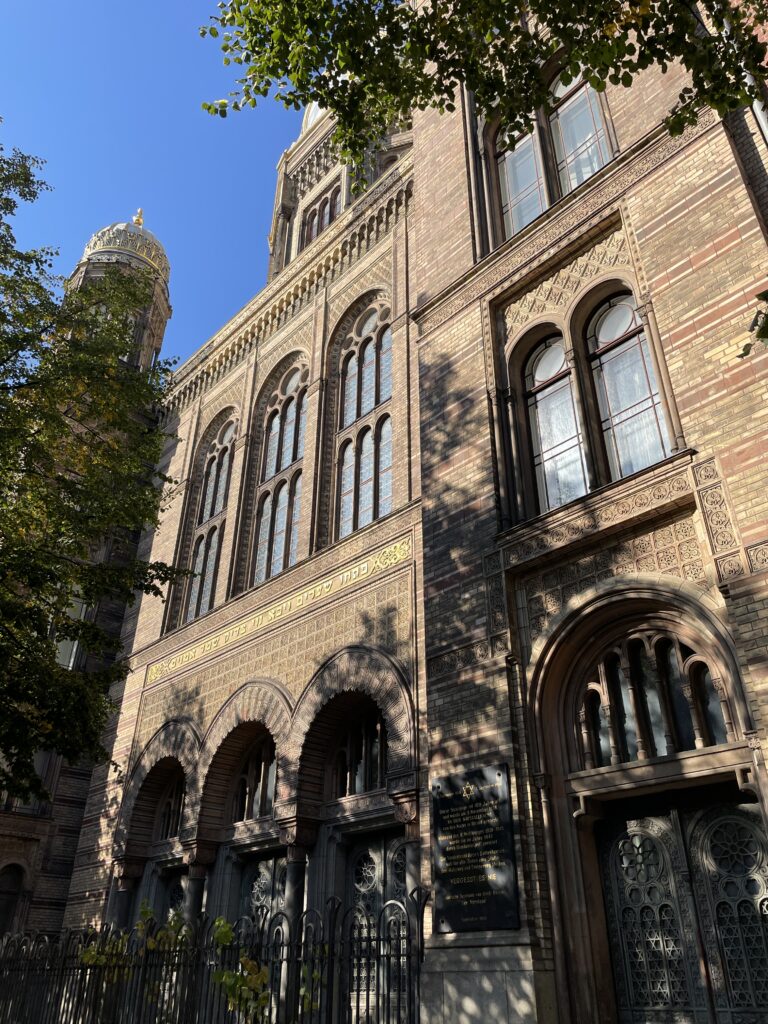
    Take Oranienburger Strasse, the main street of Scheunenviertel, and head north, perhaps taking a break by the river at Monbijoupark. Soon, you’ll reach the beautiful Neue Synagogue (New Synagogue), the most prominent symbol of the rebirth of the Berlin Jewish community. 

    The glittering golden dome of the New Synagogue stands as a symbol of the revived Jewish community in Berlin. Designed in Moorish-Byzantine style by Eduard Knob-Rauch, the original synagogue from 1866 could seat 3,200 people and was the largest synagogue in all of Germany. Thanks to its beauty and rich decorations, it became an important city monument. During the 1938 pogrom, known as Kristallnacht (Night of Broken Glass), a local police superintendent prevented the SS from setting fire to the building, an act of courage commemorated with a plaque. Nevertheless, the Nazis managed to desecrate it, although religious services continued until 1940 when the synagogue was expropriated and turned into a warehouse. Allied bombs nearly destroyed the building in 1943. With the consent of the small East Berlin Jewish community, the East German government demolished much of the ruins in 1958, leaving the main facade as a memorial. In 1988, Honecker announced his government’s decision to rebuild the synagogue, but the regime collapsed before the project could begin. The reunited German government adopted the project, and the New Synagogue was inaugurated in May 1995. It serves not only as a place of worship (though religious services are held in a small room on the second floor) but also as a museum and information center. Permanent exhibitions document the history and architecture of the building and its role in the lives of those who practiced their faith there. Among the items on display are a model of the synagogue, a Torah scroll, and a perpetual lamp from the original structure, unearthed during excavations in 1989.

    Guided tours take you behind the building, where a glass and steel structure supports the remaining ruins of the sanctuary, and a stone band outlines the giant profile of the original synagogue. There is also a dedicated space for special exhibitions on the upper floor. The dome is accessible from April to September.

    Adjacent to the synagogue is the entrance to the Hackmanhöfe, another creatively restored courtyard complex.

  • Buenos Aires

    Buenos Aires

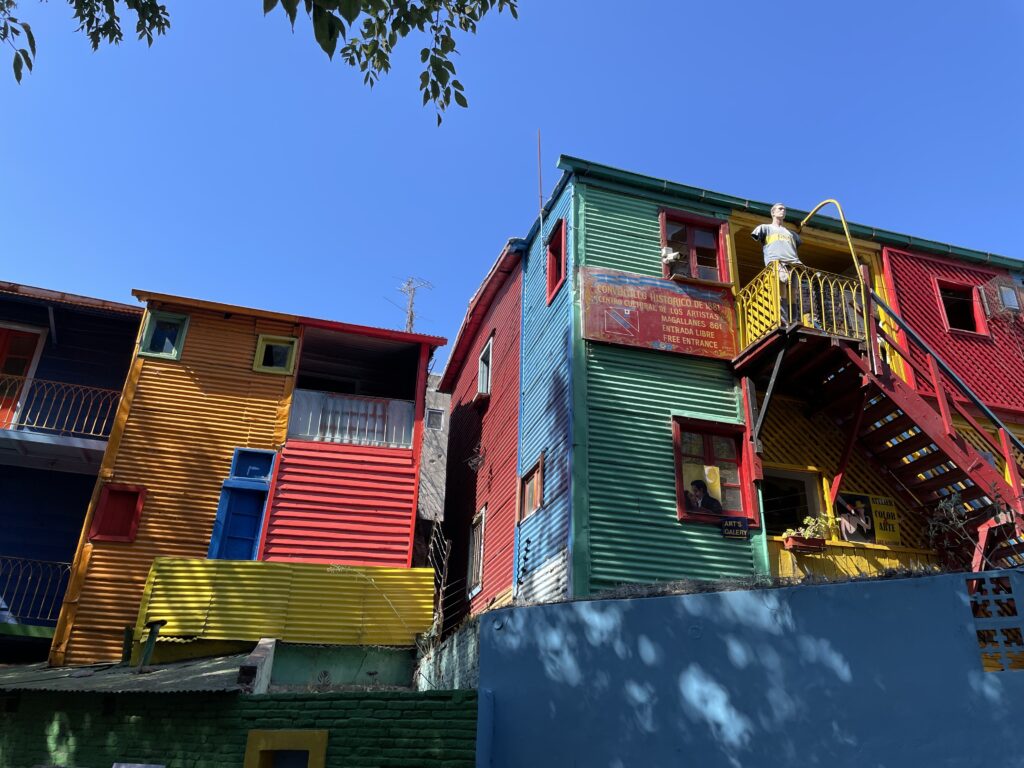
    Lorem ipsum dolor sit amet, consectetur adipiscing elit. Ut elit tellus, luctus nec ullamcorper mattis, pulvinar dapibus leo.

    Lorem ipsum dolor sit amet, consectetur adipiscing elit. Ut elit tellus, luctus nec ullamcorper mattis, pulvinar dapibus leo.

    Boca

    Lorem ipsum dolor sit amet, consectetur adipiscing elit. Ut elit tellus, luctus nec ullamcorper mattis, pulvinar dapibus leo.

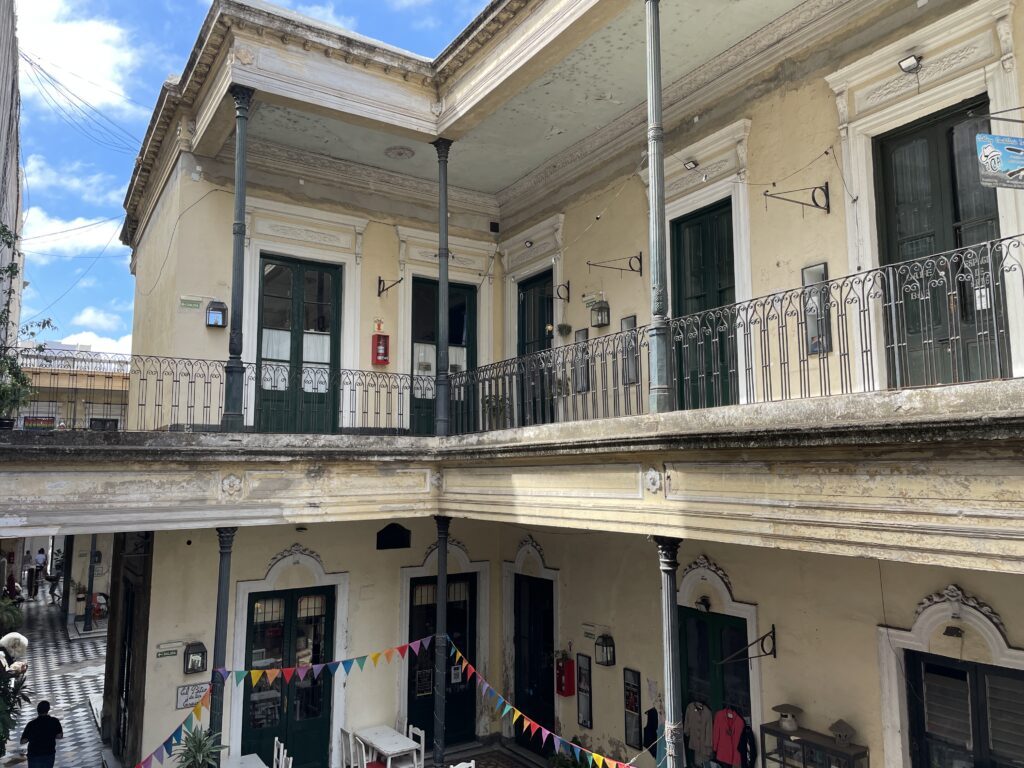
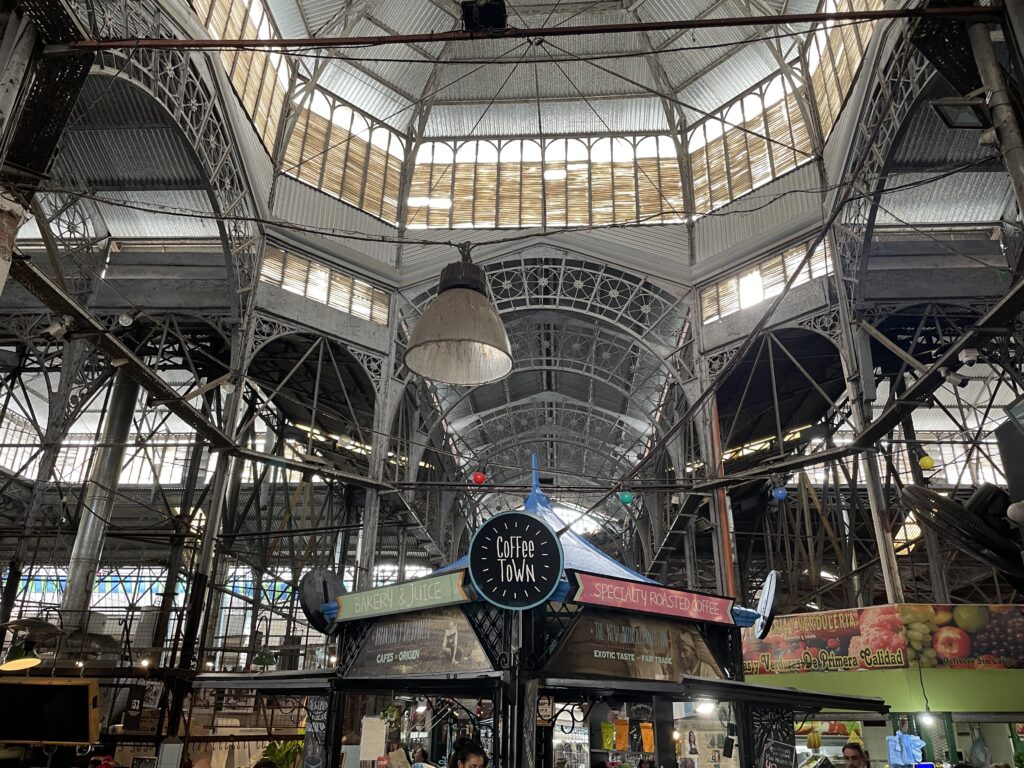
    San Telmo

    Lorem ipsum dolor sit amet, consectetur adipiscing elit. Ut elit tellus, luctus nec ullamcorper mattis, pulvinar dapibus leo.

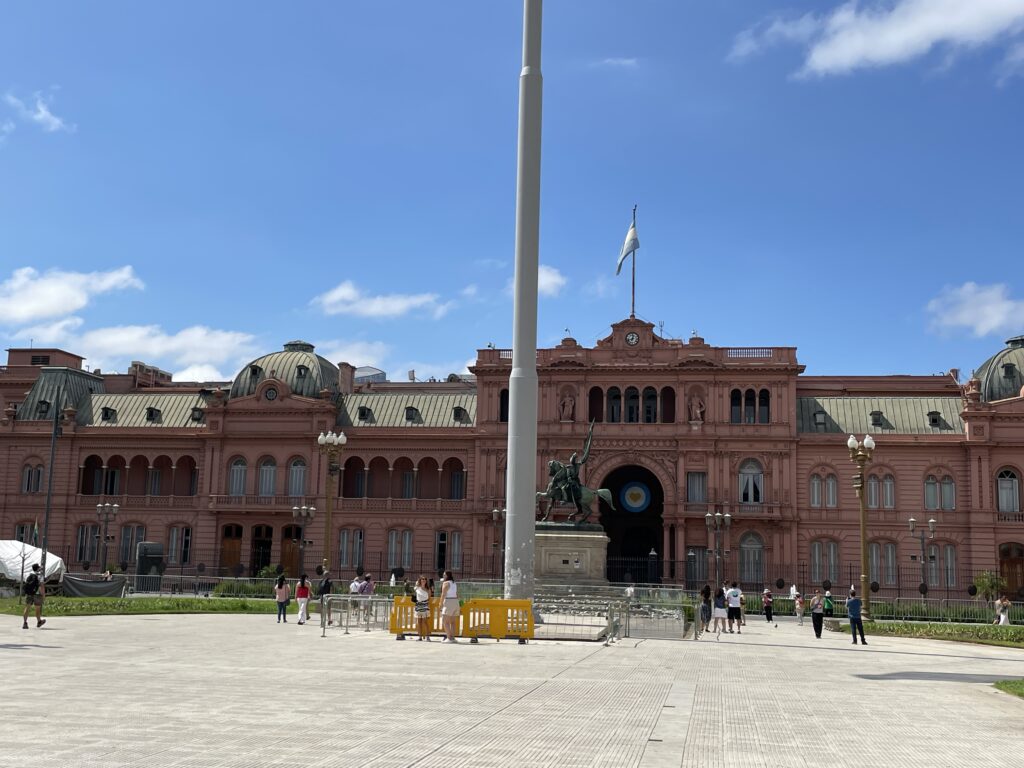
    Playa de Mayo

    Lorem ipsum dolor sit amet, consectetur adipiscing elit. Ut elit tellus, luctus nec ullamcorper mattis, pulvinar dapibus leo.

    Recoleta

    Lorem ipsum dolor sit amet, consectetur adipiscing elit. Ut elit tellus, luctus nec ullamcorper mattis, pulvinar dapibus leo.

    Lorem ipsum dolor sit amet, consectetur adipiscing elit. Ut elit tellus, luctus nec ullamcorper mattis, pulvinar dapibus leo.

    Palermo

    Lorem ipsum dolor sit amet, consectetur adipiscing elit. Ut elit tellus, luctus nec ullamcorper mattis, pulvinar dapibus leo.

    Lorem ipsum dolor sit amet, consectetur adipiscing elit. Ut elit tellus, luctus nec ullamcorper mattis, pulvinar dapibus leo.

  • Kilimanjaro

    Kilimanjaro

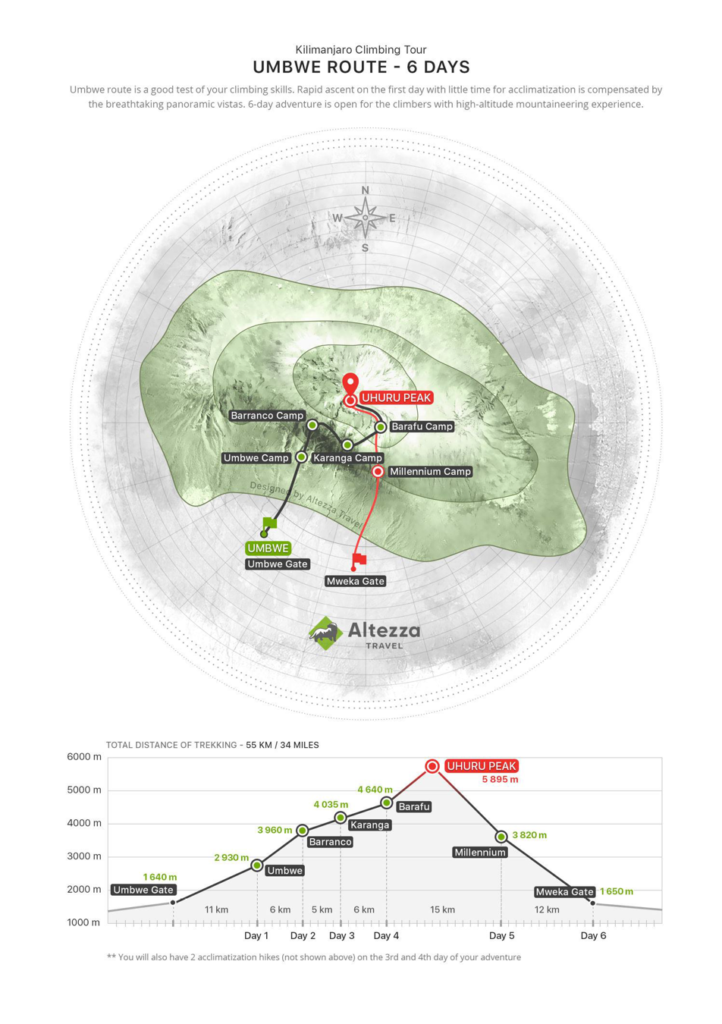
    If you have the experience in numerous high-altitude climbs over 4000-4500 m, you might try the Umbwe route. It is one of the most challenging routes due to the short duration and steeper incline. It goes along the southern slope but is less frequented than other southern routes because of the challenge it poses. The first day poses one of the biggest challenges – the route starts quite low from Umbwe Gate (1,640 m) and continues with a lengthy trek to the first camp on your way – Umbwe camp (2,930 m).

    When the trail reaches Barranco camp, it will merge with Lemosho and Machame and therefore you might meet more people at the camps. The camps are not crowded at all, you might meet 3-4 other groups in the peak season (July-September as an example)

    Day 2: TREKKING FROM UMBWE GATE TO UMBWE CAMP

    A guide and a mountain support crew will arrive at the hotel in the morning in order to meet you and hold a quick briefing, after which you will travel by vehicle to the entrance to Kilimanjaro National Park: Umbwe Gate (1,640 m). After the quick formality of acquiring climbing permits and registering with the search and rescue service, the group will start trekking up to your first camp: Umbwe Camp (2,930 m). This will be a long trekking day that includes an important increase in altitude, so don’t hurry. It is important to find the right pace for your group and stick with it for the rest of the trip. You should also remember to take your raincoats: this route includes passage through a rainforest, where tropical showers are highly probable.


    Change in Elevation: Umbwe Gate (1,640 m) — Umbwe Camp (2,930 m)

    Hiking distance: 11 km

    Hiking time: 5-7 hours

    Day 3: TREKKING FROM UMBWE CAMP TO BARRANCO CAMP

    Early wakeup, breakfast and the start of trekking to Barranco Camp. The rainforest will quickly give way to brush, and if it is not too cloudy you will be able to see Meru Volcano for the first time. Trekking for this day will be of a moderate length, and around lunchtime you will reach Barranco Camp (3,960 m), which is nestled inside a huge volcanic fault. Lunch will be provided here, and then you have the opportunity to relax for the rest of the day, which significantly facilitates the acclimatization process.


    Change in Elevation: Umbwe Camp (2,930 m) — Barranco Camp (3,960 m)

    Hiking distance: 6 km

    Hiking time: 4-5 hours

    Day 4: TREKKING FROM BARRANCO CAMP TO KARANGA CAMP

    Early wakeup, breakfast and the start of summiting Barranco Wall (we recommend you leave the camp as early as possible to avoid crowds of the other groups). Hiking up the gorge wall is not difficult and only takes around an hour. After the climb you can have a rest and take photos in front of the Kibo volcano. Then you start a more difficult hike to Karanga Camp, which features numerous ascents and descents during the route, but don’t worry: our guides are experts at choosing an optimal pace for the group. After reaching the camp you will be offered warm lunch. After a couple of hours you will have to complete an acclimatization hike in the direction of Barafu Camp with a 200-meter gain in altitude, and then descent back down to the camp.

    The acclimatization hike is an easy trek with a slight gain in altitude done in order to speed up the acclimatization process.

    You should take the acclimatization hikes very seriously. They help increase your chances of successfully summiting Kilimanjaro and save you from the consequences of altitude sickness.


    Trekking from Barranco Camp to Karanga Camp:

    Change in Elevation: Barranco Camp (3,960 m) — Karanga Camp (4,035 m)

    Hiking distance: 5 km

    Hiking time: 4-5 hours

    Acclimatization hike:

    Change in Elevation: Karanga Camp (4,035 m) — Destination point en route to Barafu Camp (4,270 m)

    Hiking distance: 2.5 km

    Hiking time: 1-2 hours

    Day 5: TREKKING FROM KARANGA CAMP TO BARAFU CAMP

    In the morning after breakfast you begin your way to Barafu Summit Camp (4,640 m), the starting point for a night summiting Uhuru Peak (5,895 m). Our team will set up a camp for you ahead of time, including tents and sleeping bags, so you can relax.

    After regaining strength, you have to complete an acclimatization hike towards the intermediate Kosovo Summit Camp (4,800 m) and then back to Barafu Camp, where you will be served a hot dinner. It is better to spend the remainder of the day resting and sleeping before night summiting.


    Trekking from Karanga Camp to Barafu Camp:

    Change in Elevation: Karanga Camp (4,035 m) — Barafu Camp (4,640 m)

    Hiking distance: 6 km

    Hiking time: 4-5 hours

    Acclimatization hike:

    Change in Elevation: Barafu Camp (4,640 m) — Kosovo Camp (4,800 m)

    Hiking distance: 2 km

    Hiking time: 1-2 hours

    Day 6: ASCENT TO UHURU PEAK AND DESCENT TO MILLENNIUM CAMP

    Departure from Barafu Camp (4,640 m) at night and the start of summiting Kilimanjaro: Uhuru Peak (5,895 m). Technically the climb is relatively simple; however, the most challenging part is the high altitude. Each pair of climbers will get a personal guide for the entire ascent to monitor your physical and mental conditions. After your successful ascent to Uhuru Peak, you can descend to the nearest glacier if desired. Then you will return to Barafu Camp and after a 2 hour rest continue your descent to Millennium Camp (3,820 m).
    Don’t forget that 90% of all accidents occur during the descent, including all broken arms and legs. Please pay attention to your feet, as there is a high risk of damaging your toenails.


    Change in Elevation: Barafu Camp (4,640 m) — Uhuru Peak (5,895 m) — Millennium Camp (3,820 m)

    Hiking distance: 15 km

    Hiking time: 8-12 hours

    Day 7: DESCENT FROM MILLENNIUM CAMP TO MWEKA GATE

    The camp is situated in a tropical rainforest. When you wake up, you will feel relief from the reduction of the height and the satisfaction of reaching the summit. After a warm breakfast, you will head for the park’s exit: Mweka Gate (1,640 m). After your descent the whole group will gather to congratulate you, followed by offering you a chance to share your opinions on the climb in the guestbook. Lastly, we will present you with your commemorative certificates in our office and provide you a transfer back to the hotel.


    Change in Elevation: Millennium Camp (3,820 m) — Mweka Gate (1,640 m)

    Hiking distance: 12 km

    Hiking time: 4-5 hours

  • Parque Nacional Los Glaciares

    Parque Nacional Los Glaciares

    Los Glaciares National Park is located in the area known as Austral Andes in Argentina, in the south west of Santa Cruz on the border with Chile. By his magnificent natural beauty, it constitutes a wonder in the world, and was declared “World Heritage” by UNESCO in 1981.

    This park shows a scenario of mountains, lakes and woods, including a large portion of the Andes practically under ice and snow to the west, and the arid Patagonian steppe to the east.
    Its name refer to the glaciers that are born on the Ice Caps – the largest continental ice extension after Anctartica- which occupies almost half its area. Also known as Patagonic Continental Ice, creates 47 big glaciers, 13 of which flow to the Atlantic. There are also more than 200 smaller glaciers, unconnected to the Ice Caps. 
    All over the world glaciers are over 2500 mts over sea level, but here, in Santa Cruz, they are originated on the Ice Caps, at 1500 mts over sea level, and flow down to 200 mts, having the possibility of an unique approach and view.
    As a result of the enormous pressure of the antique ice and the subsequent thaw, three big lakes, two of them inside the NP appeared: Lago Argentino and Lago Viedma, the waters of which flow as Rio Santa Cruz to the Atlantic Ocean crossing the province

    Cerro Fitz Roy - Laguna de Los Tres

    Laguna de Los Tres is one of the most iconic hikes in Patagonia and the best trek you can do from El Chalten in Argentina. It’s also known as Fitz Roy hike because the trail will take you to the classic viewpoint of Mount Fitz Roy and the lake. 

    Laguna de Los Tres means in English Lake of the Three, and the number three represents here three peaks towering above the lagoon – the highest Mount Fitz Roy, Cerro Torre, and Mount Poincenot.Finding trailhead to Laguna de Los Tres couldn’t be easier. 

    The trail starts at the north end of the urban area of El Chalten. You only need to follow Avenida San Martin until you reach the parking lot on your left.

    From the parking lot, the trail starts quite steeply up. The first ascent lasts about an hour, but in the end, you will be rewarded by a splendid view of De las Vueltas river sneaking through the valley.

    From this mirador, the path continues up, but not that steeply. You will walk on a narrow path partially hidden in the forest until you reach a fork where you can decide to turn right and walk through the Mirador del Fitz Roy or turn left and go via Laguna Capri.

    IMG_7075

    Generally, it does not matter which option you’ll take as you can walk the other side on the way back.

    But if the weather is pleasant, you should go via the viewpoint first as the situation can change any time, and it might be the only time you’ll get the chance to see the iconic Fitz Roy from a distance.

    After you enjoy the panoramic views, the path continues down and soon became flat, which will be a welcoming change.

    The path will now wind through the low thicket, along Del Salto Stream, and later you emerge in an open valley and walk a very scenic section where you will go across wetlands, so from time to time, it will be necessary to cross wooden boardwalks.

    At the end of this part, you will find a campground in the woods, where you can have a snack and recharge as you have the most challenging one-kilometer-long section ahead of you.

    On this last kilometer, you will gain 400 meters in elevation and have to walk the rocky trail – watch every step as it is easy to lose balance here.

    If you bring trekking poles, they will help you a lot in this section.

    Finally, after approximately 45 minutes, you will reach the end of the trail and be rewarded with stunning views of the lake and three towering peaks behind.

    IMG_7088

    Chorillo del Salto

    This pleasant trek is perfect for a first contact with the natural environment of El Chaltén, you walk through a forest area in a footpath with no difficulty. At the end of the trail a lovely waterfall and its stream invite you to take a break for contemplation at the shelter of the native forest.The trail begins in El Chaltén, at the end of Av. San Martín, on the same trailhead towards Laguna De los Tres; You must take the path going to the right. In a short time the trail ascends and immediately after it descends until you reach the unpaved route that leads to the Lago del Desierto (Provincial Route 41). Shortly after you will find a signpost on your right hand side indicating the entrance to the “Bicisenda”(bike trail) -a path exclusively for cycling, do not enter- and after a few minutes more, you will see another signpost to your left indicating that the path to the Chorrillo del Salto continues crossing the low forest of Ñires entering the foothill area again.In less than half an hour you will reach the last stretch of the trail where there is a car park area; It means that you can also get here by car or bicycle. In the last section of the trail you enter only on foot, it is forbidden to enter with bicycles. This beautiful footpath is completely flat, between low trees. The distant sound of the waterfall anticipates that you are approaching the end of the route.The waterfall is on the last leg of the Arroyo del Salto, before it flows into the De las Vueltas river. The total distance of this trek is less than 4 km from El Chaltén.

    Mirador de Los Condores - Mirador de Las Aguilas

    Starting from El Chaltén, you cross over the access bridge of the Fitz Roy river and then continue along to the trailhead starting at the National Park Visitors’ Centre. After a short walk you cross a small gate with a sign indicating the way to the left, and a few steps further you will see a second sign showing you the trail plan. From here it will be another half hour until you reach the Los Cóndores viewpoint. This footpath is relatively new, since it has been opened in 2004. It is well signposted and on its way you will find several informative signs that will let you appreciate the landscape around you. As its name indicates, the viewpoint is strategically located for the eventual observation of condors in their frequent flight between the valleys of the De Las Vueltas river and the Fitz Roy river. Furthermore it is an excellent alternative for admiring the impressive granite peaks and glaciers dominating the horizon.
    The trail to the Las Águilas viewpoint begins at the signposted bifurcation about ten minutes before arriving at the Los Cóndores viewpoint. This short trail has a gentle slope and as you go along you will discover the great Viedma lake on the horizon. The viewpoint is a natural balcony with a panoramic view over the steppe and the Viedma lake to the south, the Cerro Huemul to the west and the Cerro Piramide to the east.

    Cerro Torre - Laguna Torre

    From El Chaltén there are two head trails to Laguna Torre ; both paths merge within 5 minutes walk. Although the trek to the lake is quite long – 9 kilometers one way, the trail gains only 250 meters in elevation during this distance, and the majority at the beginning of the trail. The trail enters the valley of the Fitz Roy river and follows up alongside the stream to its source. At only 15 minutes walk you will access the first viewpoint located at the gorge of the Fitz Roy river which offers an impressive panoramic view of the Cerro Solo, Adela range, Cerro Torre and the Mount Fitz Roy. Across the river canyon lies the Margarita waterfall. Once you get to the Mirador Cascada Margarita, the first viewpoint, the hike from this point is not demanding, and you will walk mostly on a flat path, with occasional up and down sections.
    Halfway through the path you will reach a natural viewpoint with magnificent panoramic views of the Adela range, Cerro Torre and the satellite granite needles. Finally the trail crosses the De Agostini base camp where it is possible to spend the night in your tent.

    Leaving behind the campground, the path continues towards the frontal moraine, which ascends until reaching its crest after walking for 15 minutes. From there it is possible to go down to the Torre lagoon. This lagoon tends to group numerous icebergs on its shore which has fallen off from the front face of the Grande glacier.

    If you have enough energy and want to get a better view of the glacier, it is possible to extend the trip and climb up from Laguna Torre to Mirador Maestri. This detour will add approximately 2 kilometers one way (depending on how far you want to go) and a minimum 1 hour.

    Other treks

    Loma del Pliegue Tumbado

    The trail starts at the National Park Ceferino Fonzo Visitors` Centre, where a small fence indicates two paths: to the left, the trail goes to Los Cóndores and Las Águilas viewpoints, and to the right towards Pliegue Tumbado and Laguna Toro / Paso del Viento. This trail maintains an ascending slope of approximately 1100 metres in total (3,610 miles), until reaching the viewpoint located at about 1500 metres (4,920 feet) above sea level.  Due to its height, the absence of trees and the total exposure to the wind, you should go prepared with a windproof jacket and warm clothes since a small snowfall is not uncommon even in the middle of summer. Having walked for about an hour, the trail crosses a plain called “Pampa De las Carretas”, from where you can appreciate the impressive Mount Huemul, the Viedma lake to the south and the whole imposing Andes to the northwest where Mount Torre and Mount Chaltén stand out. The trail then enters a beautiful forest until reaching an altitude of approximately 1000 metres above sea level, where the landscape changes abruptly: the trees turn to bushes and scrubby vegetation, and among the many stones on the way it is possible to find the remains of marine fossils which are bout 100 million years old. The last part of the trail fades away but it is still marked with yellow sticks until you reach the top of the Pliegue Tumbado -which can be snowed and if this is the case it is not recommended to continue- with an extraordinary panoramic view.

    Huemul Glacier - Lago del Desierto

    This trek takes place in the Southern region of Lago Del Desierto, 37 km from El Chaltén. To get there you can take the services of private transfers. This trek is the usual option for those who arrive at the lake and have little time to spend in the area. You will be able to enjoy the extraordinary views of the north face of Mount Chaltén and the valley of the De las Vueltas river. The trailhead starts a few metres away from the free parking area. Remember you must pay the entrance fee since the entire trek is in private property. The footpath quickly enters the Lenga forest and after a few minutes it begins its ascent on a well-marked trail. n little more than half an hour you will reach a moraine ridge with breathtaking views of the De las Vueltas river valley and the Mount Fitz Roy. Towards the NE you will see the Lago del Desierto and the snowcapped mountains of the Del Bosque range. After walking along the moraine ridge for about 15 minutes you will arrive at the beautiful Huemul lagoon, fed by the glacier of the same name.

    Comments Off on Parque Nacional Los Glaciares
  • Alexandria

    Alexandria

    Alexandria was founded over 16 villages, encompassed between lake Marouthe and the Mediteranean sea. The Egyptians living here were fishermen and farmers at the time, while wealthier Egyptians preferred to stay closer to the river Nile. For such reason, all the Egyptian statues of kings and queens that you may find in Alexandria were just brought here at a later point in time, as no noble lived here in ancient Egypt. Later on, when the Greeks and Romans came, they cherished Alexandria and its port because of the closeness to the Mediterranean and their homeland.

    Alexander the Great came to Egypt in 331 BC and went to Memphis for 1 year, to control the whole Egypt. As he was going towards Libya, he stopped at one of the 16 villages, where later on the catacombs were created, and from there he made of Alexandria his capital. Alexandre died at the age of 33, whether poisoned or from a fever, before he could see his capital finished. He was succeeded by his general Ptolemy I, who gave rise to the Ptolemaic dynasty that continued until Cleopatra VII. At the time of Cleopatra the 7th, Alexandria was still the capital and remained such for 7 more centuries. Cleopatra and Julius Cesar’s extramarital love produced an heir, Cesarion, that was later adopted by Marc Anthony as he married Cleopatra while going at war with his co-consul Octavian. With the defeat of Marc Anthony and the death of Cleopatra, Cesarion never gained the throne and Alexandria passed under the control of the newly founded Roman Empire.

    The cohabitation of Egyptians, Greek and Romans under the Empire was made easier by their polytheism and the mutual adoption of the ancient Egyptian gods, while with new names, and continued till the Arab invasion. 

    Catholicism was introduced in Alexandria by Saint Mark, who from Libya arrived in Egypt. In the year 60 AC, when polytheism was still diffused all over Egypt, he was walking the streets of Alexandria and his sandals tore. The legend says he stopped at a shoemaker who, while mending his sandals, hurt himself: St Mark invited him to pray Jesus and the wound healed. That shoemaker and his family were the first to be baptized and he later became the first pope of the Coptic church (that is the reason why the Coptic Pope up to today is called the Pope of Alexandria).

    Catacombs

    “Cata” means “under” and “comb” means “tomb”, so these are literally underground tombs. So when you reach the site, don’t get fooled by the sarcophagi waiting for you before the entrance, as these were carried here later to create atmosphere! But do pay attention to the grass on your left: this was the level of the ground covering the tombs when they were discovered in the 1900’s. At that time, when nobody knew of the existence of the tombs, a donkey carrying a heavy load fell into the shaft as the terrain collapsed. After excavation, multiple mummies, skeletons and ashes were found, a proof of the multicultural use of these tombs. Only poor people were cremated; rich Greek and Romans were mostly mummified, an Egyptian inheritance as a way of preserving the body for the afterlife. Less wealthy people could get mummified but with less layers of lines and less intricate wrappings. Another difference was that mummification lasted 70 days for rich people, as they were immersed in tar (the word “mummy” comes from the Persian word “mumiat” that means “asphalt”), while only 40 days for commoners. This is the reason while today, muslins and orthodox go to pray at day 40 after a passing.

    The Catacombs seen from the shaft
    The triclinia

    The catacombs are carved in the rock except for the shaft, and even the stairs are original. They date to the II century AC, used by the polytheistic Romans for at least 3 centuries.

    The shaft was built mainly to lower the sarcophagi

    The tomb has 3 floors, the second one being the main one as it shows perfectly the mixture of cultures and art (Egyptian, Greek and Roman) that was Alexandria. 

    While you enter the tombs on the first floor, note the benches that used to provide rest for the visitors, and the half shell on their top, coming from the Venus tradition of the Romans. Far ahead to your right, an area opens with 3 stone benches. This room, known as the Hall of Banquets, was reserved for mourners to visit their deceased. The benches are triclinia, where the families used to eat and drink; the remaining’s of the feast were stored in plain jars and thrown on the floor to avoid bad luck (till now, Greeks before dancing throw plates on the floor, Jews break glasses after weddings).
    The next room hosts the loculi, square holes where bodies were buried one on top of each other. Note that the loculi on the lower level have a round portion for the head, these were probably reserved for wealthier people to be buried alone.

    The second floor was used in the beginning by a rich family and was housing their sarcophagi; later the tomb was enlarged and multiple loculi were added. Here you are welcomed by a pure mix of the 3 cultures: note above your head the circle with wings, symbolizing Ra, the columns carved in the Greek way but with leaves of papyrus, and the 2 statues facing each other, a man and a woman with Roman features but Egyptian dresses. By the door of the burial chamber, a Medusa head overhangs a fanged snake with a Aesculapian symbol next to it. Enter the burial chamber, you will see that the noble family sarcophagi are carved in one piece to prevent tomb robbers from opening them. Above them, the goddess Isis with winged arms looks at her brother Osiris, here in the form of a bull. Over the central tomb, the god Anubi is presiding over a mummification. Three canopii containing the deceased organs are at his feet.

    Vault to the Hall of Caracalla

    On the right side of the second level, you enter into the Hall of Caracalla. The roman emperor was not particularly loved but he was very smart, and to put an end to his multiple enemies among the young Romans inhabiting Alexandria, he indicted a horse race just above the Hall. While his young enemies were racing, the terrain gave way and they all fell and died in the catacombs, together with their horses whose bones you can still see under glass. The Hall is surmounted by a triangular vault (Greek in style) with the Ra disc in the middle, and paintings both Egyptians and Romans in style.

    You can walk down to the third floor but there is nothing to see here.

    Pompey’s Pillar

    In this area rose a Greek temple with 400 columns, a 90×80 m square built in the III century BC and used both by Greek and Egyptians. When the Romans came, they continued to use the temple to worship their deities. During the times of Diocleziano in 297 AD, to get the approval of the people of Alexandria, he built the pillar that now is standing alone. As such, the name “Pompey’s pillar” is a misnomer, as it was built 300 years after the death of Pompey and it’s technically not a pillar (square) but a column. The Pompey name comes from one of the triumviri, Gneo Pompeo, that broke the allegiance with Cesar and was thus killed: his head was delivered to Cesar in a golden bowl and the body cremated and the ashes lost. After the pillar’s erection, a jar with the ashes was discovered by Romans and placed on top of the pillar as a way for the name “Pompey” to be remembered.
    The pillar is 500 tons and 30 meters high. It was carved from the granite in Assuan and transported by water through the flooded Nile: Romans followed the Egyptian ways of transporting heavy loads by river, they tied the pillar to wooden boats on every side. 

    The Pompey pillar
    Api, the bull form of the Egyptian god Osiris

    The two sphynxes that guard the pillar are in honor of 2 of the successors of Ptolemy I. Around the pillar, ruins of the original temple that was destroyed by an earthquake in the VI century AD. The temple was known as the Serapium Temple: the suffix “-ium” means “massive”, while Serap is the name of the god Osiris. Osiris had human form, or could assume the form of the bull Api, and from the word “Osirapi” the Greek got the name Serap. When the Greeks invaded Egypt, they adopted the same gods as the Egyptians but with a condition: no forms of animals and no forms of birds. As such, the Egyptians dropped the Api-bull form of Osiris, and the Greek adopted him as Zeus; Horus, son of Osiris, did not have the head of a falcon anymore but the form of a child. 

    While walking to the pillar, look to your left and go down few stairs that lead to the original sanctuary of the temple: here you will admire a replica of the Api-bull with the Ra-disc between the horns.

    On the right side, a sign points towards the library but there is not a lot to see here.

    Bibliotheca Alexandrina

    It was not Alexander the Great who built the original library, as he died few years before his capital was completely finished. His generals took power and they gave rise to the dynasty of the Ptolemy. The idea of a magnificent library was put in Pt I mind by his statesman Dimitrios, governor of Athens, and philosopher. The library was completed in 288 BC and it was under  Ptolemy II that the library flourished so much that because of the numbers of scroll a second satellite was built.

    The decline of the library started with the war of Alexandria, when Cleopatra VII battled on of her brothers Ptolemy XIII for the throne of Egypt and a large portion of the library was destroyed by accident. The final destruction of the library happened when Julius Cesar was at war with Pompey. At the time, Cesar and Cleopatra VII were lover, and so Cleopatra’s brother (the good one, not the one with which she had battled) in an attempt to satisfy Cesar killed Pompey and had his head delivered to his brother in law. Cesar, still a man of honor, wanted to kill Pompey in fair battle and as a revenge he burned Cleopatra’s brother fleet. The fire however extended from the sea to the library and many scrolls were burned. Some of them were rescued, but a second fire by arson in 392 AD burnt the remaining scrolls. Only one scroll survived, ironically, the classification of the all lost scrolls… And it’s kept in Vienna, not even in the new library!

    The Bibliotheca Alexandrina

    The reconstruction started in 1972 with an idea suggested by the Chief of Department of  History of Alexandria. The Bibliotheca Alexandrina as we see today was started in 1995 with a competition won by a Norwegian architectural firm and finished in 2001; the official opening with books was in 2002.

    The BA has the shape of an incomplete rising sun to symbolize how knowledge can spread; the wall is made of 6000 granite blocks coming from Assuan, on them we find 4200 letters engraved from 120 languages. The library now hosts sections for children 6-11, for young adults 12-16 yo and for adults over 16 years of age there is the main reading area.

    The main area is the biggest open reading space in the world, accommodating 2000 people at a time. It hosts 2.5 million books in various languages. Each floor of the open area is specialized in a particular subject: ancient maps (with 7000 maps), arts and multimedia, rare books (15000 manuscripts dating back to the late 1400), francophone library, braille library. The ceiling has an inclination of 16 degrees to limit the damage to the books from direct sunrays; the multiple glass panels covering the ceiling take the shape of an eyelid from the inside and eyelashes from the outside to prevent accumulation of water and dust. Green and blue led lights, symbolizing the earth and the sea, provide relaxation for the readers.

    The walls are covered in concrete walls that reduce the sound and absorb the echo.

  • Tour du Mont Blanc,  Val d'Aosta

    Val d’Aosta

    Lorem ipsum dolor sit amet, consectetur adipiscing elit. Ut elit tellus, luctus nec ullamcorper mattis, pulvinar dapibus leo.

    Gran Paradiso National Park

    Day 1 – Colle del Nivolet and lakes tour

    It’s the Aostan access to the Colle del Nivolet where you will find the Rifugio Savoia, built in 1860 as a royal hunting manor. From the parking in Port Valsavaranche, yellow signposts point to the start of the dirt path to the Colle del Nivolet. The pathway climbs in a forest of larches, passes a beautiful waterfall and becomes steeper and steeper until the panorama opens up onto the Gran Paradiso glacier. Few bends of the pathway will take you after 1 hour walk to the Arolley Cross (2310 m). Going on, you will walk the open plane of the Nivolet, a 6 km path surrounded by an open nature that reminded us of the Hobbit’s Shire. Walk along the river until you reach the Rifugio Savoia, on the shores of the Lake Nivolet.

    Book in advance your bunkbed at the Rifugio Savoia for the night, you will need an early start on Day 2 for the Basei glacier. The Rifugio is not your typical mountain hut with warm people, it’s on the main road and its customers are mainly bikers, but it’s clean and will do for one night.

    Spend the afternoon exploring the lakes behind the Rifugio. This lakes tour is a magnificent itinerary, not too tiring but instead with an awe-inspiring landscape. Once you have reached the peak of the Colle del Nivolet you have admired the two lakes of Nivolet in front of the Rifugio; now follow the right-side dirt path on the back of the Rifugio (yellow signs) which with a gentle slope will lead you to the plane from where you can explore the three lakes. If you keep walking straight ahead of you, you will reach the Lake Rosset, a transparent pearl that is overhung by the Punta Basei and its glacier. Continue your walk and leave the first lake on your left to reach the Lake Trebecchi, the best place to admire the Gran Paradiso that is reflecting in its waters. Go back towards the Lake Rosset, walk along its shores towards the Punta Basei and you will arrive at the Lake Leita. During your walk you will certainly encounter groundhogs that spy on you from behind the colored flowerbeds.

    Day 2 – Punta Basei

    An amazing climb in a varied and colorful panorama. The trek is to be considered alpinist only in its final portion that requires some skills on ice and rock climbing, and some equipment (tampons and picks). The path starts behind the Rifugio Savoia and gently rises on a hill next to the Lake Leita (2700 m). At the left edge of the Lake Leita the path starts a steep climb to reach a crossroad where you will take the right path. After a section with lots of debris you will reach a plane  from where you can admire the small Basei glacier (your goal) and the Lakes Nivolet below (your starting point). Keep following the path and you will reach the edge of the glacier. Here you can decide whether to continue left and cross the glacier to the peak, or walk towards the right side and the crest of the mountain where in the summer season the terrain is cleared of ice. In the second case, while ascending with the help of fixed metal ropes, you can admire on your right the Val di Rhemes. In few minutes you will reach the cross at the peak of the Basei (3338 m), on of the most panorami peaks of the Gran Paradiso National Park, with a 360 view on the Gran Paradiso, Cervino, Monte Rosa and Monte Bianco.

    Day 3 – Aosta

    Lorem ipsum dolor sit amet, consectetur adipiscing elit. Ut elit tellus, luctus nec ullamcorper mattis, pulvinar dapibus leo.

    Our tour starts at at the Arch of Augustus (2), the entrance door to the Italian peninsula during the Romans times. It was built to celebrate the victory of Augustus emperor of the 25 BC. The pitched roof is from 1917 and the crucifix above from the XV century. Keep walking beyond the Arch and pass the river Buthier to admire an original Roman bridge (1). The street that now starts from the Arch is via Sant’Anselmo, the heir of the Roman decumanus that was the backbone of the city: keep walking along it and on the right (still outside of the original Roman walls) you will reach the Church of Sant’Orso (3), the most famous religious site of the city of Aosta and still a pilgrimage stop for those walking the Via Francigena.

    Once you reach the Church, on your right side you will see the tickets stand for the cloister: while you’re queuing for the tickets, admire the three buildings and the octagonal tower that form the priory in which you are standing. It was built by Giorgio di Challant (the noble aostan family of the Middle Ages) in 1468. The tickets will allow you a visit to the cloister, surrounded by 52 capitelli built from 110 onwards, that tell the story of the life of Saint Orso. A written legend outside of the cloister gives detailed explanation to each capitello. To the left of the cloister, the Church of Saint Orso dates to the year 994: walk the three navels and admire the wooden choir and the glazed windows.

    In front of the Church, stop to admire a 400 years old linden and follow the small road to the paleo-christian Church of San Lorenzo (4), now deconsecrated, that hosts in the  basement a nice archeological tour of the original church remains and of the adjoined burial ground.

    Back to Via Sant’Anselmo you will reach the Pretorian Doorway (5), the true monumental entrance to the Roman city. Enter through one f the three arches and you can still feel the grandiosity of the Roman Empire. Once you are inside the Roman walls, on your right you will be able to admire the Roman Theatre (6) that during the I century BC could host an audience of 3000 people. Its grandiosity had the scope to leave in awe whoever was entering the Roman Empire from Gaul.

    Keep walking to Torre dei Balivi (7), the residence of the Savoia representative in the city during the 1200, and turning left you will see the remains of the amphitheater (8) of the I century DC. Another left turn will take you to Piazza Chanoux (9), the heart of the city, built under the rein of Carlo Alberto of Savoia. This huge piazza is the heart of the modern Aosta, where ceremonies, expositions and markets are held. The Hotel de Ville (10) occupies nearly 140 meters of the right side of the piazza. The neoclassical facade is characterized by porches. Being a public office, you may be just able to glimpse the staircase and the ample salon.

    Exit the piazza by via Jean-Baptiste de Tillier (11), continue to via Croix de Ville (12) and via Monsignor de Salles (13) to admire the neo-classic buildings, and remember that Calvin flew Aosta from these streets once he failed to convert the city. You will reach piazza Giovanni XXIII (14) that act as a stage for the criptoportico forense (15) and the Cathedral (16).

    On the left side of the piazza, by a staircase, you will gain access to the monumental gallery that forms the criptoportico (a hidden porch, basically), that has an horse-shoe plant and had the initial scope of an indoor walk. Between the III and IV century, it became a storage area. When we visited Aosta, the Cathedral (16) was closed but maybe you will have better luck.

    Continue your visit to via San Giocondo (17), that used to be the religious part of the city, and reach piazza Roncas (18)that used to be the cardo maximus through which Romans could reach the passo del Gran San Bernardo. On one corner of the piazza you can admire an hidraulic wheel that works over a small channel of Roman origins.

    Last stop of our itinerary is the Church of Saint Stephen (19), now outside of the Roman walls, that has a massive wooden statue of San Cristoforo inside.

    Monte Bianco

    Day 4- Val Veny “Balcony”

    Equivalent to anti-clockwise stage 4 in Kev Reynolds’ TMB (Tour Mont Blanc) guidebook. This stage can be walked independently, not as part of the whole 10 day trek. Features a moderate 600m/600m elevation gain/loss, and spectacular and continuous views of the Italian side of the Mont Blanc (Monte Bianco). Total walking time of the full day hike as marked: 5-6 hours excluding optional detours (Lago Miage and Rifugio Elisabetta). Generally recommended from June to September, but check weather forecast and avoid in bad weather.

    Get to La Visaille (1800m) at the top of the Val Veny valley road. Either drive all the way up and park between the bridge and the closed gate, or take the hourly Val Veny bus from Courmayeur to the last stop. 
    Walk up the valley for about an hour (ascending about 200m), and connect to the main TMB trail near Combal (2000m). Optional 30 min detour to Lago Miage (recommended).
    Ascend along the TMB for about an hour to the highest point of the trail (2400m), then descend to Rifugio Maison Vieille (2000m).
    From Rifugio Maison Vieille you have several options:
    a. Easiest: Descend to Courmayeur (1300m) using the Dolonne cable car in July-August only: http://www.courmayeur-montblanc.com/?
    b. Longest: Descend to Courmayeur (1300m) on foot, following the main TMB trail
    c. Shortest: Descend straight to Val Veny valley (1700m), where the aforementioned bus has multiple stops along the valley road.
    d. Closing the loop: Descend back to La Visaille (1800m), where your car is parked – this route is marked on the map.
    For options C and D – take trail number 6 which goes north-west from the Rifugio clearing.

    Day 5 – Dent du Geant and Aiguille du Midi

  • Sirmione

    Sirmione

    Add Your Heading Text Here

    Lorem ipsum dolor sit amet, consectetur adipiscing elit. Ut elit tellus, luctus nec ullamcorper mattis, pulvinar dapibus leo.

    Lorem ipsum dolor sit amet, consectetur adipiscing elit. Ut elit tellus, luctus nec ullamcorper mattis, pulvinar dapibus leo.


    Lorem ipsum dolor sit amet, consectetur adipiscing elit. Ut elit tellus, luctus nec ullamcorper mattis, pulvinar dapibus leo.

    Lorem ipsum dolor sit amet, consectetur adipiscing elit. Ut elit tellus, luctus nec ullamcorper mattis, pulvinar dapibus leo.

    2019-12-03 21.08.00
    2019-12-03 21.08.54
    2019-12-03 21.30.15
    2019-12-03 21.30.28

    Previous
    Next

    Add Your Heading Text Here


    Lorem ipsum dolor sit amet, consectetur adipiscing elit. Ut elit tellus, luctus nec ullamcorper mattis, pulvinar dapibus leo.

  • Uncategorized

    Abu Dhabi

    OK, so it’s finally happening. After all that bragging and boasting on the phone the time has arrived to show off the brilliant UAE capital to all our friends and family.

    There is a lot to consider as we prepare to play tour guide in the city; never fear, though, there is so much to be proud of in our amazing emirate and enough activities to fill a lifetime of holidays. The hardest thing might be deciding what not to do. Let’s embrace our visitors and treat them to an unforgettable getaway – Abu Dhabi style.

    Whether you’re here on holiday, you’re new to the country or you’ve been here a while, your time in Abu Dhabi still requires some careful planning. There’s just so much to do here you can’t possibly experience absolutely everything that’s cool about this city in only seven days. So to help you make the most of your stay, here are our top tips for the perfect week in the capital.

    Day 1 - Corniche, Emirates Palace and Heritage village

    Let’s start the day by enjoying a scenic stroll through the Corniche. The Corniche is one of the most beautiful stretches in the UAE, made up of an eye-catching 8 km of manicured waterfront lined with cute cafes, play areas and an award-winning beachfront. Part of the appeal of a holiday in Abu Dhabi is the lovely weather, so why not kick off your week with a good old-fashioned sunbathing session? The city has so many brilliant beaches to choose from, but the huge Corniche is a great place to start. It doesn’t cost a single dirham to access and the pathway to of the Corniche Park are perfect for jogging, walking or cycling on. It boasts a huge inflatable waterpark, an outdoor gym, yoga classes and loads of food trucks.

    While walking along the Corniche it’s impossible to miss the Founder’s memorial is a permanent tribute of the late Sheikh Zayed bin Sultan Al Nahyan, the founding father of the UAE and a great place to learn about him through art, nature, words, stories and multimedia experiences. The centerpiece of the memorial is a public artwork named The Constellation, a dynamic 3D portrait of Zayed that can be experienced differently from around the city.

    From the end of the Corniche, a 5 minutes walk will take you to Emirates Palace, possibly the most opulent of Abu Dhabi’s hotels. It’s worth a visit just to see the beautiful building and amazing grounds. But if you can keep a couple of hours free in your afternoon for the most majestic, gasp-inducing of afternoon tea experiences, make a royal appointment at Emirates Palace. The Royal Afternoon Tea Affair is a step above the usual cucumber sandwich fare, too, with luxurious bites such as 24k gold-crusted salmon sandwiches on pumpernickel bread, king crab on brioche, plus freshly baked scones and decadent dessert.


    With your belly full, take a taxi to  the Heritage Village fora blast with the past. Embracing the vibrant, progressive and thoroughly modern Abu Dhabi is brilliant, but it is nice to take a glimpse into the past now and again, too. Modern-day Abu Dhabi is glitzy, lively and buzzing with excitement. But it’s fascinating to see what it was like before it was transformed into the bustling metropolis that it is today. You can retrace the steps of the emirate of a bygone era at Heritage Village, a faithful reconstruction of a traditional oasis on the Corniche breakwater. Replicating everyday life in the pre-oil era of the UAE, this walled complex contains a fort (used to repel invaders from the sea), a souk (for trading goats and other goods), and a mosque. Check out the open museum to get up close with traditional aspects of the desert way of life, from a goat’s hair tent to a campfire with coffee pots. Visitors can also get a first-hand look at a series of workshop where craftsmen showcase skills such as metalwork, glass blowing, pottery, weaving, spinning and pottery before picking up mementos at the spice shop, which offers a wide range of dried herbs, handmade soaps and treasured trinkets. This is a fun way of learning about the history of the city, and it doesn’t cost a thing.

    Day 2 - Louvre, Manarat, Mangroves national park

    Since opening in November 2017, the Louvre Abu Dhabi has been named one of the Seven Urban Wonders of the World. This dream development that was more than a decade in the making has proved well worth the wait. The structure of the museum really is beautiful. Before you even start to examine the amazing objects that are housed inside, you’ll be totally wowed by the building. Designed by French architect Jean Nouvel, this is the kind of building that was made for Instagram. The Rain of Lightroof is made from thousands of metal stars, and when the sun filters through the gaps, the effect is absolutely stunning. Just walking around the promenade, looking out over the water and photographing the cool tree statue and other striking piecese of art is a brilliant experience on its own. Then when you get inside, the collection of more than 900 incredible artworks and artefacts is out-of-this-world amazing. The landmark venue is home to hundreds of incredible works of art, spanning centuries and civilizations, from artistic visionaries such as Van Gogh and Andy Warhol to Leonardo da Vinci. 

    However, Louvre Abu Dhabi is not he sole artistic hub of Saadiyat Island. A short taxi ride will take you to Manarat Al Saadiyat. There’s always so much going on at this arty hub. Whether you’re into music, cinema. Art, or just want to work on your own creative skills, you’ll find something to capture your interest at Manarat Al Saddiyat. This establishment was the first piece in the Saadiyat Cultural district jigsaw, and its program is always full of workshop, gigs, art fairs and other special events. Head to the drop-in studio to have a go at creating your own work of art for 30 dirhams. All the materials are provided and art instructors are on hand to offer inspiration. Meanwhile, the Cinema Space is a legendary Abu Dhabi institution. Free screenings of restored classics and contemporary world films are shown every Monday and Saturday.

    Before you arrived in Abu Dhabi, you might have imagined that it was a place made up entirely of skyscrapers and sand. But many people don’t realize the city is home to so many areas  of natural beauty as well. The Mangrove National Park contains thousands  of mangrove trees and a huge variety of wildlife. There are still plenty of gorgeous views of the lush mangroves to take in, but you won’t see them at such sedate pace from the land. A taxi ride from Saadiyat to downtown Abu Dhabi will take you to the Mangroves Anantara hotel where you can rent a kayak to explore the natural park. Have yourself an “oar-some” time by picking up a paddle and taking to the azure waters for a fine kayaking session. There aren’t many better ways to explore the vast mangrove forests, and you can even journey to some of the emirates vast network of idyllic islands while doing so.

    Although you can still see the towering buildings of the Downtown area from the water, it feels far removed from all the hustle and bustle of the city. Head here a few hours before sunset and hire yourself a couple of kayaks. Then you are free to explore the waterways between the trees, hunt for wildlife and rest on the secluded beaches at your leisure. Afterwards you can grab a coffee from one of the many food outlets along Eastern Mangroves Promenade, then sit back and relax as you watch the sun go down.

    Day 3

    Take a tour of the Sheikh Zayed Grand Mosque. Mere words cannot do this magnificent landmark justice. Put simply, it is an awe-inspiring architectural marvel that you must visit. Voted the world’s second favorite landmark (ranking above iconic tourist attractions such as the Taj Mahal and the Sydney Opera House), the gleaming white structure boasts 82 domes, the world’s largest hand-woven carpet and a chandelier bedded with one million crystals. Free guided tours are held during the week, with knowledgeable staff on hand to answer questions and boost your understanding of Islamic culture. The bold vision of His Highness Sheikh Zayed bin Sultan Al Nayhan is a fitting legacy to his leadership.

    The Sheikh Zayed Grand Mosque is one of the most important things to see while you are staying here in the capital. Just driving past it for the first time is enough to make your jaw drop. With countless gold-embellished white domes, it really is a beautiful creation (and one of the biggest of its type in the world). The structure can hold up to 40.000 people, and it was inspired by designs from Turkey, Morocco, Pakistand and Egypt. The iconic prayer hall holds the world’s largest chandelier, and the experience of wandering bare foot around the immaculate passage ways is totally humbling.

    Stroll around Umm Al Emarat Park. Abu Dhabi is blessed with many picturesque green spaces and Umm Al Emarat Park in the Mushrif area is one of the best. One of the largest and oldest park in the city it is home to an animal barn, amphitheater, botanical garden, children’s garden and many other wonderful features. Take a picnic, go for a jog or just enjoy walking around. On a Saturday afternoon, you can also experience the Ripe Market. This community event features more than 100 awesome stalls full of fruit, vegetables and other local produce. So whether it’s fresh food you want or a little something to spruce your home, you can be sure the Ripe Market has the answer. But it’s not all about splashing the cash, there’s live music, entertainment, workshops and activities also on offer.