Seoul
-
Seoul
November 16, 2025 /To understand South Korea is to understand transformation.
In just a few generations, it evolved from the ashes of war into one of the world’s most innovative nations — a place where tradition and technology move in step, not in conflict.
The Han River cuts through Seoul like a shimmering boundary: north of the river lies the old city, where palaces and hanoks whisper of Confucian order; south of it, glass towers rise over shopping districts and neon boulevards.
Locals like to say, “Everything new is south of the river; everything true is north.”
And that’s where this day begins.Gyeongbokgung Palace — Where the Heavens Aligned with Stone and Wood
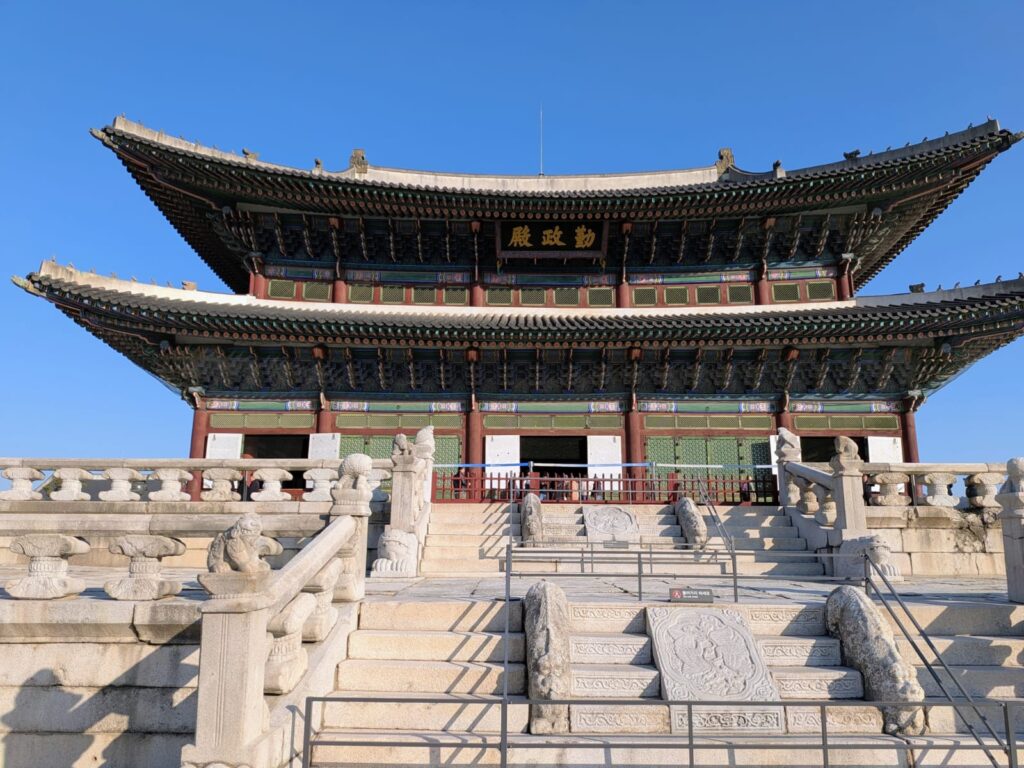
At the northern edge of Seoul, protected by Mount Bugaksan and facing the wide Han River, rises Gyeongbokgung Palace (경복궁) — “The Palace Greatly Blessed by Heaven.” Built in 1395 by King Taejo, the founder of the Joseon dynasty (1392–1897), it was not just a royal residence: it was the cosmic center of a new nation grounded in Confucian philosophy, moral governance, and harmony with nature.
For more than five centuries, the Joseon rulers shaped Korea’s identity through Neo-Confucian philosophy, elevating scholarship, etiquette, and moral discipline above luxury.
Their palaces were designed as moral diagrams rather than monuments to wealth — each gate, courtyard, and hall aligned with heaven’s geometry. Gyeongbokgung became the spiritual and political center of this vision: a city within a city, where architecture embodied virtue.The palace stands on a site chosen through pungsu-jiri, Korea’s interpretation of feng shui.
To the north, Mount Bugaksan protects like a guardian wall; to the south, the Han River carries life and prosperity; to the east rises the Blue Dragon (vitality), to the west the White Tiger (strength).
This balance between mountain and water, shadow and flow, was thought to harmonize the cosmic forces that sustained the realm.Constructed from Korean red pine and granite, the palace reflects quiet strength. Its beams are painted in dancheong — patterns of mineral reds, greens, blues, yellows, and whites — each color with purpose: red for dignity, green for renewal, blue for harmony, yellow for balance, white for purity.
Under morning light, the pigments shimmer like living calligraphy against the grey stone.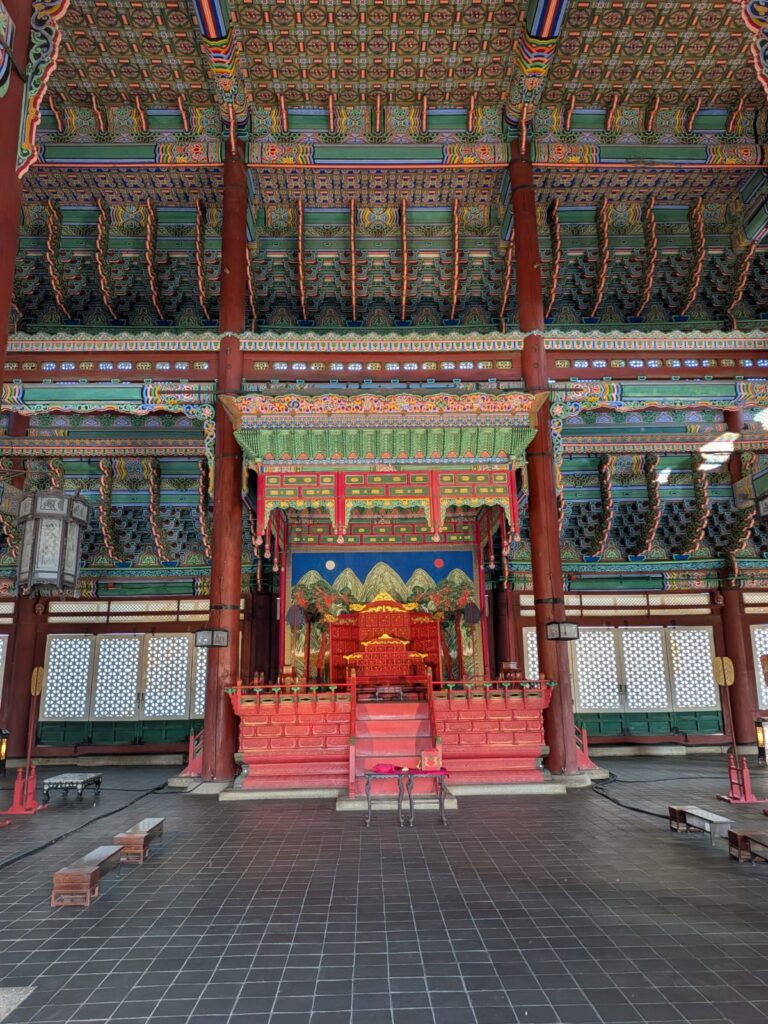
Passing through Gwanghwamun Gate, visitors enter the vast courtyard of Geunjeongjeon Hall, the throne room and first original building of the palace.
The stone pavement is uneven by design — scattering the sun’s glare during ceremonies and reminding all that perfection belongs only to the heavens.
Every axis draws the gaze from earth to mountain, reinforcing the Confucian ideal that the ruler is a bridge between the two.The palace’s tranquility was shattered in 1592, when Japan invaded during the Imjin Wars and burned almost everything to ashes.
It remained in ruins until 1867, when King Gojong ordered its grand reconstruction — more than 400 buildings and 7 000 rooms reborn from stone foundations.
But tragedy returned under Japanese occupation (1910–1945): most halls were again demolished, and the massive Government-General Building was erected before the main gate to dominate Korea’s symbol of sovereignty.
After independence, restoration became an act of national healing. The colonial structure was torn down in 1995, exactly six centuries after Gyeongbokgung’s founding, and the palace slowly reclaimed its horizon.West of the throne hall stands Gyeonghoeru Pavilion (경회루), completed in 1412 under King Taejong — the second major building of the complex and one of the few to survive the centuries.
Built above an artificial pond on 48 granite pillars, it was the stage for royal banquets and receptions. Its reflection doubles in still water, symbolizing the perfect harmony between heaven and earth.Inside, the doors hang from the ceiling, not the floor, lifted or lowered with ropes to control breeze and light — an ingenious design centuries ahead of its time.
When opened, the pavilion dissolves into air and water, its pillars mirrored by rippling lotus leaves; at night, the lanterns transform it into a floating constellation.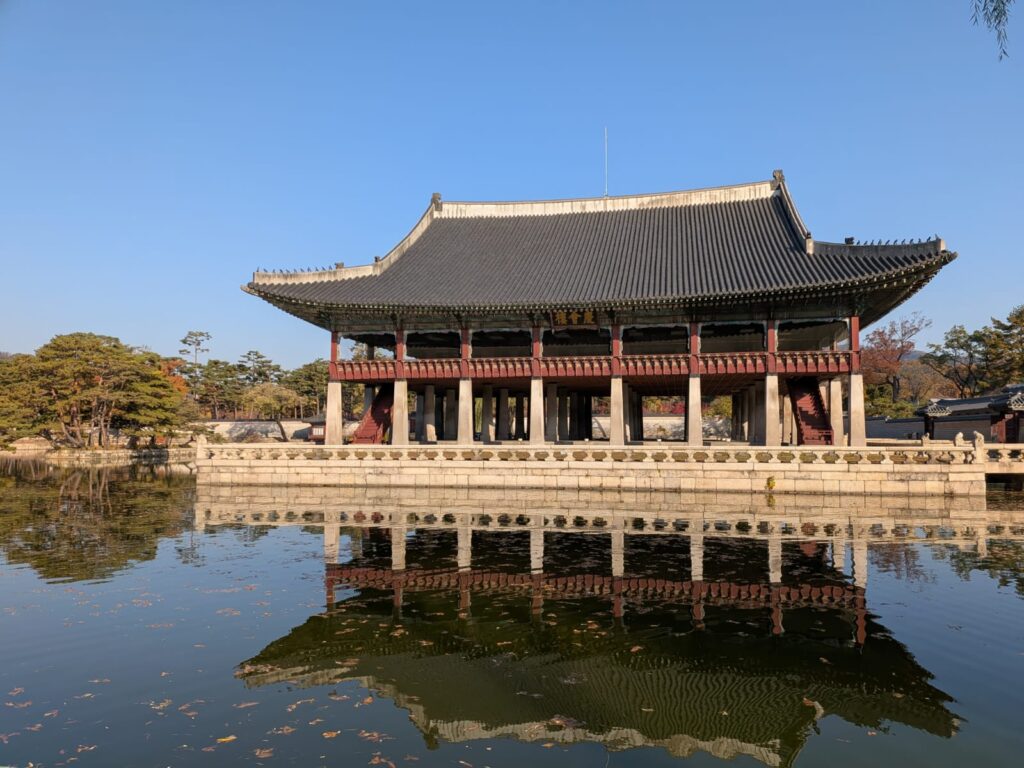
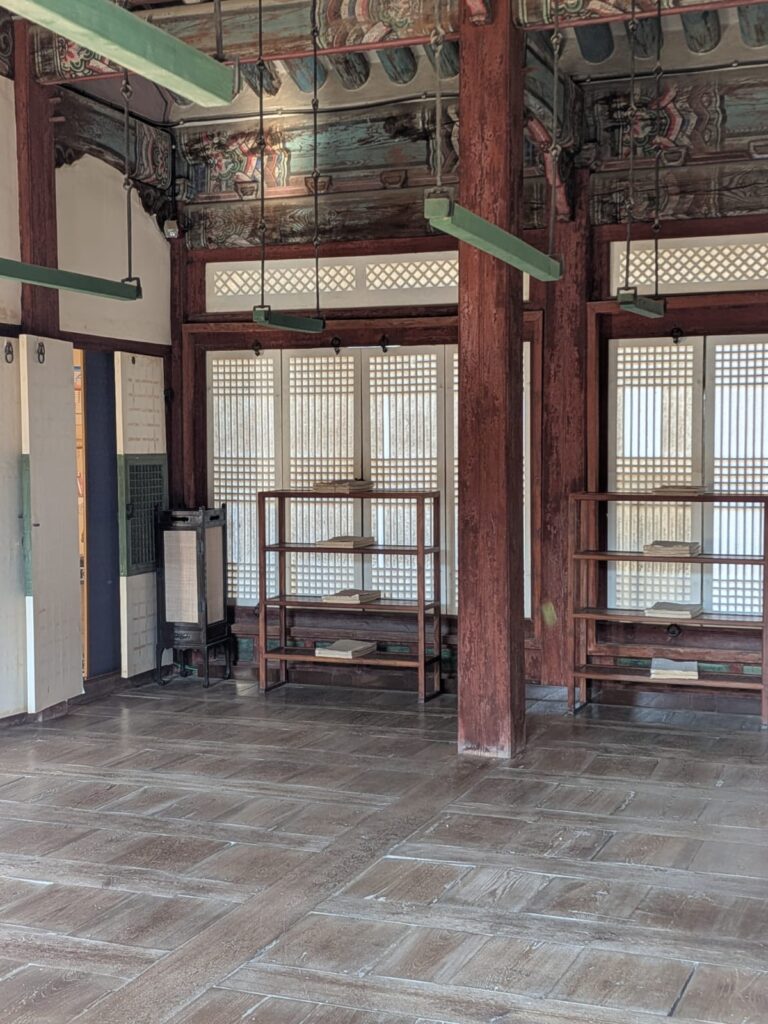
Behind the ceremonial courtyards lies Gangnyeongjeon Hall (강녕전), the king’s living quarters — a faithful reconstruction of the originals.
The residence was divided into three wings for the seasons: a south-facing suite with heated ondol floors for winter, a cool northern wing for summer, and a central set of rooms for spring and autumn.Despite his title, the king lived with almost no privacy. Attendants and scribes surrounded him day and night. His bed was plain wood, his workspace minimal — a writing table, scrolls of the Confucian Classics, and little else.
The ground outside was covered in gravel, so that every footstep produced a crunch, alerting guards to intruders in the night.
Even meals carried symbolism: the king ate with brass chopsticks, believed to change color on contact with poison — a quiet ritual of vigilance.There was no toilet inside the chambers. Instead, the king used a porcelain or brass vessel, which the court physician examined each morning to assess his health.
Afterward, the contents were used to fertilize a small plot within the palace grounds where the “royal rice” was grown — grain imbued, it was said, with the vitality of the sovereign himself.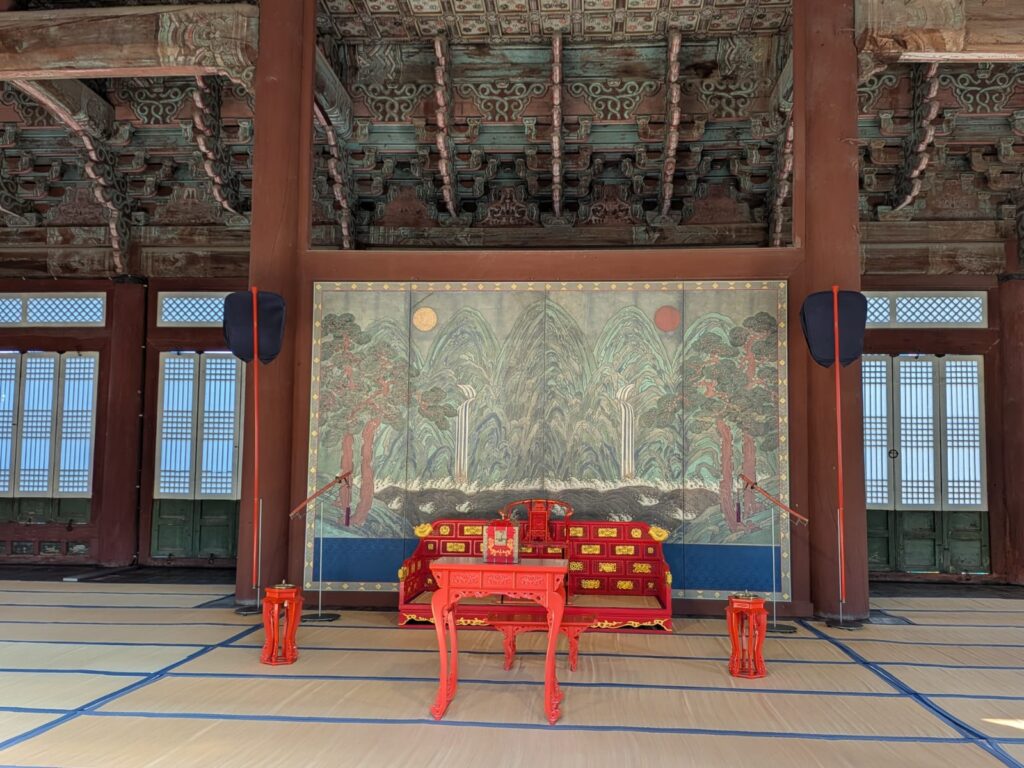
Today, Gyeongbokgung has reawakened.
Every morning and afternoon, the Changing of the Guard ceremony unfolds at Gwanghwamun Gate — soldiers in crimson and cobalt robes march to the beat of great drums, horns echo off granite walls, and banners of phoenix and tiger rise against the skyline.
It is a reconstruction, yet it feels profoundly real — a gesture of continuity, the echo of an empire that measured time in rituals, not clocks.Gyeongbokgung endures as more than a monument. It is a breathing map of Korean history — of balance, discipline, and rebirth.
Walk its uneven stones, listen to the gravel whisper behind the royal chambers, and watch the reflection of the pavilion tremble in the pond.
Here, between mountain and river, Seoul still remembers how to align with the heavens.Dongdaemun Design Plaza — Where Seoul Curves Toward the Future
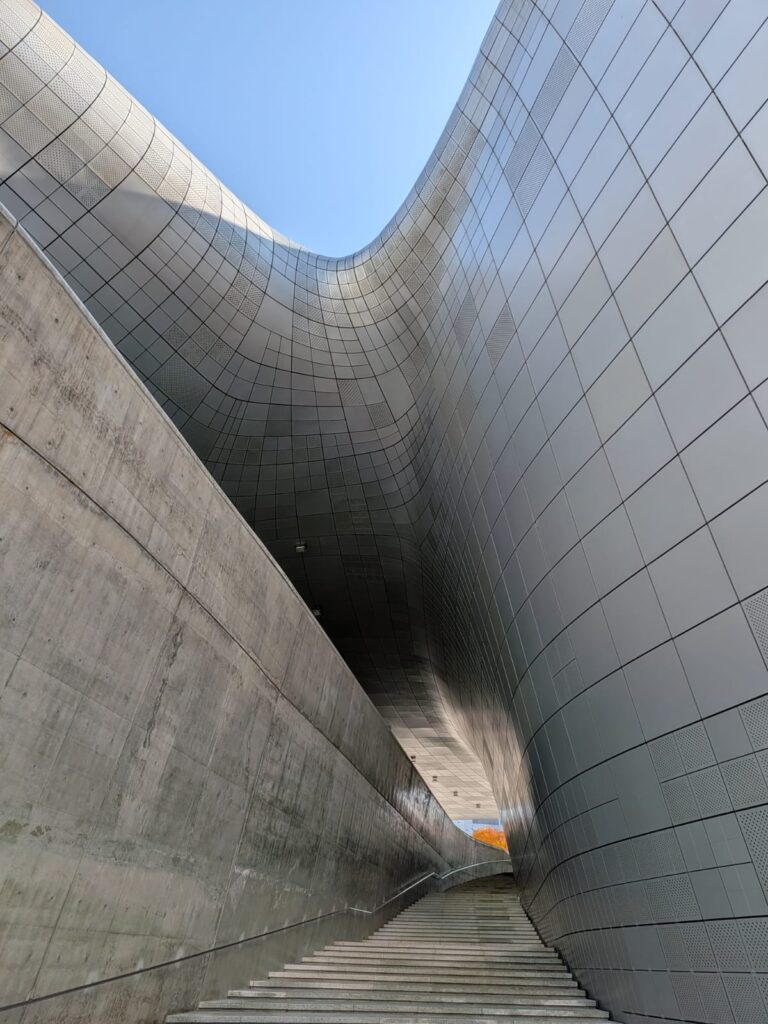
If Gyeongbokgung embodies the symmetry and order of the past, the Dongdaemun Design Plaza (DDP) expresses the pulse of the future.
It stands on sacred historical ground — the former site of Heunginjimun, the “Great East Gate,” one of the four gates that once enclosed the old capital.
For centuries, this was the city’s threshold: merchants, scholars, and travelers entered Seoul through this very point.
Now, the DDP rises in its place like a comet fallen to earth — a seamless fusion of design, memory, and technology.Designed by the late Zaha Hadid, whose visionary curves reshaped contemporary architecture, the DDP was inaugurated in 2014 as Seoul’s new icon of creativity.
Its organic form — fluid, continuous, almost alive — is built from 45,000 unique aluminum panels, each one digitally modeled and fitted using Samsung’s advanced engineering systems.
The result is a metallic skin that bends light like silk, a building that appears to move even when it stands still.Beneath the surface lies another layer of history.
During excavation, workers unearthed long-buried sections of the original Joseon-era fortress wall, fragments of Seoul’s ancient boundary. Instead of covering them, the architects preserved the stones in situ, integrating them into the Dongdaemun History & Culture Park that surrounds the plaza.
Here, the city’s medieval foundations literally support its futuristic architecture — the perfect metaphor for Seoul itself, a place where the past is never erased, only transformed.The DDP also carries more recent ghosts.
During the Japanese colonial period (1910–1945), this very site hosted the Dongdaemun Stadium, where baseball and athletic events were held under occupation.
Those stadiums — symbols of both imported culture and political control — were demolished to make way for the new plaza, turning a site once marked by domination into one dedicated to imagination and art.
Even today, traces of the old stands remain beneath the walkways, a quiet reminder of how deeply history layers itself under every Seoul street.Inside, the building unfolds like a living organism: galleries, design studios, and fluid exhibition spaces connected by gently sloping ramps.
A baseball training area was even installed inside during the building’s early tests — a playful nod to the site’s past and to the precision of its acoustics.
As you move through it, the walls curve without angles, and the light seems to pour rather than shine.At sunset, the DDP becomes a spectacle.
Its aluminum surface reflects the fading sky, shifting from pearl grey to violet, and finally to deep cobalt under the city lights.
Around it, the park glows softly, and the surviving stones of the Joseon wall appear suspended between centuries — the old gate illuminated behind a building that belongs to tomorrow.The Art Hall is the heart of the DDP, a monumental, open space that hosts rotating exhibitions of art, fashion, and technology.
It’s a building designed not just to display creativity, but to be creative — light glides across curved walls like brushstrokes, and shadows themselves become part of the show. Major exhibitions have ranged from avant-garde fashion retrospectives to immersive digital art. The acoustics are so refined that, during construction, engineers famously tested them with a baseball field installed inside — a surreal yet perfectly Seoul-like image, blending play and precision. Walking through, you feel suspended between sculpture and atmosphere: sound softens, reflections bend, and the city outside seems to dissolve into light. Beneath the sweeping exterior lies the Design Lab, the beating heart of the complex. Here, designers, startups, and students share workspaces where ideas move faster than daylight.
The building’s open-plan concept encourages collaboration — 3D printers hum beside hand-drawn sketches, and exhibition booths transform daily into new experiments of Korean creativity. Next to it, the Design Market operates almost 24 hours a day, a luminous bazaar of books, crafts, home décor, and concept products. It’s half gallery, half night market — the perfect place to feel the city’s nocturnal energy.
From here, you can step directly into the world of Seoul’s young creators: graphic designers, ceramic artists, and architects who treat the DDP as both workplace and muse.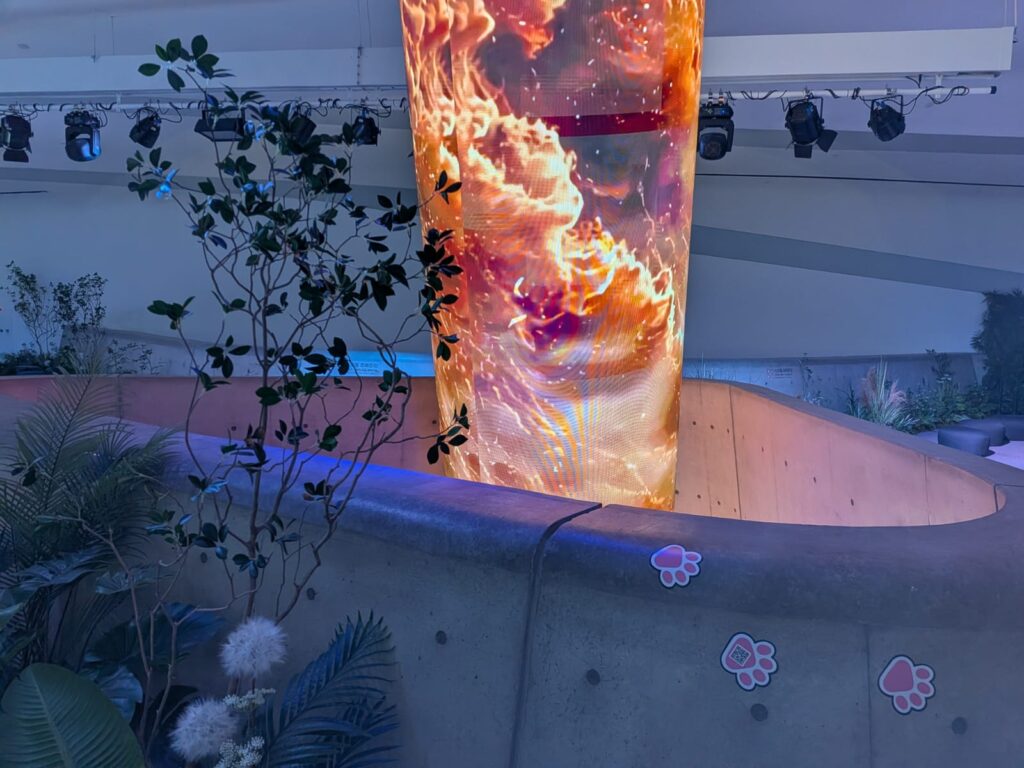
When construction began, archaeologists discovered remnants of the original Joseon-era fortress wall buried under the site. Instead of removing them, the architects wove them into the new complex — a gesture of profound respect.
Walking through the Dongdaemun History & Culture Park, you see centuries overlap: granite stones from the 15th century resting under LED lights, fragments of the old city walls displayed beside the glass façade of Hadid’s design. This ground carries deeper echoes.
During the Japanese colonial period (1910–1945), the same site was home to Dongdaemun Stadium, where baseball and athletic competitions took place under occupation.
The stadium was later demolished to make way for the DDP, turning a place once tied to domination into one of imagination — from control to creativity.
A few traces of the old stands remain, like quiet fossils under the plaza’s modern walkways.Bukchon Hanok Village — Time Suspended Among Wooden Roofs
From the futuristic shimmer of Dongdaemun, the path winds back toward stillness — to Bukchon Hanok Village, where Seoul slows down and exhales.
Perched on a hill between Gyeongbokgung Palace and Changdeokgung Palace, Bukchon is a labyrinth of narrow alleys lined with hanok — traditional Korean houses built in wood, clay, and stone. Their curved tiled roofs rise and fall like waves frozen in time, a landscape that feels more like memory than city.The name Bukchon means “Northern Village”, and for six centuries this has been home to Seoul’s nobility: high-ranking scholars, ministers, and courtiers of the Joseon dynasty.
Unlike the reconstructed palace or the futuristic plaza, Bukchon is alive and inhabited — a real neighborhood where residents hang laundry under eaves carved centuries ago, and the scent of pine mingles with the sound of schoolchildren’s footsteps on stone.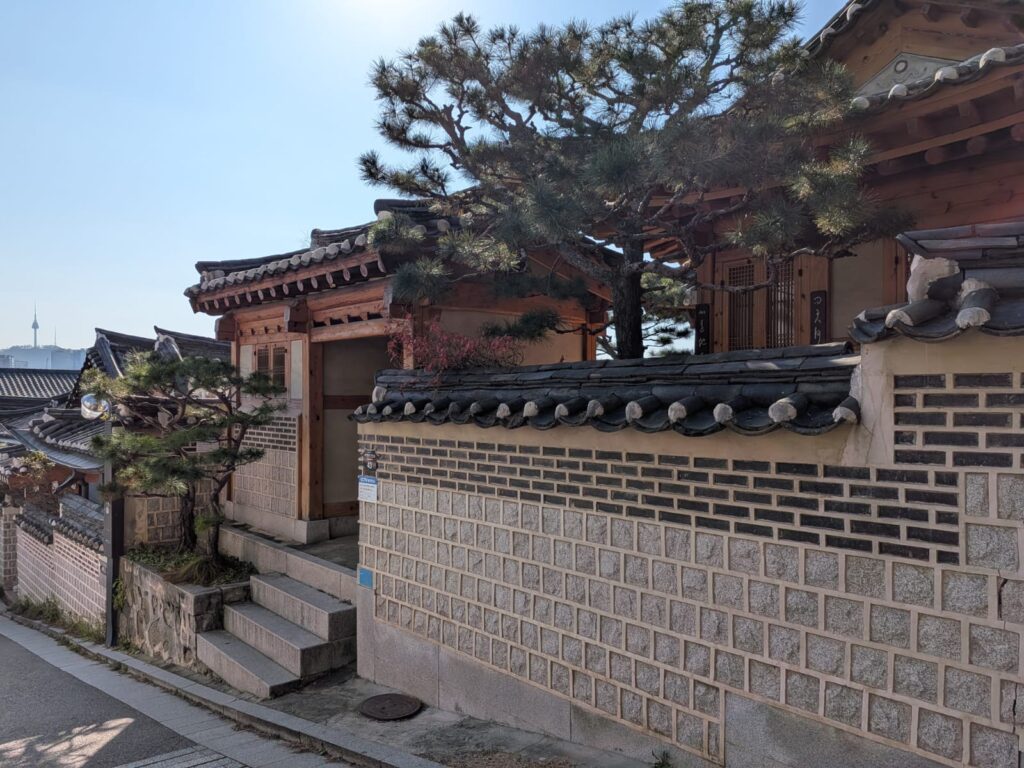
Each hanok follows the principles of pungsu-jiri, the same geomantic harmony that shaped the royal palaces.
Wooden beams breathe with the seasons; heated ondol floors warm the interiors in winter; open courtyards catch breezes in summer.
From certain alleys, the tiled roofs frame the skyline — a surreal blend of past and present, with the spires of modern Seoul rising gently beyond the ancient ridges.Inside some of the preserved houses, visitors can glimpse fragments of daily life: calligraphy brushes laid beside rice-paper windows, lacquer bowls glinting in soft light, a quiet rhythm of tea being poured.
Many hanok now host craft studios, galleries, and tea houses, allowing guests to step inside without disturbing the families who still live next door.
The experience is deeply tactile — the scent of warm wood, the echo of your steps on uneven stones, the faint hum of a fan behind a paper door.Bukchon is also a place of silence and respect.
Signs gently remind visitors to whisper, as most homes remain private dwellings. The balance here is delicate — beauty coexisting with the ordinary.
Even the air feels slower, as if the city itself pauses in reverence.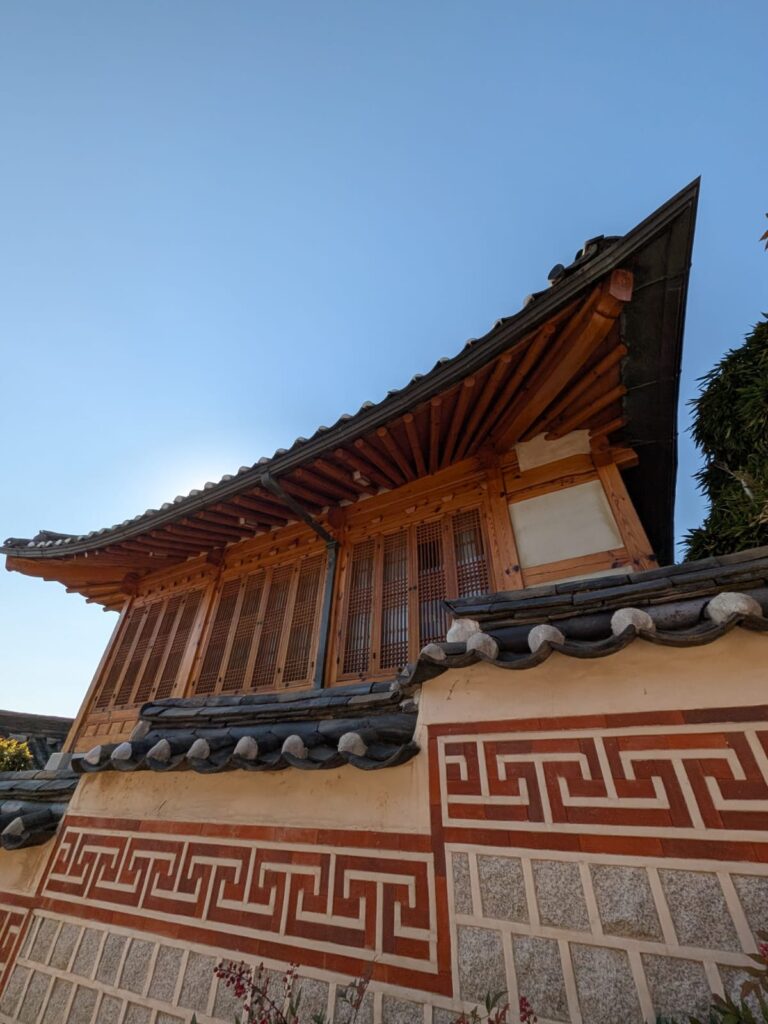
Gangnam — The Pulse of Modern Seoul
As daylight fades, the city crosses the river — literally.
South of the Han, Seoul becomes a different world: glass towers replace tiled roofs, traffic hums like electricity, and neon veins light up the skyline.
This is Gangnam (강남, “south of the river”) — a symbol of South Korea’s transformation from post-war austerity to global modernity.In just a few decades, Gangnam evolved from farmland into one of the most futuristic cityscapes in Asia.
Wide boulevards lined with flagship stores and tech headquarters announce the ambitions of a nation that rebuilt itself not just quickly, but brilliantly.
It’s a district where fortune, fashion, and innovation converge — and yet, beneath the surface, you can still feel the same Confucian rhythm that ordered Gyeongbokgung: precision, discipline, and an obsession with harmony, now translated into glass, steel, and data.The streets around Gangnam Station pulse with energy — commuters, students, and travelers moving in every direction, screens glowing like lanterns.
Cafés spill onto sidewalks, K-pop beats echo from every corner, and digital billboards flash faces more famous than kings.
This is the Seoul of now — endlessly connected, eternally awake.A short walk from the main avenue, COEX Mall stretches like a city beneath the city: a maze of restaurants, boutiques, art spaces, and the iconic Starfield Library, where thousands of books climb toward a ceiling of light.
Nearby, the SMTOWN complex celebrates the country’s pop culture empire, while sleek electric cars glide silently along the broad avenues.
Even the crosswalks here seem choreographed — the choreography of a city that’s always performing itself.But Gangnam is not all noise and glass.
Step a few streets away and you find quiet alleys lined with minimalist cafés, boutique design studios, and rooftop bars where the skyline reflects in every window.
From there, you can look north across the river — toward Gyeongbokgung, Bukchon, and the mountains beyond — and realize that Seoul is not two cities, but one story told in two directions:
the past written in wood and stone; the future in light and motion.