-
New Orleans
October 11, 2026 /Creole Food, Classic Cocktails and Traditional Jazz
We came to New Orleans for work. The American Academy of Ophthalmology held its annual meeting at the Convention Center on the riverfront, and between talks, a poster and a reception there wasn’t much room left for the Garden District, the streetcar or the WWII Museum. Those will have to wait for a second trip.
So we made a choice: if we only had a few free hours, we’d spend them on the three things this city does better than almost anywhere else. Creole cooking, cocktails that were invented here, and jazz played the way it was played a hundred years ago.
This isn’t a day-by-day itinerary. It’s four places, each one worth planning a trip around.
Food: Dooky Chase's, Tremé
Dooky Chase’s sits on Orleans Avenue in Tremé, a short cab ride from the French Quarter, and from the outside you’d never guess its history. Emily and Edgar “Dooky” Chase Sr. opened it in 1941, after starting out with a sandwich shop that also sold lottery tickets. It became a real restaurant thanks to their son, a jazz musician, and above all to his wife Leah.
Leah Chase cooked here for more than seventy years and came to be known as the Queen of Creole Cuisine. She died in 2019 at 96, and the family still runs the place with her recipes.
In the years of segregation this was one of the very few places in the South where Black and white people could sit at the same table. Civil rights activists met upstairs to plan their campaigns, and the lawyers who fought desegregation in court, Thurgood Marshall and A.P. Tureaud among them, ate the same fried chicken you’ll be served today. Later came presidents (George W. Bush and Barack Obama both stopped here), writers and musicians. Look at the walls while you wait: the red dining rooms hold one of the most important private collections of African American art in the city, which Leah started collecting herself.
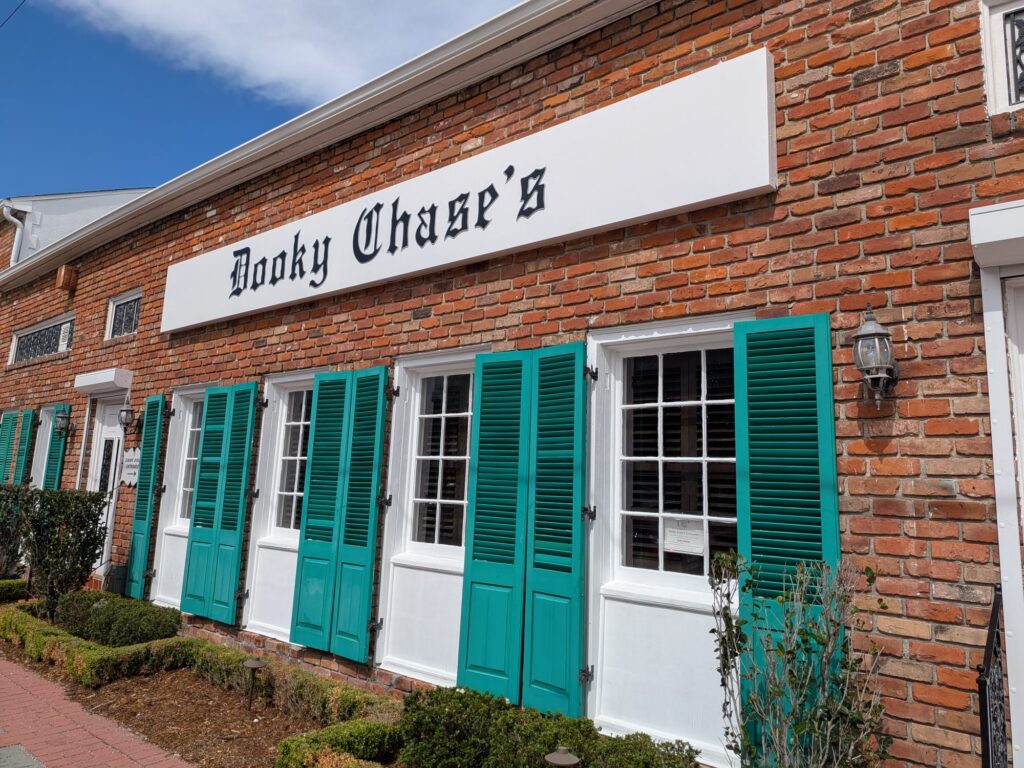
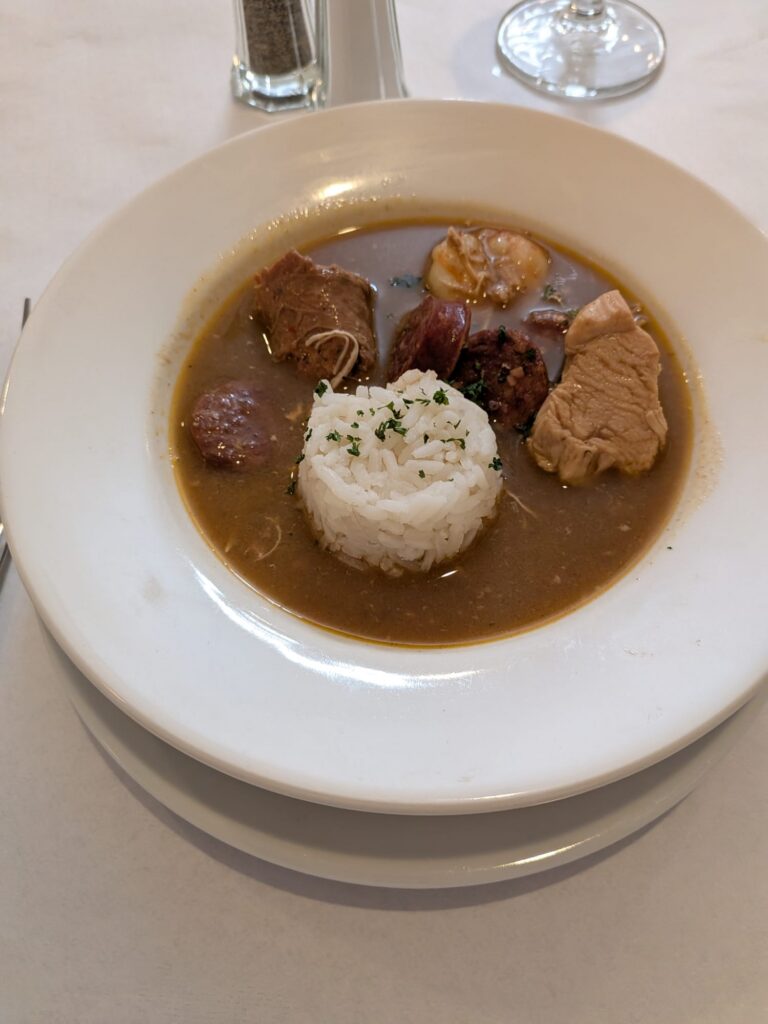
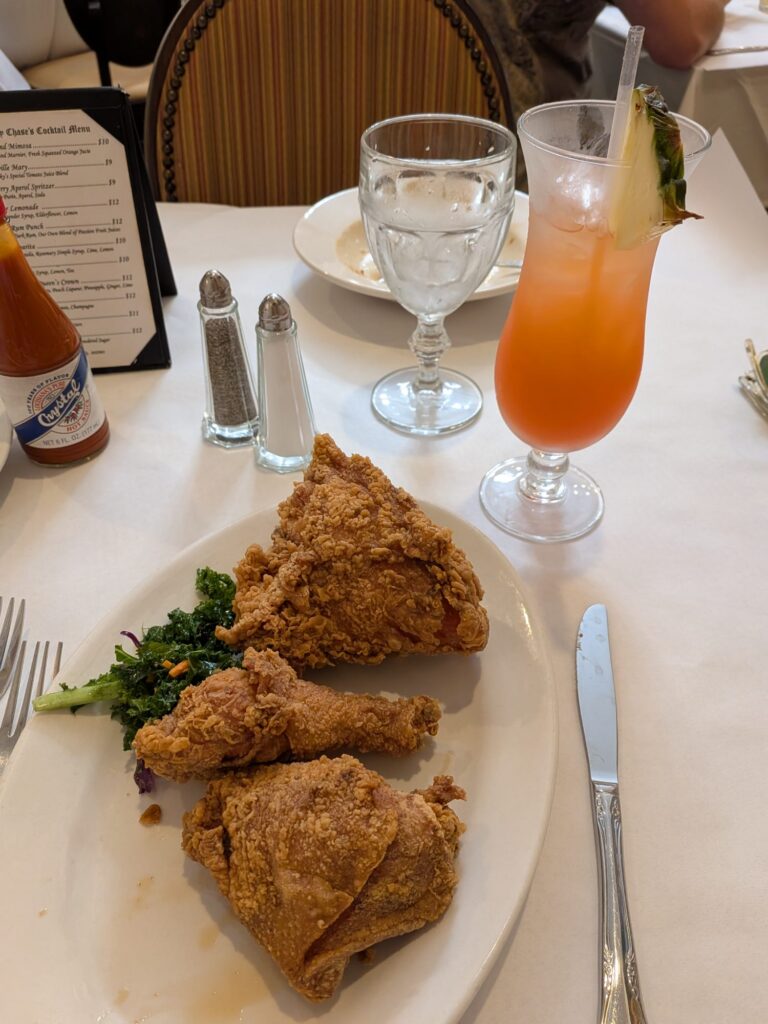
The room still feels formal, with white tablecloths and a dress code, but the food is home cooking at its best. What to order:
- Creole gumbo. Get a cup rather than a bowl, you’ll need the space.
- Fried chicken. The dish the place is famous for. The smart move is Red Beans & Rice, which comes with two pieces of chicken, so you get both classics on one plate.
- Shrimp Clemenceau. Shrimp sautéed in garlic butter with peas, potatoes and mushrooms. It’s the most “Leah Chase” dish on the menu, and perfect for sharing.
- Sides and dessert. Candied sweet potatoes or mustard greens, then praline bread pudding or peach cobbler.
Lunch runs Tuesday to Friday from 11 to 3, with dinner only on Fridays and Saturdays. Book ahead: without a reservation you may not get a table.
Drinks: the Sazerac Bar at the Roosevelt
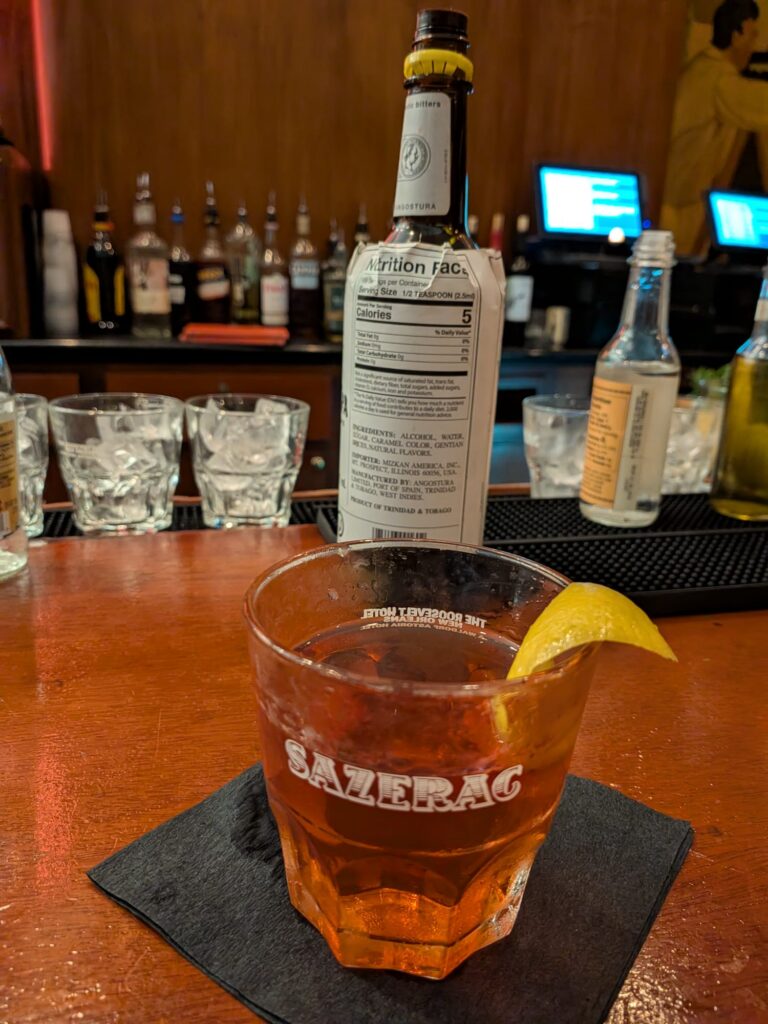
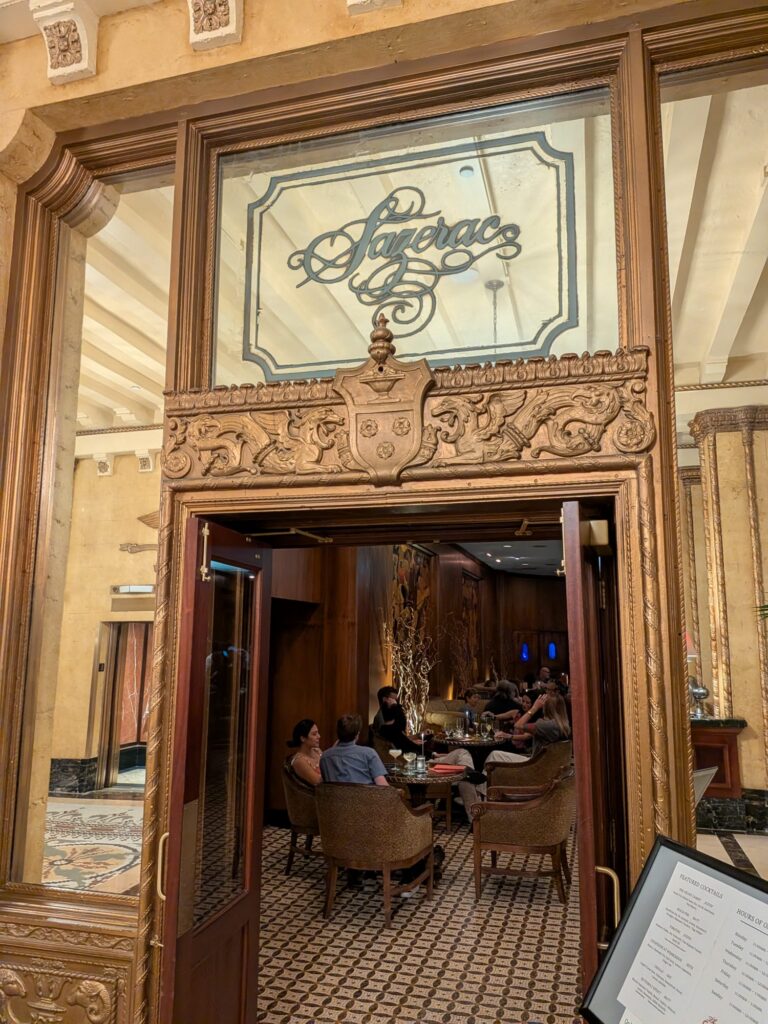
New Orleans has a fair claim to being the city where the American cocktail grew up, and the best place to start is the Sazerac Bar inside the Roosevelt Hotel. It’s a long, dark room with a walnut bar, art deco murals and bartenders in white jackets. It feels like 1940, and that’s the point.
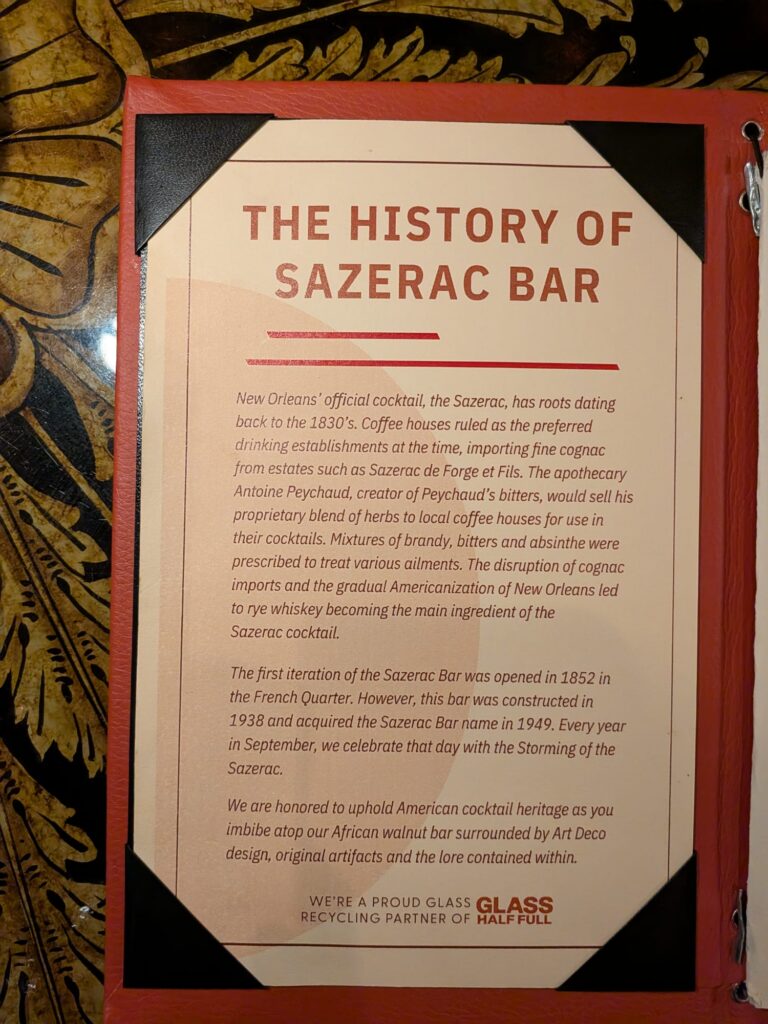
The drink that gives the bar its name goes back to the 1830s and to Antoine Peychaud, a Creole apothecary in the French Quarter who made his own bitters and mixed them with cognac for his customers. When phylloxera wiped out French vineyards later in the century, cognac became hard to find and bartenders switched to American rye. What you get today is rye, sugar and Peychaud’s bitters, stirred and served in a glass rinsed with absinthe (or Herbsaint, the local anise liqueur), with a lemon peel twisted over the top and then thrown away. Louisiana made it the official cocktail of New Orleans in 2008.
Order the second classic too. The Ramos Gin Fizz was invented in 1888 by Henry C. Ramos: gin, citrus, cream, egg white and orange flower water, shaken for so long that the bar used to employ a line of young men doing nothing but shaking. It comes out cloud-white and foamy, closer to a dessert than a cocktail. The story goes that Governor Huey Long loved it so much he flew a Roosevelt bartender to New York to teach the staff of his hotel there how to make it.
One more piece of history: until 1949 the bar was for men only. Women were allowed in just one day a year, Mardi Gras, until the day in September 1949 when a group of them simply walked in and sat down. New Orleans still calls it the storming of the Sazerac.
No reservations here. On a Friday evening the room fills up from about 6, so come at 5:30 if you want a seat at the bar.
Drinks: the French 75 Bar at Arnaud's
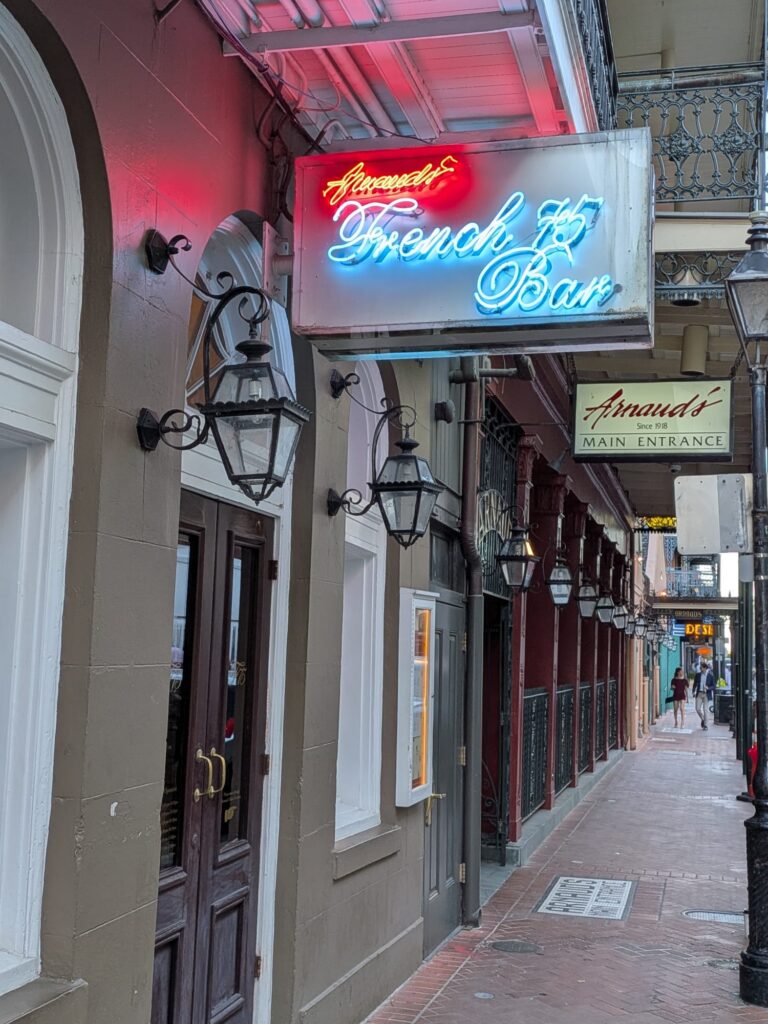
A few blocks away, on Bienville Street, the French 75 Bar is the front room of Arnaud’s, one of the grand old Creole restaurants of the Quarter. A Frenchman known as “Count” Arnaud Cazenave opened the restaurant in 1918, and the bar still looks the part: dark wood, a mosaic tile floor, small round tables and a lot of brass.
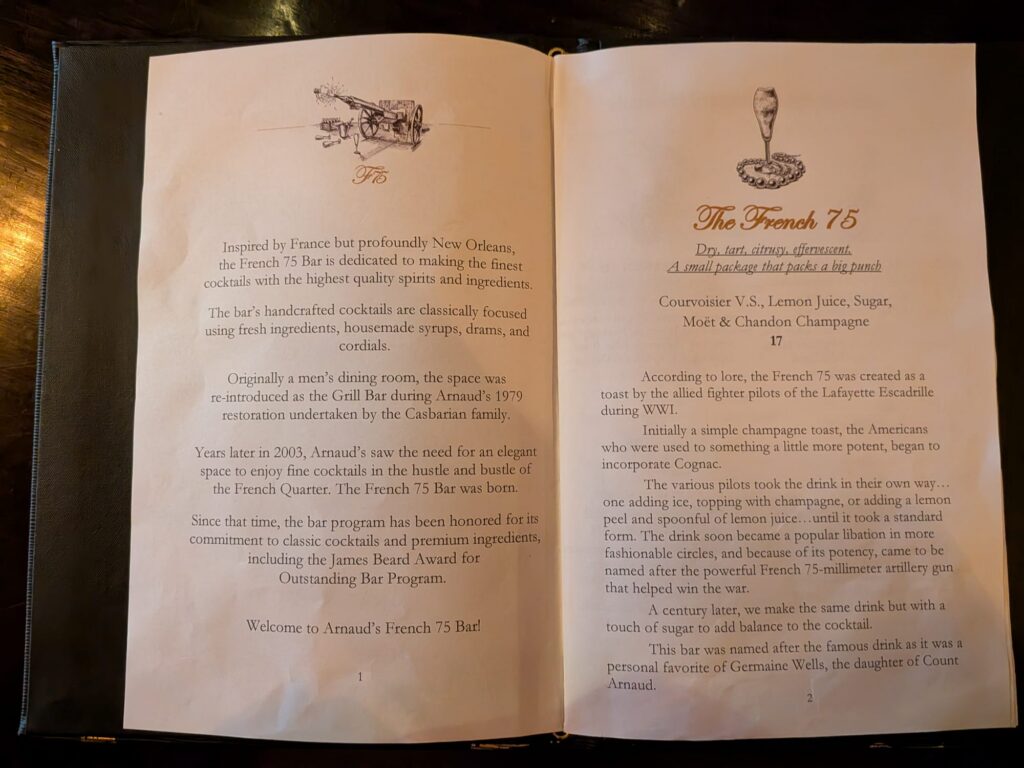
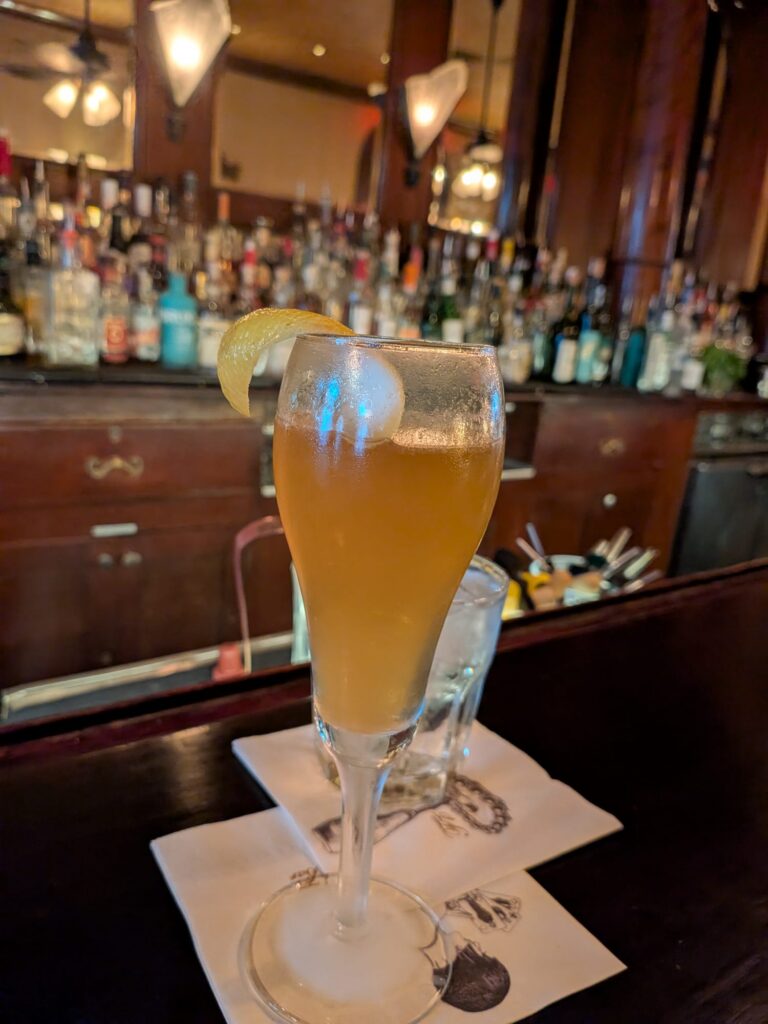
The drink is named after the French army’s 75 mm field gun of the First World War, supposedly because it hits you with about the same force. Most bars around the world make it with gin. Here it’s made with cognac, plus lemon, a little sugar and Champagne, and the result is rounder and warmer than the version you probably know. Order that first.
The bartenders are serious about the classics, so for a second round ask for a Brandy Crusta or a Vieux Carré, two more drinks born in New Orleans.
Don’t leave without the soufflé potatoes. They come from Arnaud’s kitchen: thin slices of potato fried twice until they puff up like little hollow pillows, served with béarnaise for dipping. It’s a dish you’ll find in very few places outside this city, and it goes perfectly with a glass of bubbles.
The bar opens at 5:30 in the afternoon. It’s small, which is part of the charm, so earlier is better.
Music: Preservation Hall
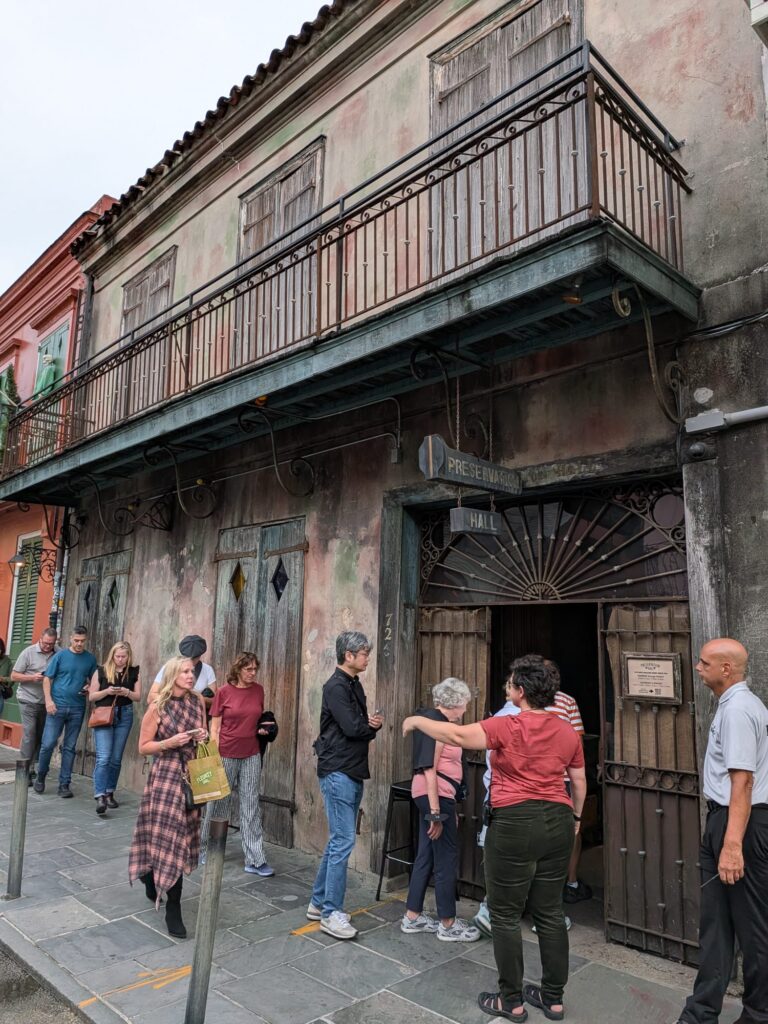
If Bourbon Street is what you picture when you think of New Orleans music, walk one block over to St. Peter Street and look for a weathered building with a wrought-iron gate and no sign worth mentioning. That’s Preservation Hall.
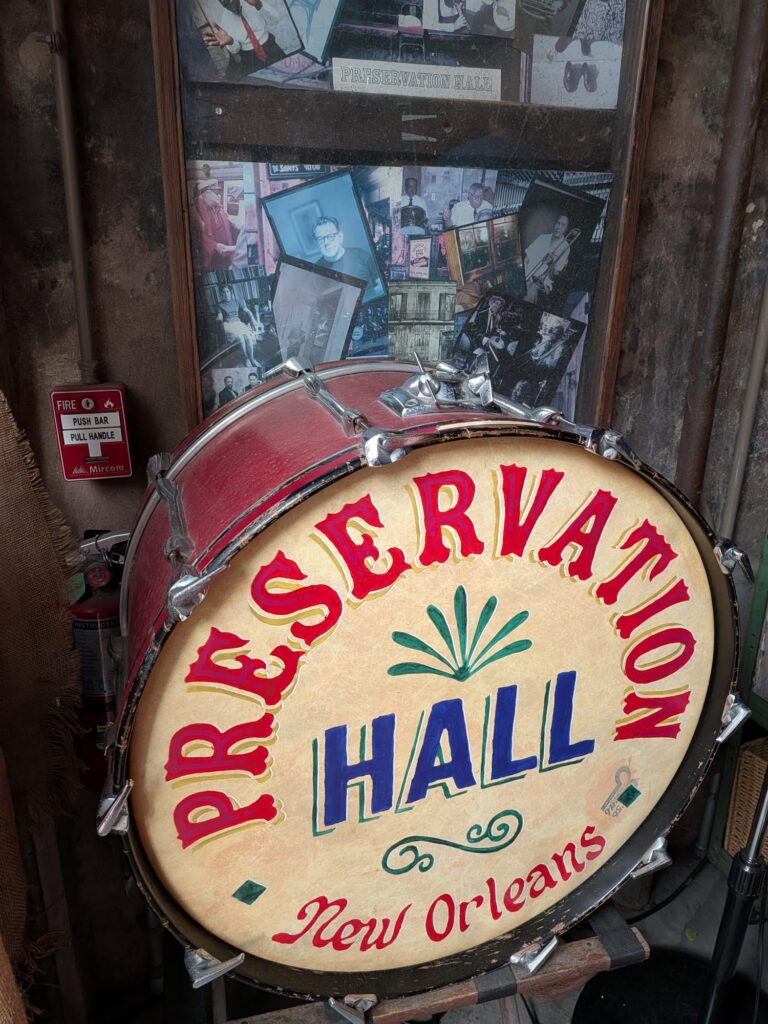
It opened in 1961, when traditional New Orleans jazz was disappearing. Rock and roll had taken over and the old musicians who had played in the brass bands and dance halls of the 1920s had nowhere left to play. Allan and Sandra Jaffe, a young couple who had come to town for the music, turned this room into a place where those musicians could perform every night. The name says it all: the point was to preserve something before it was gone. More than sixty years later the Hall is still run by the Jaffe family, and the musicians on stage today learned from the ones who played here before them.
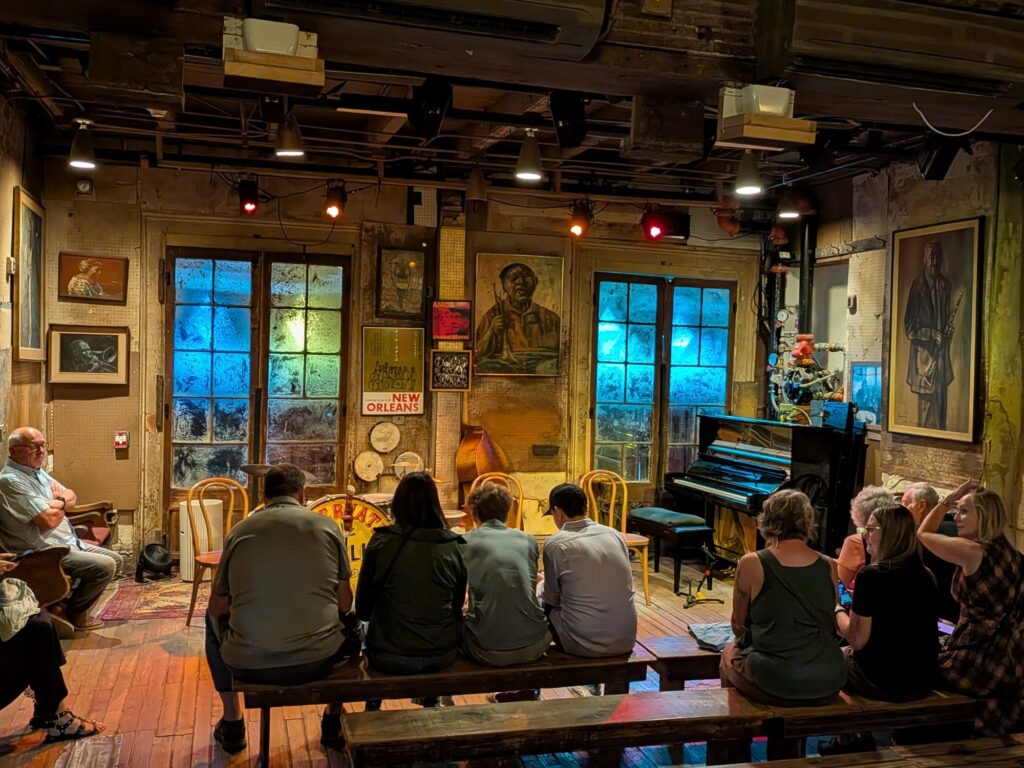
The room is tiny and almost bare. A few rows of wooden benches, some cushions on the floor, people standing at the back, and the band a few feet from your knees. No bar, no air conditioning worth the name, no phones allowed during the set. A show lasts about 45 minutes and it goes by in what feels like ten.
There’s no amplification, so you hear the trumpet, the clarinet and the trombone exactly as they sound, and you can watch the players pass the melody between them. When the band gets going and the whole room starts clapping on the off-beat, you understand why this music was born to be heard live and up close.
There are several sets every evening (5:00, 6:15, 7:30 and 8:45 when we went). Buy tickets online in advance: the bench seats go first, and on busy nights the standing room sells out too.
Before you go
All four places are within a few minutes of each other, except Dooky Chase’s, which is about ten minutes by cab from the Quarter. Three things are worth booking before you land: a table at Dooky Chase’s, tickets for Preservation Hall, and, if you have a Sunday, a jazz brunch at one of the old Creole houses (Commander’s Palace sells out well in advance; Arnaud’s is a good fallback).
What we missed and want for next time: the St. Charles streetcar through the Garden District, a long lunch at Commander’s Palace, and an evening on Frenchmen Street hopping between the small jazz clubs.
-
Vienna
October 3, 2026 /Gustav Klimt was born in Vienna on 14 July 1862, in the village of Baumgarten, the son of a gold engraver. He studied here, became famous here, scandalised the city here, and died here in February 1918. He is buried here too. So Vienna is not a place where you go to see “some Klimt”: it is the whole story, spread across a dozen buildings, from the ceilings of the Burgtheater to a garden studio on the western edge of the city.
The problem is that the story is scattered. The Kiss is in one palace, the Beethoven Frieze in a basement under a golden dome, his most controversial paintings no longer exist at all, and his last studio is a U-Bahn ride out of town. We came back to Vienna more than once (July 2015, then September 2018) and every trip added a piece.
This itinerary puts the pieces in order. Day 1 is the young Klimt and the revolt of the Secession, Day 2 is the golden period and the scandal of the University paintings, Day 3 is the last years in Hietzing. Three days is comfortable. Two are enough if you skip a couple of the minor stops (more on that at the end).
Day 1 - The Ring and the Secession
Before he was the painter of gold and kisses, Klimt was a decorator. In 1883 he founded the Company of Artists with his brother Ernst and their friend Franz Matsch, and for ten years the three of them painted ceilings and staircases for the new buildings going up along the Ring. Then, in 1897, Gustav walked out of the official art establishment and founded the Secession. Day 1 covers both Klimts, and it is all walkable
Kunsthistorisches Museum
Start where nobody looks for Klimt. The art history museum is famous for its Bruegels and Titians, but climb the main staircase and look up, between the columns. The paintings in the spandrels and between the columns were done in 1890-91 by the same trio, each panel standing for an era of art history. Klimt’s are the ones that already look strange: the Egyptian girl holding an ankh, the Greek girl from Tanagra, the Florentine Quattrocento figures. They are academic, but the faces are already his.
They are high up and hard to see. Sometimes the museum builds a temporary platform or puts a scope on the landing so you can get close, so it’s worth asking at the entrance.
Leopold Museum
Cross the Ring to the MuseumsQuartier. The Leopold is known for Schiele, but its Vienna 1900 exhibition has a whole Klimt section, with a reconstruction of his studio and a small room on Emilie Flöge, his lifelong companion.
The painting to stand in front of is Death and Life (1910-11). On the left, Death in a robe covered with black crosses, holding a club. On the right, a heap of sleeping bodies: a baby, a mother, lovers, a grandmother, wrapped in flowered fabric. Klimt kept working on it for years and repainted the background, which was originally gold, in the dark grey-blue you see now. Notice that everyone on the right is asleep, eyes closed, except one woman who is awake and staring. Nobody on that side is looking at Death.
Until October 2026 there are also two landscapes on loan from the Kamm collection, Italian Garden Landscape (1913) and Garden Landscape with Hilltop (1916). If you are reading this later, they will probably be gone.
Casa Piccola
Walk out of the MQ onto Mariahilfer Straße. At number 1a, above the café on the corner, Emilie Flöge and her sisters ran their fashion salon, Schwestern Flöge, from 1904 to 1938. Klimt and Kolo Moser are said to have designed the interiors, and Klimt drew dresses for it. There is nothing to visit, only a plaque on the wall, but it is two minutes from the museum and it is the only place in Vienna where Emilie is the protagonist.
The Secession
Ten minutes on foot and you are in front of the building that started everything. Joseph Maria Olbrich designed it in 1897-98 for the new association, with Klimt as its first president, and topped it with a dome of gilded laurel leaves that the Viennese immediately nicknamed “the golden cabbage”. Above the door: Der Zeit ihre Kunst, der Kunst ihre Freiheit (to every age its art, to art its freedom).
Upstairs is contemporary art. Go downstairs. The Beethoven Frieze was painted for the 14th Secession exhibition in 1902, built around a statue of Beethoven by Max Klinger, and it runs about 34 metres around three walls of the room. It was meant to be thrown away when the show closed. It survived because a collector bought it and cut it into sections, the Austrian state acquired it in 1973, and after a long restoration it has been back here since 1986.
Read it left to right, like a story. On the first wall, humanity’s longing for happiness and a knight in golden armour setting out to fight for it. On the end wall, the hostile forces: the giant Typhoeus as a huge ape, the Gorgons, Lust, Unchastity and Excess, and gnawing grief. On the last wall, poetry, the arts, and finally a choir of angels and an embracing couple, “this kiss to the whole world” from Schiller’s Ode to Joy. Put the fourth movement of the Ninth in your headphones before you walk in. It sounds cheesy and it works.
Café Museum
Around the corner on Operngasse, the café Adolf Loos designed in 1899. It was so plain for its time that people called it Café Nihilismus, and it became a hangout for the Secession crowd. Have a Melange and a slice of cake and sit down for a while, you have been standing all day.
Burgtheater
This is where the Company of Artists made its name. Between 1886 and 1888 the three painted the ceilings over the two grand staircases of the new theatre, a history of drama from Dionysus to Shakespeare, and the Emperor gave Klimt the Golden Cross of Merit for it. Look for the scene in the Globe Theatre in London: Klimt painted himself into the audience, next to his brother Ernst and Matsch. It is the only known self-portrait of a man who otherwise refused to paint himself.
You don’t need to see a play to get in, the staircases are part of the guided tour. Check the tour times when you plan the day and slot it in where it fits; in the evening, a play is the other way in.
Day 2 - The Belvedere and the lost paintings
Today is gold, and scandal. Book the first time slot at the Upper Belvedere online the day before: by mid-morning the room with The Kiss is a wall of phones.
Upper Belvedere
The Belvedere was built in the early 1700s as the summer palace of Prince Eugene of Savoy, two palaces facing each other across a long terraced garden. Today it holds the largest Klimt collection in the world. Most of it is on the first floor.
Don’t run straight to The Kiss. Start with Portrait of a Woman (1893-94), in room NO1 on the east side: a young woman in a black evening gown, standing next to a carpet hung on the wall, painted so precisely that it looks like a photograph (and Klimt probably did work from one). She was a friend of Emilie Flöge, and this is Klimt’s first society portrait. Keep her in mind, because ten years later he painted women completely differently.
Judith I (1901) is the proof. Judith looks out with half-closed eyes and parted lips, gold around her neck and behind her, and you almost miss the severed head of Holofernes at the bottom right edge of the canvas. Look at the frame too: the embossed copper with JUDITH UND HOLOFERNES was made by his brother Georg, a metal engraver.
Then Fritza Riedler (1906), seated in a cloud of white ruffles against a red wall, with a mosaic window behind her head that works like a headdress (art historians link it to the hair of Velázquez’s infantas). And finally The Kiss (1907-08), which the Austrian state bought at the 1908 Kunstschau exhibition before the paint had a chance to get famous. It is bigger than you expect, almost 1.8 metres per side. Get close enough to see that the man’s robe is all black and white rectangles and the woman’s is all circles and flowers. Then look at her feet, curled over the edge of the meadow, right where it ends.
On the way out, find the Portrait of Johanna Staude (1917-18): orange background, a blue patterned jacket, a black fur collar. It was still unfinished when he died in February 1918.
Lower Belvedere: Pigment & Pixel
Walk down through the garden (the view back up to the palace is the photo everyone takes, and so did we) to the Lower Belvedere. Until 10 January 2027 it hosts Gustav Klimt – Pigment & Pixel, and it is the reason this itinerary is worth doing this year.
The story behind it is the biggest scandal of Klimt’s life. In 1894 the University of Vienna commissioned three huge ceiling paintings for its Great Hall: Philosophy, Medicine and Jurisprudence. The university expected allegories of reason defeating darkness. Klimt delivered a column of naked bodies drifting through space, a river of the sick and the dying with Death floating among them, and a condemned old man wrapped in the tentacles of an octopus, watched by three Furies. Professors signed petitions against Philosophy, Medicine was debated in Parliament, and in 1905 Klimt gave back the money and took the paintings home. In May 1945 all three burned in the fire at Schloss Immendorf, where they had been stored during the war.
All that survived were black-and-white photographs, plus one colour photo of Hygieia, the goddess of health in red and gold who stands at the bottom of Medicine with a snake around her arm. When we saw them in 2018 that was all there was: grey reproductions with a single red figure. Now the Belvedere and Google Arts & Culture have used AI to reconstruct the original colours, and you can see the three paintings in colour, at full size, arranged on a ceiling the way they were meant to hang.
Wien Museum and Karlsplatz
From the Belvedere it is ten minutes on foot to Karlsplatz. Before you go in, look at the two little green-and-white pavilions on the square: Otto Wagner designed them in 1898-99 as stations for the city railway, and they are as much a part of Vienna 1900 as anything in the museum.
The Wien Museum reopened in late 2023 after a long renovation, and its permanent exhibition on the history of the city is free. The fin de siècle rooms have two Klimts you won’t see anywhere else: Pallas Athene (1898), square, with a golden helmet and a tiny naked Truth in her hand, and the 1902 portrait of Emilie Flöge, in a long blue dress covered with spirals. Next to them there is a replica of the long smock Klimt wore to paint in his last years.
If you still have energy...
Three smaller stops, all near the centre. The MAK has Klimt’s 1910-11 design drawings for the mosaic frieze of the Palais Stoclet in Brussels, the Tree of Life in its working version. The Theatermuseum, in Palais Lobkowitz, has Nuda Veritas (1899) in a small room of its own, unless it is out on loan. The Heidi Horten Collection, behind the Albertina, opens its permanent display with Church in Unterach on the Attersee, one of his lake landscapes.
Day 3 - Hietzing, the last studio
The last day leaves the centre. Take the U4 west to Unter St. Veit, in the 13th district, where the city turns into villas and gardens. One thing to check before you plan this day: the Klimt Villa opens only Thursday to Sunday, 10:00 to 18:00.
Klimt Villa
At Feldmühlgasse 11, in 1911, Klimt rented a small single-storey garden house and turned it into his studio. He worked here until his death: Adele Bloch-Bauer II, Lady with Fan and the portrait of Friederike Beer were all painted in these rooms. In 1923 the new owners built a neo-Baroque villa on top of the garden house, which is the only reason the studio survived. Today it has been restored with the furniture as it appears in old photographs, and it hosts Klimt Lost, a permanent exhibition on the works that were stolen, destroyed or are still missing.
There are no great original paintings here. Come for the place itself: the light from the windows, the size of the room, the garden where his roses grew. It is the most personal stop of the three days.
One of the most famous photos of this studio, by Moriz Nähr, shows two canvases on easels: Lady with Fan and The Bride, Klimt’s last allegory, left unfinished. We saw The Bride in 2018. It belongs to the Klimt Foundation and has been on long-term loan to the Belvedere, but it moves around, so check where it hangs before you go: it is worth seeing after you have stood in the room where it was painted. Half of it is finished in colour and half is still a pencil sketch, so you can see how Klimt drew his figures nude first and “dressed” them in pattern afterwards.
Hietzing Cemetery
Klimt had a stroke at his home on Westbahnstraße on 11 January 1918, caught pneumonia in hospital, and died on 6 February at the General Hospital on Alser Straße. He was 55. He is buried in the Hietzing cemetery at Maxingstraße 15, right against the wall of the Schönbrunn park, in an honorary grave in Group 5 (numbers 194/195). It is a quiet place, and there are usually fresh flowers.
From the cemetery it is a short walk down to Café Dommayer, at the corner of Schönbrunn, for lunch or a coffee.
Medicine, on a hospital wall
On the way back, if you are curious, stop at the General Hospital (AKH) campus. On the facade of the Anna Spiegel research building of the Medical University, Medicine has been reproduced in giant format, Hygieia and all. For a painting that was chased out of the university, it is a good ending.
-
Canada
September 21, 2026 / -
United Arab Emirates
September 21, 2026 / -
Halifax
September 18, 2026 /Halifax, the capital of Nova Scotia, is a city built around one of the largest natural harbours in the world. Its history has always been closely connected to the sea, navigation, and the military role the city played for centuries along Canada’s Atlantic coast.
Downtown Halifax is compact and easy to explore on foot, with the Citadel overlooking the city from above and the waterfront forming its lively heart. Historic buildings, museums, modern public spaces, restaurants, and working piers all sit within a relatively small area, making the city particularly easy to discover with children.
Day 1 - Waterfront
The first afternoon is best spent along the Halifax Waterfront Boardwalk, a long pedestrian promenade following the harbour through piers, boats, historic buildings, restaurants, and public art installations.
Start at Bishop’s Landing and walk north along the water. Along the way, pass Halifax’s distinctive bent lamppost sculptures, the Salt Yard, and several small piers overlooking the harbour and Dartmouth on the opposite shore.
Continue past the Maritime Museum of the Atlantic and reach Queen’s Marque, one of the newer sections of the waterfront. Wide public spaces and granite steps descend directly toward the harbour, creating a good place to stop and watch ferries and boats moving across the water.
From there, continue toward the Halifax Ferry Terminal and the Historic Properties, where old waterfront warehouses have been restored and transformed into shops and restaurants.
The route is easy, mostly flat, and particularly suitable for families with small children. It is also the best introduction to Halifax, showing immediately how closely the city is connected to its harbour.
Day 2 – Halifax Citadel and Point Pleasant Park
The second day in Halifax combines two places that help explain the city from very different perspectives: the Halifax Citadel, which tells the story of the city’s military origins, and Point Pleasant Park, where forest trails and coastal scenery hide the remains of another layer of Halifax’s defensive system.
Halifax Citadel
Halifax was founded by the British in 1749 around its strategic harbour, and a fortification was built almost immediately on this hill to protect the new settlement and naval base. Four different citadels occupied the site over the following century. The present stone fortress was begun in 1828 and completed in 1856, after almost three decades of construction.
Its elevated position was deliberate. From the ramparts, the garrison could watch both the harbour and the approaches to the city. By the mid-19th century, Halifax had become one of the British Empire’s principal naval stations in North America.
Today, the Citadel has been restored largely to its Victorian appearance. Costumed soldiers representing the 78th Highland Regiment bring the site to life, while the barracks, parade square, defensive tunnels and artillery positions provide a good introduction to daily military life in 19th-century Halifax.
A good family visit does not need to cover every exhibition. Start with the ramparts for the panoramic views over downtown and the harbour, then explore the barracks and some of the tunnels built into the fortifications.
The highlight is the Noon Gun. Every day at exactly noon, a cannon is fired from the Citadel, continuing a Halifax tradition that dates back to at least 1856. With small children, it is worth standing slightly farther back, as the shot is surprisingly loud.
Allow around 1½ to 2 hours for the visit.
Point Pleasant Park
In the afternoon, leave downtown behind and head to Point Pleasant Park, at the southern tip of the Halifax Peninsula.
This large wooded park feels surprisingly removed from the city despite being only a few minutes from downtown. Trails run through dense forest before reaching rocky sections of coastline overlooking Halifax Harbour, McNabs Island and the open Atlantic approaches.
The peaceful landscape also hides an important military history.
Beginning in the 1790s, the British constructed batteries around Point Pleasant to prevent enemy ships from entering Halifax Harbour or the Northwest Arm. For several decades, these fortifications formed the first line of defence for the city.
One of the most important surviving structures is the Prince of Wales Tower, built in 1796–97. It was the first Martello-style defensive tower constructed in Canada and one of the earliest examples in the British Empire. Other batteries remained in military use much longer, some continuing to serve Halifax until the Second World War.
For a visit with young children, the best route starts near the lower entrance on Sailors Memorial Way. Follow the path toward the Naval Memorial and Point Pleasant Battery, then continue along the coast toward Black Rock Beach before returning through the forest.
There is no need to follow a strict loop. The main attraction is the contrast between woodland, ocean views and the remains of the old harbour defences.
Allow around 1 to 1½ hours for an easy family walk.
Together, the Citadel and Point Pleasant Park show why Halifax developed where it did. The harbour made the city important, while the network of forts surrounding it was designed to protect one of the most strategically valuable ports on the Atlantic coast.
Day 3 – Discovery Centre and Dartmouth
The third day in Halifax is a good combination of something designed specifically for children and one of the easiest ways to experience the harbour from the water.
Discovery Centre
Start the morning at the Discovery Centre on Lower Water Street, Halifax’s interactive science museum.
The museum is designed around hands-on exhibits rather than traditional displays, making it especially suitable for younger children. Exhibits cover science, technology, engineering, nature and the human body, with plenty of opportunities to touch, build, experiment and move between activities.
For families with small children, there is no need to follow a fixed route. Two or three hours are enough to explore the most engaging areas without turning the visit into a long museum day.
The Discovery Centre is also well placed for families staying downtown, directly beside the southern section of the waterfront.
Ferry to Dartmouth
In the afternoon, head to the Halifax Ferry Terminal and take the Alderney Ferry across the harbour to Downtown Dartmouth.
The Halifax-Dartmouth ferry service has been operating in different forms for centuries and is one of the oldest continuously operating saltwater passenger ferry services in North America. The short crossing is also one of the simplest and cheapest ways to see Halifax from the water.
The ride takes only around 15 minutes, but the views back toward the Halifax skyline, Citadel Hill and the waterfront make the crossing worthwhile in itself.
Dartmouth Waterfront
The ferry arrives at Alderney Landing, the cultural and transportation hub of Downtown Dartmouth.
From here, walk through Ferry Terminal Park and continue along the Dartmouth Harbourwalk. The waterfront is much quieter than Halifax’s, with open views across the harbour and plenty of space for children to walk and explore.
A short section of the Harbourwalk is enough with young children. There is no need to complete the full trail toward Woodside.
After the waterfront, continue into Downtown Dartmouth along Portland Street, the main commercial street of the neighbourhood. Small restaurants, cafés, independent shops and colourful murals give this part of Dartmouth a more local and relaxed atmosphere than Downtown Halifax.
Return to Alderney Landing and take the ferry back across the harbour.
This is an easy half-day excursion and one of the best ways to understand Halifax Harbour as a whole. Halifax provides the historic centre and busy waterfront, while Dartmouth offers a quieter perspective from the opposite shore.
-
Lake Muskoka
August 31, 2026 /Day 1
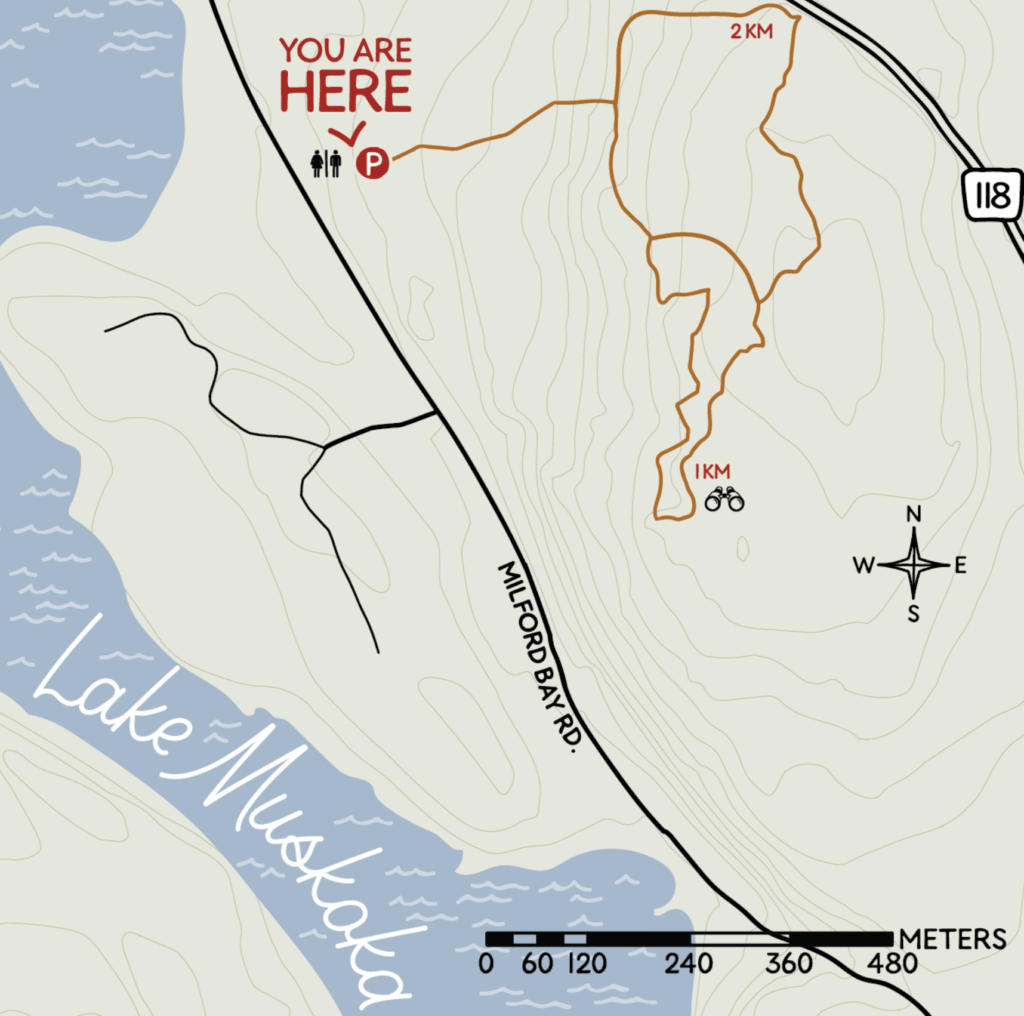
The day begins at Huckleberry Rock Lookout Trail, a short 2.5 km loop near Milford Bay that crosses the exposed pink granite of the Canadian Shield. The rock is more than a billion years old, and the landscape bears the marks of glaciation, erosion, fire, and historic logging. The trail climbs gradually over broad granite slabs to viewpoints across Lake Muskoka and the surrounding forest. Small wetland areas and black spruce contrast with the dry, open rock, showing how varied the Muskoka landscape can be within a very short distance.


The afternoon continues in Port Carling, the historic hub of the Muskoka Lakes. The village occupies a strategic position between Lake Muskoka and the upper lakes, Rosseau and Joseph. Its locks begin construction in 1869 and open in 1871, allowing steamships to travel between the lakes and helping transform the region from a relatively isolated frontier into one of Ontario’s best-known summer destinations. The village takes its name from John Carling, then Ontario’s Minister of Public Works and Agriculture. The locks remain operational, so boats still pass through the same narrow waterway that plays such an important role in the development of Muskoka.
A short walk from the locks leads to the Port Carling Wall, one of the village’s most distinctive landmarks. From across the street, the wall appears to show a single historic image of the steamship RMS Sagamo passing through the locks. Closer inspection reveals that the mural is composed of more than 9,000 photographic tiles based on hundreds of archival images documenting local life between 1860 and 1960. Measuring roughly 111 by 45 feet, it works almost like a visual archive of the region, bringing together steamships, settlement, tourism, and everyday life in Muskoka.
Together, Huckleberry Rock and Port Carling provide a compact introduction to Muskoka. The morning explains the geography, granite, forest, and lakes that define the region, while the afternoon explains how those waterways shape settlement, transport, and tourism. It is an easy way to understand why Lonely Planet describes Muskoka as the heart of Ontario’s cottage country.
Day 2 - Gravenhurst, Lake Muskoka and the Steamship Era
The second day shifts from Muskoka’s landscape to the history of how the region becomes accessible, fashionable and ultimately famous. It begins in Gravenhurst, at Muskoka Wharf, where the modern tourism story of the lakes is closely tied to steam navigation. Lonely Planet presents the Muskoka region as classic Ontario cottage country, shaped by lake towns, historic steamship travel and a strong relationship between settlement and waterways.

The steamship story predates Canada itself. The first steamer, Wenonah, begins service on Lake Muskoka in 1866, one year before Confederation. Over the following decades, the Muskoka Lakes Navigation Company develops one of the largest inland steamship fleets in North America. These vessels are not originally pleasure boats. They act as extensions of the railway network, transporting settlers, mail, supplies, hotel guests and, eventually, generations of summer residents between Gravenhurst and the increasingly populated shores of Lakes Muskoka, Rosseau and Joseph.
The cruise departs from Muskoka Wharf, on the southern side of Muskoka Bay. The geography explains why Gravenhurst becomes such an important gateway to the region. Muskoka Bay forms a sheltered approach to the larger lake, and after the railway reaches Gravenhurst in 1875, passengers and freight can transfer directly from trains to steamships. From here, the waterways become the main arteries into the interior of Muskoka.
As the ship leaves the bay, the character of Lake Muskoka changes constantly. The lake is not simply a broad open body of water. It is a complicated landscape of narrow channels, islands, rocky peninsulas, coves and exposed Canadian Shield. These constricted passages are one of the defining features of the lake’s geography and help explain why navigation here has always required detailed local knowledge. The alternation between open water and narrow corridors also gives the cruise much of its visual interest, with changing perspectives on forested shorelines, cottages and boathouses.

The modern Wenonah II, launched in 2002, is a contemporary vessel designed to evoke the traditional Muskoka steamships and named after the original Wenonah. From its decks, the lake reveals the geography that drives the development of the region: long shorelines, protected bays, narrow passages and islands that naturally become sites for cottages, resorts and landing points.
The shoreline also contains several unexpected layers of history. One of the most unusual is Camp 20, a prisoner-of-war camp for German soldiers that operates in Gravenhurst from 1940 to 1946. The camp occupies a large waterfront site in the Muskoka Bay area, near what is now Ungerman Gateway Park. Its perimeter includes almost a kilometre of fencing and even an underwater barrier extending into the lake, allowing prisoners to swim while preventing escape. Today, only limited physical remains survive, but the site is interpreted through historical markers.
The same area has an equally striking medical history. Before the POW camp, Gravenhurst is associated with the treatment of tuberculosis. The Muskoka Free Hospital for Consumptives opens in 1902, part of the wider sanatorium movement that sends patients to rural areas where clean air, rest and isolation are considered central to treatment. The hospital later becomes part of a larger institutional complex on the Muskoka waterfront. After the decline of the sanatorium era, the site changes function again. In 1958, the Ontario Fire College opens on the former hospital grounds and becomes an important provincial training centre for firefighters.
This sequence is one of the most fascinating aspects of Gravenhurst. A stretch of shoreline that now appears peaceful and recreational has successively served as a medical site, a wartime detention area, a provincial training facility and, eventually, part of a major tourism landscape. Some local accounts refer to psychiatric use in the area, but the sources reviewed here clearly document tuberculosis hospitals and sanatoria rather than a psychiatric hospital, so that point should be treated cautiously unless the specific institution can be identified.
The cruise itself therefore becomes more than a scenic excursion. It is a moving introduction to how Muskoka develops through transportation, health institutions, wartime history and tourism. The water is not merely the backdrop. It is the element that connects all of these phases.

The second half of the day continues at the Muskoka Discovery Centre, also in Gravenhurst, which provides the historical and cultural context behind what is visible from the ship. One of its most important exhibitions is Misko-Aki: Confluence of Cultures, developed with Indigenous elders, scholars and linguists representing Anishinaabek, Haudenosaunee, Huron-Wendat and Métis perspectives. It traces more than 10,000 years of Indigenous presence in the Muskoka watershed, placing the nineteenth-century steamship era within a much longer history of human occupation.
Other exhibits focus on the relationship between Muskoka and water itself. Watershed Wonders explores the interconnected system of lakes, rivers, wetlands and communities, while the Grace & Speed Boathouse contains an extensive collection of classic wooden boats. Together they show how canoe travel, steam navigation, recreational boating and cottage culture evolve around the same basic fact: in Muskoka, water has historically been the principal route of movement, economic development and recreation.
For younger visitors, the museum is unusually accessible. The KidZone uses hands-on STEAM activities rather than relying only on conventional displays, making the centre suitable even for very young children. This creates a strong balance for the day: the steamship provides the physical experience of Muskoka from the water, while the museum explains the Indigenous history, engineering, ecology and tourism that shape the landscape seen from the deck.
Taken together, the cruise and Discovery Centre provide one of the clearest introductions to Gravenhurst and to Muskoka as a whole. The first day explains the region through granite, forest and the locks at Port Carling. The second follows the water itself, showing how steamships, narrow channels, hospitals, wartime institutions and cottage development all emerge from the same geograph
Day 3: Bracebridge, Waterfalls and the Industrial Heart of Muskoka
The third day moves inland from the lakes and steamship routes to Bracebridge, one of Muskoka’s historic commercial centres. Lonely Planet describes Bracebridge, together with Huntsville and Gravenhurst, as one of the classic bases for experiencing cottage country, combining local trails, lake access and compact town centres.
Bracebridge develops around the Muskoka River, and the river explains much of the town’s history. The community is incorporated as a village in 1875 and becomes a town in 1889. By then, its economy already includes tanneries, a grist mill, woollen mill, flour mill and sawmill, all taking advantage of the river’s considerable water power. Unlike Port Carling, whose story is dominated by navigation between the lakes, Bracebridge grows as an industrial town built around waterfalls and moving water.

The morning begins at Bracebridge Falls and Bracebridge Bay Park. The falls sit directly below the historic centre, where the North Branch of the Muskoka River drops toward Bracebridge Bay. The waterfront seen today is partly the result of a major restoration program begun by the town in 1969, intended both to recover public access to the river and to highlight its importance to early explorers and settlers. Bracebridge Bay Park officially opens in 1981.
The falls are not simply scenic. Water power becomes one of the engines of Bracebridge’s nineteenth-century economy, supporting mills and manufacturing and eventually electricity generation. Hydroelectric infrastructure still makes use of Bracebridge Falls today, creating an unusually visible connection between the town’s industrial past and its modern landscape.
This stretch of river also predates European settlement by many centuries. Local historical interpretation describes the flat ground near present-day Bracebridge Bay Park as a traditional stopping and camping area used by Indigenous peoples travelling through the Muskoka waterways. Later explorers and surveyors use the same river corridors, portaging around Bracebridge Falls as they move through the region. The falls are therefore both an obstacle and a meeting point in Muskoka’s transportation history.
From the waterfront, the route continues uphill toward Manitoba Street, Bracebridge’s historic main street. Originally called Muskoka Road, it is renamed Manitoba Street in 1867, the year of Canadian Confederation, alongside nearby streets named Ontario, Quebec and Dominion. Wooden sidewalks appear in 1876 and the original dirt road is surfaced with stone in 1879. It remains the commercial spine of downtown Bracebridge.
Several buildings reveal the prosperity of the late nineteenth and early twentieth centuries. Among the most recognizable is the Old Post Office and Clock Tower on Manitoba Street, now protected for both its architectural and historical importance. Nearby heritage buildings and the town’s walking-trail markers help reconstruct a period when Bracebridge functions as the main service and industrial centre for the surrounding Muskoka countryside.
The development of the railway accelerates that transformation. In 1885, the Northern Railway reaches Bracebridge, requiring substantial engineering works across the Muskoka River and through the surrounding Canadian Shield. The railway links the town more efficiently with southern Ontario, while steamships continue carrying people and goods across the lakes. For several decades, Bracebridge therefore sits at the intersection of three transportation systems: road, rail and water.

The town’s relationship with the river is equally important to the logging industry. Huge quantities of timber from the forests upstream, including areas toward Algonquin, are floated down the Muskoka River toward sawmills. Logging, mills and manufacturing reshape both the economy and the landscape, helping turn Bracebridge from a small frontier settlement into the regional centre it becomes by the late nineteenth century.
A short walk through downtown therefore reveals a different Muskoka from the grand cottages and steamships of the previous day. Gravenhurst tells the story of tourism, Port Carling of navigation, while Bracebridge tells the story of industry and settlement. The same rivers and lakes that attract summer visitors also provide transportation routes, power mills, move timber and determine where communities develop.
For a family visit, the most practical route is compact: begin at Bracebridge Falls and Bracebridge Bay Park, walk through the historic waterfront, continue up Manitoba Street, and finish around Memorial Park before lunch. The town maintains a Heritage Walking Trail with 12 interpretive signs through the downtown core, so much of this history can be followed without turning the morning into a formal museum visit.
The contrast with the first two days is useful. Huckleberry Rock introduces the ancient geology of the Canadian Shield. Port Carling explains how the lakes become connected. Gravenhurst shows how steamships transform Muskoka tourism. Bracebridge completes the picture by showing how waterfalls, timber, mills and railways create a permanent town in the middle of cottage country.
Day 4: Muskoka Heritage Place and the Portage Flyer
The fourth day moves north to Huntsville and into the social history of early Muskoka. At Muskoka Heritage Place, the Pioneer Village recreates a small community from the period when permanent settlement begins to expand through the region. Many settlers arrive after Ontario’s Free Land Grant Act of 1868, which offers land to families willing to clear and improve it. The promise sounds generous, but the reality is difficult: thin soil, exposed granite and dense forest make farming hard, and early communities depend on a mixture of agriculture, logging, local trades and transport.
The village is not simply a collection of replicas. Muskoka Heritage Place develops gradually from the 1960s onward, with historic buildings moved to the site from surrounding communities. The school, general store and blacksmith shop arrive in 1967, while the Pioneer Village formally opens in 1971. Other structures, including barns, workshops, houses, a church and an inn, are subsequently added to create the impression of a functioning rural settlement rather than a conventional museum.


The one-room schoolhouse gives one of the clearest pictures of everyday life. Rural schools bring children of different ages into a single room, often with one teacher responsible for the entire group. One of the preserved schoolhouses dates from 1895 and originally opens with twenty students. Nearby, the blacksmith shop explains why skilled trades are essential in isolated communities: tools, horseshoes and metal repairs must be produced locally, often far from larger towns. The general store serves a similarly central role, supplying food and household goods while also acting as a meeting place and commercial hub.
Hands-on demonstrations make the village more convincing than static displays alone. Depending on the day, visitors may encounter blacksmithing, candle dipping, wool carding, pioneer laundry, croquet, school lessons or traditional food demonstrations. These activities show how much domestic and agricultural work is done manually, and how little separation exists between work, home and community life in nineteenth-century Muskoka.
The site also places European settlement within a longer Indigenous history. Displays and demonstrations include Indigenous as well as pioneer perspectives, helping avoid the impression that Muskoka’s history begins with the arrival of settlers. Long before roads, railways and steamships, Indigenous communities use the region’s lakes and rivers as transportation corridors and seasonal routes through the Canadian Shield.

The visit ends with the Portage Flyer, one of the most distinctive pieces of Muskoka transportation history. The original railway operates from 1904 to 1959 between North and South Portage near Dwight. At only about 1⅛ miles of narrow-gauge track, it becomes known as the world’s smallest commercial railroad. Its purpose is entirely practical: Peninsula Lake and Lake of Bays lie close together geographically but at significantly different elevations, making a navigable canal or lock system prohibitively difficult and expensive.
The railway therefore functions as a land bridge between two steamship systems. Passengers and cargo travel by steamship through Huntsville and Fairy Lake to Peninsula Lake, transfer onto the Portage Flyer, cross the short stretch of land, and then board another steamship on Lake of Bays. Mail, building materials, supplies and tourists all make the same journey. From South Portage, steamships continue toward famous resorts such as the Britannia Inn, Wa Wa Hotel and Bigwin Inn.

Today’s Portage Flyer operates from Rotary Village Station in Huntsville using a 1926 steam locomotive during the summer season. The recreated journey follows the Muskoka River toward Fairy Lake and preserves the atmosphere of the original line rather than its exact historic route. What begins as a short train ride therefore completes the broader story developed over the previous days: Muskoka evolves through a network of waterways, portages, steamships, roads and railways, each solving the problem of moving through a landscape dominated by lakes, forest and exposed rock.
Taken together, the Pioneer Village and Portage Flyer show a different side of Muskoka from the grand lakeside cottages and steamships of Gravenhurst. Here the focus is on settlement, labour and connection: how people build communities in difficult terrain, how local trades support daily life, and how even a tiny railway becomes essential in linking otherwise separate lake systems.
Day 5: Hardy Lake Provincial Park
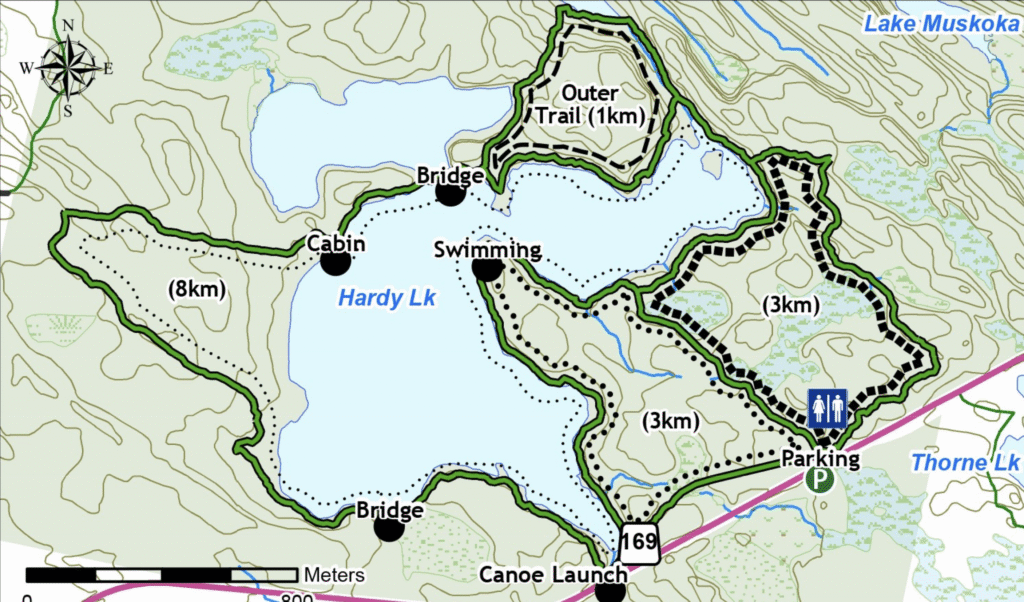
The fifth day returns to the landscape itself, this time at Hardy Lake Provincial Park, south of Port Carling near Torrance. Unlike Huckleberry Rock, where the main attraction is the exposed granite and the broad lookout over Lake Muskoka, Hardy Lake offers a more enclosed and intimate version of the Canadian Shield landscape: forest, wetlands, rocky shoreline and small sections of open water appearing repeatedly through the trees. The park protects more than 800 hectares and is classified as a Natural Environment Park.

The route follows the 3 km loop, one of the two principal hiking options in the park. The Township of Muskoka Lakes classifies the trails here as moderate to difficult, with the shorter loop providing access to the shores of Hardy Lake without committing to the much longer circuit around the lake. The terrain is typical of Muskoka: uneven roots, exposed Precambrian bedrock, narrow forest paths and sections close to the water.
Hardy Lake is particularly interesting from a geological and ecological perspective. The park sits within the ancient rock landscape of the Canadian Shield, shaped repeatedly by glaciation. Ice sheets grind, score and polish the bedrock, while meltwater fills depressions and channels left behind in the rock. Over thousands of years, these become the interconnected lakes, ponds and wetlands that now define much of southern Muskoka.
One of the park’s most unusual features is botanical rather than geological. Ontario Parks protects a community of Atlantic coastal plain plant species that survives here far from the modern Atlantic coast. Their presence is a legacy of the enormous glacial and post-glacial lakes that once covered much of the region. As ancient Lake Algonquin receded, some shoreline plant communities remained isolated in suitable habitats around lakes such as Hardy. The park therefore preserves not only the physical evidence of glaciation, but also a biological remnant of the landscapes that follow it.
The trail also reaches sections of shoreline characteristic of Muskoka’s Precambrian landscape, with dark water, exposed rock and dense forest meeting almost directly at the lake edge. The official trail guide describes Hardy Lake and nearby Lake Muskoka as examples of the rugged, lake-studded shoreline that defines the region. There is little infrastructure inside the park, which gives the walk a noticeably more secluded character than the better-known tourist sites around Port Carling and Gravenhurst.
The 3 km loop works particularly well as a family hike. It is long enough to feel like a genuine excursion into the forest but short enough to complete during a morning without sacrificing the slower rhythm of a cottage holiday. There are no major built attractions along the route and no single dramatic viewpoint comparable with Huckleberry Rock. The appeal lies instead in the gradual transitions between forest, wet ground, granite and shoreline.

Hardy Lake therefore adds another piece to the geography of Muskoka. Huckleberry Rock reveals the exposed surface of the Canadian Shield from above; Hardy Lake shows how that same ancient rock interacts with water, soil and forest at ground level. Together, the two hikes illustrate why Muskoka’s landscape feels so distinctive: the lakes are not separate features placed within the forest, but part of a single glacial landscape in which rock, water and vegetation continuously overlap.
Day 6: Arrowhead Provincial Park and a Morning by Canoe
The sixth day moves away from Muskoka’s historic towns and back into the wilderness, at Arrowhead Provincial Park, just north of Huntsville. The park lies within the same Canadian Shield landscape that defines much of central Ontario, but its character is different from the exposed granite of Huckleberry Rock or the intimate shoreline of Hardy Lake. Here the landscape is broader and quieter, shaped by forest, small lakes and the winding course of the Big East River. Ontario Parks describes Arrowhead as one of the region’s most accessible outdoor destinations, with sandy beaches, hiking trails and canoeing opportunities concentrated within a relatively compact area.
The morning begins on the water. Canoes can be rented directly inside the park, making it possible to launch without transporting equipment or dealing with a separate outfitter. The lake is calm and sheltered compared with Lake Muskoka, with far less motorboat traffic, which makes it particularly suitable for a short family paddle. The route does not need to be ambitious: the appeal comes from moving slowly along the shoreline, surrounded by forest and still water, rather than covering distance.
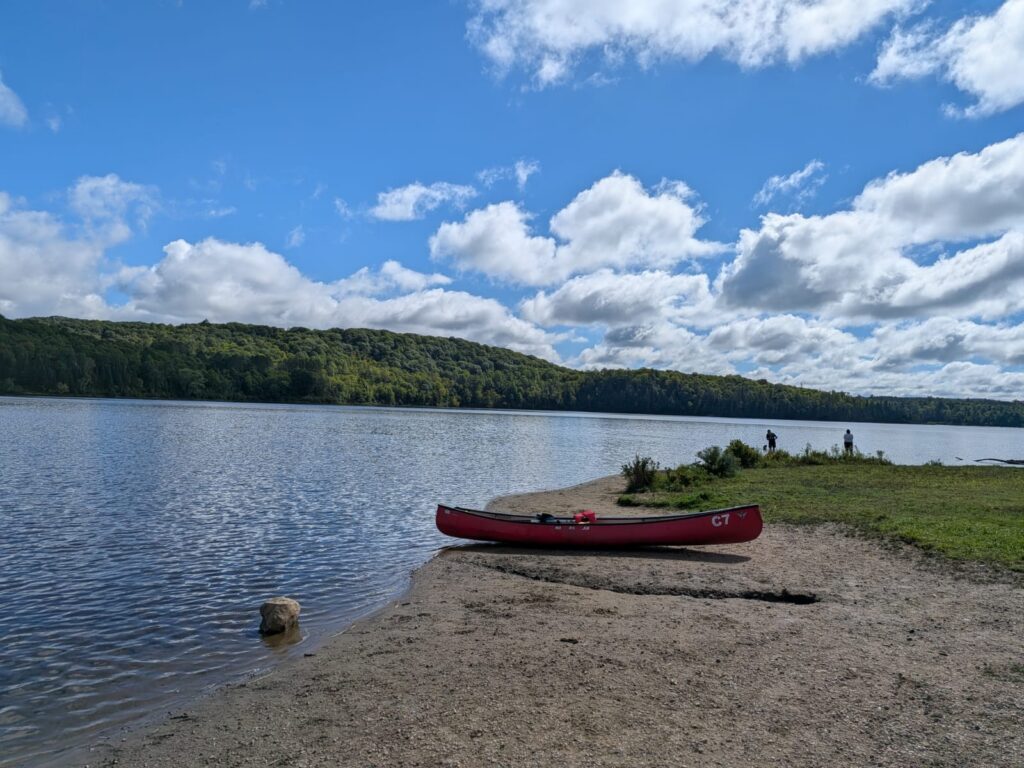
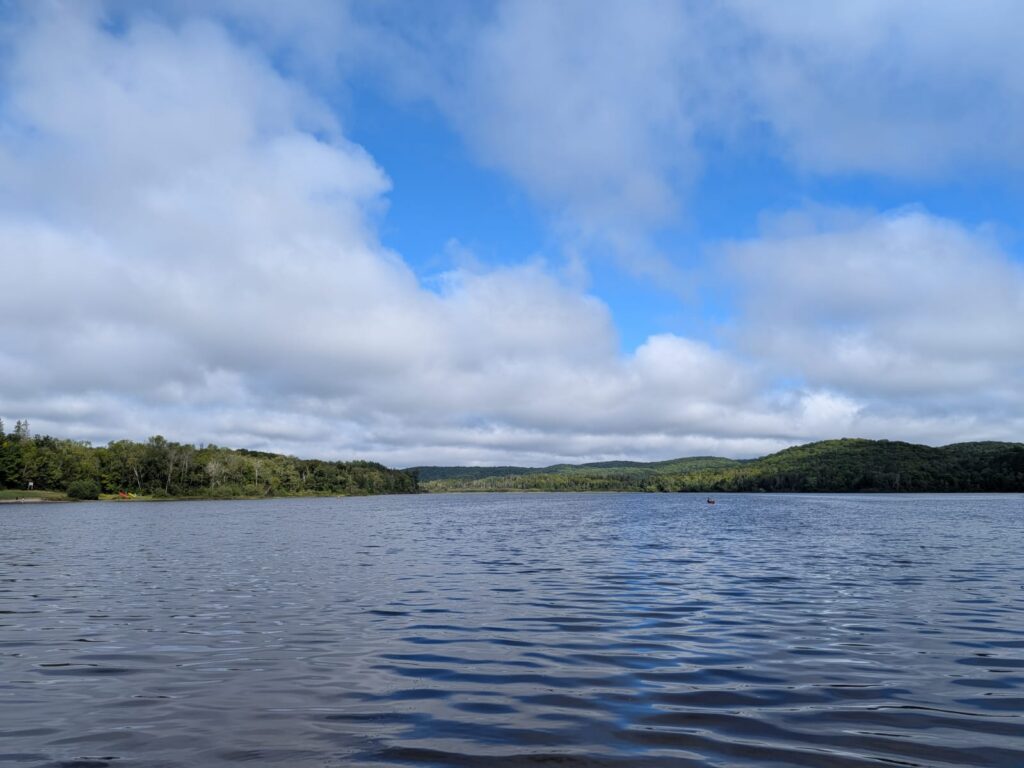
Canoeing is one of the most characteristic ways to experience the Ontario interior. Long before roads or railways, Indigenous peoples use interconnected lakes and rivers as travel corridors, and the canoe becomes essential to movement across the Canadian Shield. Later, fur traders and settlers adopt the same routes. In places like Arrowhead, that history is still easy to understand physically: the water provides the most natural way through a landscape where dense forest and exposed rock make overland travel slower and more difficult.
After the paddle, the visit continues at Big Bend Lookout, one of Arrowhead’s signature viewpoints. The overlook sits above a dramatic curve in the Big East River, where the river bends sharply through the forested valley below. Unlike a mountain viewpoint, the panorama is not about height alone. It shows how rivers actively shape the landscape, cutting through glacial deposits and creating the broad meanders that characterize this part of the park. The viewpoint is easy to access, making it a good complement to the morning on the water.
Arrowhead also offers a useful contrast with the previous days. Hardy Lake feels quiet and almost untouched, with minimal infrastructure and narrow woodland trails. Arrowhead is more developed, but that makes it especially effective for families: canoe rental, short walks, beaches and viewpoints can all be combined without turning the day into a long expedition.
The most memorable part of the visit, however, is the simplicity of the canoe itself. On a calm inland lake, surrounded by forest and with no need to follow a fixed route, the experience feels much closer to the traditional rhythm of travel through Ontario than a motorized cruise or scenic drive. The landscape changes slowly, and the water becomes part of the journey rather than merely something to look at.
Taken together, the canoe and Big Bend Lookout provide a concise introduction to another side of Muskoka and the surrounding highlands: less about settlement and tourism, more about water, forest and movement through the landscape. It is one of the most direct ways to experience the geography that has shaped the region for thousands of years.
Day 7: Huntsville by Canoe
The seventh day returns to the water, this time in Huntsville, where the Muskoka River threads directly through the town before opening toward Fairy Lake. This setting makes paddling feel very different from Arrowhead. Instead of starting in a provincial park, the canoe launches from an urban waterfront and quickly moves into a landscape where town, river and forest overlap.
Huntsville develops around exactly this relationship with water. Long before modern roads dominate travel, the river system links the community with the surrounding lakes and provides one of the natural corridors through northern Muskoka. The town later becomes an important junction between steamship routes, portage connections and rail travel, which explains why so much of its historic identity remains tied to the waterfront.
A short canoe trip from downtown is therefore less about wilderness in the strict sense and more about understanding how settlement grows around a navigable river. The route passes stretches of shoreline where houses and docks gradually give way to quieter water, trees and marshy edges. The change is subtle, but it shows one of Muskoka’s recurring themes: human settlement rarely replaces the landscape entirely. Instead, towns are inserted into the same network of lakes, rivers and granite that defines the surrounding countryside.
For a child, the scale of the trip works particularly well. The canoe stays close to shore, the route can be shortened at any time, and the experience is active without requiring a long hike. After the success of the first canoe outing at Arrowhead, repeating the experience in a new setting offers a useful contrast. Arrowhead feels enclosed and protected, while Huntsville feels more connected to the historical geography of travel and settlement.
While one part of the family is on the water, the downtown waterfront works equally well for younger children. River Mill Park sits close to the centre of Huntsville and combines open green space, river views and a playground, making it easy to split the morning without turning it into two completely separate excursions.
The broader context is what makes the morning interesting. Over the course of the trip, water has appeared in several different forms: as the transport corridor of the steamships in Gravenhurst, as the lock system at Port Carling, as quiet forest shoreline at Hardy Lake, and as a protected paddling environment at Arrowhead. Huntsville adds another variation, showing how a town can develop directly around a river while still retaining a strong connection to the surrounding wilderness.
The result is one of the simplest days of the itinerary, but also one of the most characteristic. Muskoka is often described through its cottages and lakes, yet the region becomes easier to understand when seen from the water itself. Canoeing through Huntsville makes that connection immediate: the river is at once a recreational space, a historic transportation route and part of the everyday structure of the town.
Day 8: Torrance Barrens, Muskoka’s Lunar Landscape
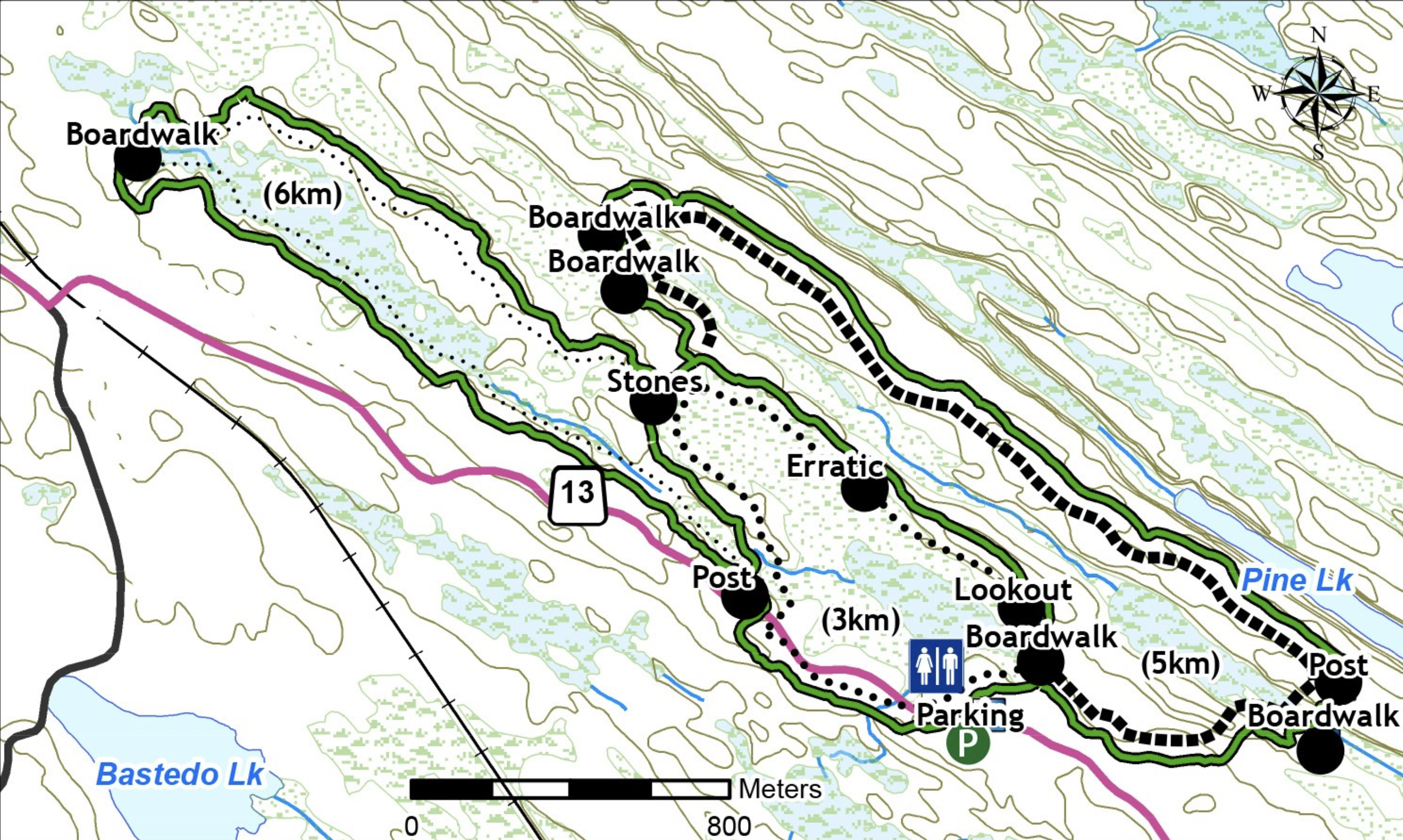
The final hiking day moves into one of the most unusual landscapes in Muskoka: the Torrance Barrens Conservation Reserve, south of Lake Muskoka. Unlike Hardy Lake, where forest and shoreline dominate, Torrance Barrens is defined by broad expanses of exposed Precambrian bedrock, low granite ridges, peat-filled depressions, wetlands and scattered stands of trees. The Township of Muskoka Lakes describes it as one of the most striking geological areas in the region, with a landscape that can feel almost lunar.
The route follows the 5 km trail, one of the three principal hiking options in the reserve. It is officially classified as difficult, not because of major elevation gain but because much of the route crosses uneven rock, wet ground and exposed surfaces where footing can be irregular. The trail repeatedly shifts between open granite and more sheltered sections of forest and wetland, making it visually very different from the other hikes of the trip.
Geologically, the reserve sits within the Grenville Province of the Canadian Shield, with ancient gneiss and migmatite bedrock exposed across large areas. Glaciation plays a major role in shaping the landscape. Ice and meltwater strip away much of the overlying soil, leaving broad rock barrens interrupted by shallow depressions that later fill with peat, ponds and wetlands. Glacial features such as polished bedrock, fractures, erratic boulders and thin deposits of till remain visible throughout the reserve.
Despite its apparently harsh surface, Torrance Barrens supports a surprisingly rich ecosystem. The reserve covers roughly 1,900 hectares and contains close to 500 species of flowering plants, around 150 bird species and numerous mammals, reptiles and amphibians. The contrast between dry exposed rock, wet hollows and wooded uplands creates a mosaic of habitats within a relatively compact area.
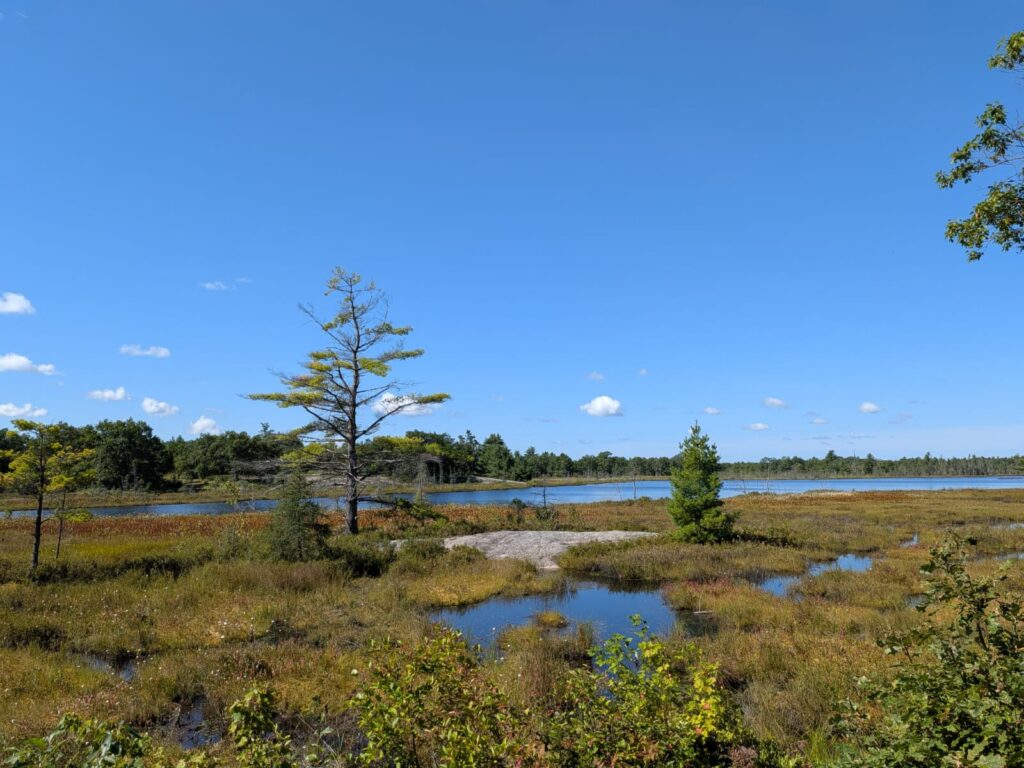
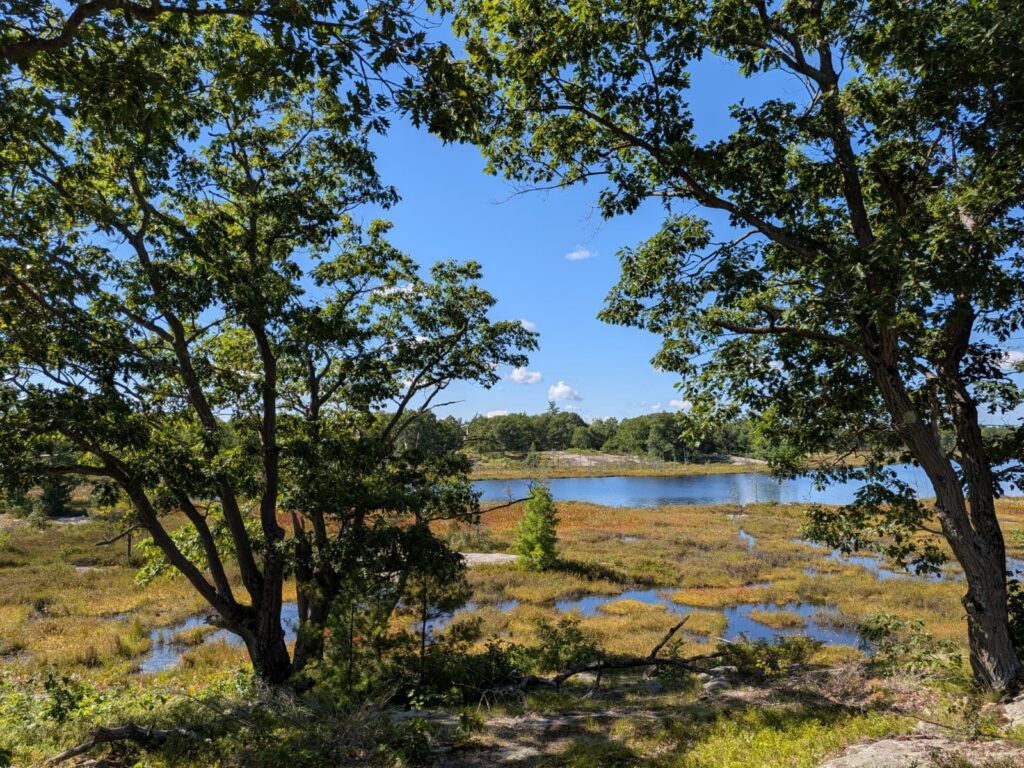
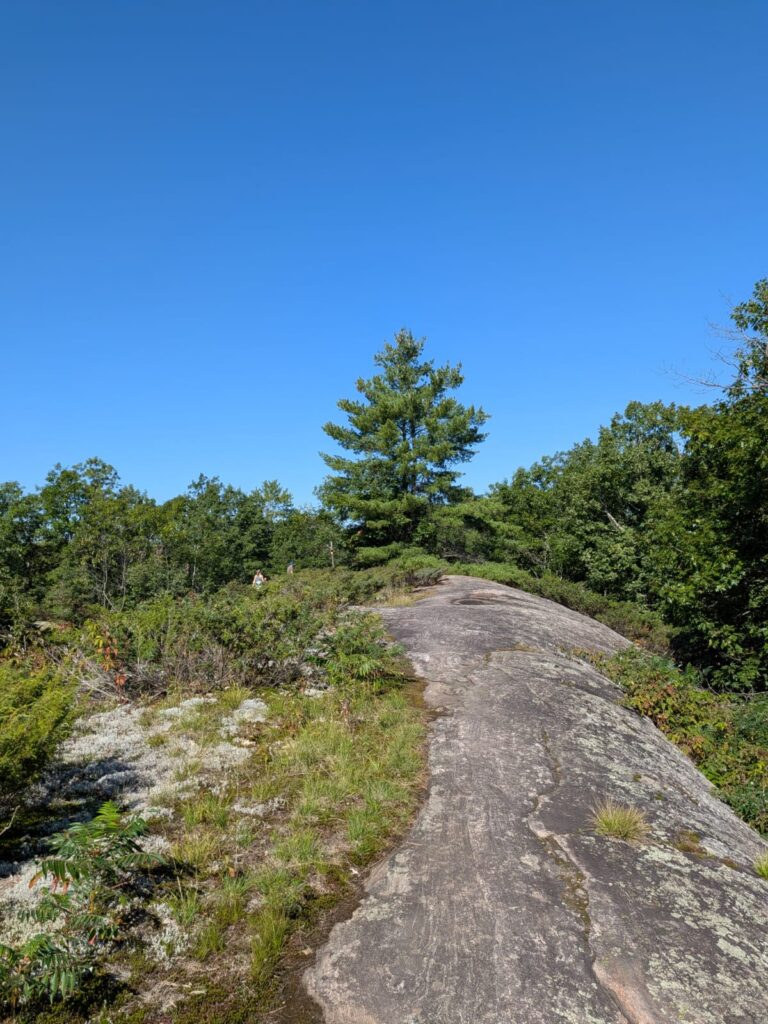
The reserve is also closely connected ecologically with Hardy Lake Provincial Park and other protected areas between Lake Muskoka and the Severn River. Together they form an important corridor of relatively undeveloped land across southern Muskoka. This makes Torrance Barrens a useful complement to the earlier Hardy Lake hike: both protect the same broader Canadian Shield landscape, but reveal very different expressions of it. Hardy Lake feels enclosed, forested and water-dominated; Torrance Barrens feels open, exposed and austere.
Torrance Barrens has another distinction that is almost as important as its geology. In 1999 it becomes Canada’s first officially recognized Dark Sky Reserve. Its distance from major sources of artificial light, open horizons and broad granite surfaces make it particularly suited to astronomy and astrophotography. The designation is intended not only to protect the quality of the night sky for visitors, but also to preserve the ecological value of natural darkness.
The 5 km loop therefore provides a very different ending to the hiking portion of the trip. Huckleberry Rock introduces the exposed Canadian Shield from a viewpoint above Lake Muskoka. Hardy Lake brings the trail into forest and rugged shoreline. Arrowhead adds river and canoe travel. Torrance Barrens strips the landscape back almost to its geological foundations, revealing how thin the boundary can be between bare ancient rock, wetland and forest in this part of Ontario.
It is perhaps the most distinctive walk of the trip for exactly that reason. The landscape is not conventionally dramatic, but it feels older, emptier and more elemental than the better-known lakefront scenery. It shows another side of Muskoka, one shaped as much by geology and glaciation as by cottages, villages and waterways.
-
Curaçao
March 12, 2026 /Curaçao is one of those Caribbean islands that surprises visitors almost immediately. The water is impossibly clear, the coastline alternates between wild cliffs and hidden coves, and the capital, Willemstad, looks more like a small Dutch town painted in bright tropical colors than a typical Caribbean port.
Located just 65 kilometers off the coast of Venezuela, Curaçao sits outside the hurricane belt and enjoys a dry, sunny climate year-round. This geography shapes much of the island’s character. The landscape is rugged and arid rather than lush, dominated by cacti, low shrubs, and rocky hills. Beaches are rarely long stretches of sand. Instead, they tend to be small coves where limestone cliffs drop into turquoise water, creating some of the best snorkeling and diving conditions in the Caribbean.
Curaçao’s history is layered and complex, shaped by Indigenous cultures, European colonization, and centuries of global trade.
Before Europeans arrived, the island was inhabited by the Arawak Caquetío people, who had migrated from the northern coast of South America. They lived primarily from fishing, agriculture, and trade with mainland communities.
In 1499 the island was encountered by Spanish explorers led by Alonso de Ojeda. Spain initially considered Curaçao of limited value due to its dry climate and lack of precious metals, and for several decades it remained sparsely populated.
Everything changed in 1634, when the Dutch West India Company captured the island from Spain. The Dutch quickly recognized Curaçao’s strategic importance. Its natural deep harbor, the Schottegat, became one of the most important ports in the Caribbean. During the 17th and 18th centuries, Willemstad developed into a major trading hub linking Europe, Africa, and the Americas.
Like much of the Caribbean, Curaçao was deeply involved in the transatlantic slave trade. Enslaved Africans were brought to the island and redistributed across the region. This painful chapter left a lasting cultural imprint that still shapes Curaçao’s identity today.
Slavery was officially abolished in the Dutch colonies in 1863, after which the island gradually transitioned toward commerce, shipping, and later oil refining. In the 20th century, the construction of a large Royal Dutch Shell refinerytransformed Curaçao into a key energy hub in the southern Caribbean.
Today Curaçao is a constituent country within the Kingdom of the Netherlands, alongside Aruba and Sint Maarten. While it has internal self-government, the Netherlands remains responsible for defense and foreign affairs.
Culture and Identity
One of Curaçao’s most distinctive features is its cultural mix. The island’s population reflects centuries of migration and trade, blending African, Dutch, Spanish, Portuguese, and Caribbean influences.
This diversity is reflected in the languages spoken. Papiamentu, a Creole language that combines elements of Portuguese, Spanish, Dutch, African languages, and Arawak, is widely spoken and forms an important part of the island’s identity. Dutch and English are also official languages, and Spanish is commonly heard due to the proximity of Venezuela and Colombia.
Religion, food, music, and architecture all reveal this cultural layering. Dutch colonial buildings line the waterfront in Willemstad, Caribbean rhythms fill the streets during festivals, and local cuisine mixes African, Latin American, and European traditions.
Willemstad and the Heart of the Island
Most visitors arrive through Willemstad, a UNESCO World Heritage Site famous for its pastel-colored colonial buildings along the harbor. The city is divided into two historic districts, Punda and Otrobanda, connected by the floating Queen Emma Bridge. Walking through these neighborhoods gives an immediate sense of Curaçao’s maritime past and its cosmopolitan character.
Beyond the capital, the island quickly becomes quieter and more natural. The western side of Curaçao is dotted with national parks, small beaches, and traditional fishing villages, while the northern coast is dramatic and rugged, where the Caribbean waves crash directly against limestone cliffs.
What Makes Curaçao Different
Compared with many Caribbean islands, Curaçao feels less like a resort destination and more like a place with a strong local identity. The beaches are spectacular but rarely crowded. The island rewards exploration, from hidden coves and snorkeling spots to small local restaurants and historic neighborhoods.
It is also an island of contrasts. Within a short drive you can move from colorful colonial streets to cactus-covered hills, from calm turquoise bays to wild, wind-swept cliffs.
For travelers willing to explore beyond the main beaches, Curaçao reveals itself as a place shaped by history, trade, migration, and the sea.
Day 1
Morning: Cas Abao Beach
Start the day at Cas Abao Beach, one of the most famous beaches on the island and a good introduction to Curaçao’s coastline.
Unlike many of the small rocky coves around the island, Cas Abao is wide and sandy, with calm turquoise water protected by the surrounding cliffs. The beach is very well maintained and offers good facilities. There are sunbeds, umbrellas, showers, and a beach bar. For families, it is also one of the easiest beaches to enjoy with children.
The water is exceptionally clear, and snorkeling is excellent along the rocky edges of the bay. Fish tend to concentrate near the cliffs, where coral formations create natural shelters. Even a short swim can reveal parrotfish, angelfish, and sometimes sea turtles.
The only drawback is that Cas Abao is popular. It is best to arrive in the morning, ideally before 10:00, when the beach is still quiet and the water is perfectly calm.
Afternoon: Playa Daai Booi
In the afternoon drive about fifteen minutes north to Playa Daai Booi. This beach has a completely different atmosphere.
Daai Booi is much smaller and more local. Fishermen often keep their colorful boats on the sand, and the beach feels less organized and more authentic. There are usually fewer visitors, especially later in the day.
The bay is deep and narrow, surrounded by cliffs, which makes the water calm and excellent for snorkeling. Sea turtles are often seen here, especially near the rocky areas on the sides of the beach.
There is a simple beach bar where you can buy drinks and basic food. The setting is relaxed and unpretentious, which makes it a pleasant contrast after the more structured environment of Cas Abao.
Late afternoon is a particularly nice time to visit, when the light becomes softer and many people leave the beach.
Evening: Dinner at Landhuis Daniel
After the beach, drive a few minutes inland to Landhuis Daniel, one of the most charming places to have dinner in this part of the island.
The restaurant is located inside a restored 18th-century plantation house (a landhuis), part of the colonial estates that once structured agricultural life on the island. The building itself is beautiful, with thick stone walls, a shaded courtyard, and a relaxed open-air dining area.
The cuisine focuses on Caribbean and Dutch-Caribbean dishes, prepared with local ingredients. Typical plates include grilled fish, Caribbean stews, and slow-cooked meats. The atmosphere is informal but refined, and the setting feels very authentic compared with many tourist restaurants closer to Willemstad.
After a day of beaches and sun, it is the perfect place to end the first day on the island before heading back to your accommodation.
Day 2
The Story of Blue Curaçao at Landhuis Chobolobo
One of the most interesting cultural stops in Curaçao is Landhuis Chobolobo, the historic distillery where the island’s famous Curaçao liqueur is produced.
While most visitors know the bright blue bottles from cocktail bars around the world, few realize that the drink originates from a very specific local fruit and a centuries-old tradition that began on this island.
The key ingredient of Curaçao liqueur is the Laraha, a bitter orange that grows only on the island.
The fruit originally descended from the Valencia orange, introduced by Spanish settlers in the 16th century. Curaçao’s dry climate and rocky soil transformed the fruit over time through natural mutation. The result was something quite different from the original orange. The Laraha became extremely bitter and essentially inedible, but its peel developed a very intense aromatic oil.
Harvesting the fruit requires care. The oranges cannot simply be pulled from the tree because the branches are fragile. Instead they are cut with knives and collected by hand. Once harvested, the fruit is opened and the pulp is discarded, often used as compost. Only the peel is kept for the liqueur.
The peels are then sun-dried for several days, which concentrates the aromatic oils responsible for the distinctive citrus aroma.
After drying, the peels are placed in small fabric bags that resemble large tea bags. These bags contain not only Laraha peel but also a blend of spices. The exact proportions remain secret, but they include ingredients such as cardamom and cloves, traditionally imported from India.
Sugar for the liqueur is sourced from Colombia, while the neutral alcohol base historically comes from the Netherlands. The alcohol used for extraction is extremely strong, about 96 percent, and is poured over the spice-filled bags inside the distillation system.
The distillery still uses a copper still that is more than 120 years old, and remarkably it remains fully operational. The spice bags steep in alcohol for about ten days, slowly releasing the aromatic oils. The result is a concentrated citrus extract.
After this extraction stage, the concentrate is transferred into tanks where it is diluted and sweetened. A typical batch may include roughly 280 liters of concentrate and around 400 kilograms of sugar.
From there, the liquid becomes the base of Curaçao liqueur.
Originally, Curaçao liqueur was colorless, similar to other orange liqueurs such as triple sec. In fact, Curaçao-style liqueur was already known in Europe before the modern brand identity of Blue Curaçao emerged.
In the 1960s, producers introduced bright colors to distinguish the product visually and make it more appealing for cocktails. Blue became the most iconic version, representing the Caribbean sea surrounding the island. Other colors were also introduced:
Green for the island’s cacti
Yellow for the tropical sun
Red for the sunset
Despite the different colors, they are all chemically the same triple sec, typically bottled at about 31 percent alcohol.
The bottle itself is distinctive and was deliberately designed to represent the Laraha fruit.
Its round shape mimics the orange, the textured glass reflects the fruit’s rough peel, and the small decorative element around the neck represents the branch from which the fruit grows. While the brand patented the bottle design, it is of course impossible to patent the island or the fruit itself.
All bottles and caps are imported and fully recyclable, and the distillery emphasizes avoiding plastic in the packaging process.
The filling machine used in the factory is also historic. It does not fill bottles completely to the top, so each bottle must be manually topped up before sealing.
Production at Landhuis Chobolobo remains relatively artisanal compared with industrial spirits.
In a typical small production cycle of around twenty days, the distillery produces roughly 2,000 bottles. The concentrated base is now produced continuously, but when the factory shifts fully to the classic triple sec production, output can reach about 160,000 bottles per year.
Over time the distillery expanded the range with additional flavored liqueurs. Unlike the classic Curaçao, these are not based on Laraha peel and are bottled at lower alcohol levels, around 26 percent.
Examples include flavors such as Chocolate Coffee, Rum Raisin, and Tamarind, which was introduced in 2016.
An interesting historical note involves the distillery’s ownership. At one point the senior owners were Jewish, which meant that the production process followed kosher requirements. For this reason, the distillery still maintains kosher certification, and a rabbi visits periodically to verify compliance with the rules.
Besides the liqueurs, the distillery also produces a few small specialty items derived from the same aromatic oils, including things such as cooling lotions and fragrances, sometimes marketed under names like Glacier.
The tour at Landhuis Chobolobo offers a rare chance to see the full story of Curaçao liqueur, from the unusual Laraha fruit to the century-old copper still that still drives production today.
It is a reminder that behind the bright blue bottles seen in bars across the world there is a very local product, rooted in the island’s climate, agriculture, and history.
Visiting the Curaçao Ostrich Farm
The second stop of the day is a place that surprises many visitors: the Curaçao Ostrich Farm. Located in the dry northeastern part of the island, the farm sits in a landscape of cacti, dust, and low hills that feels almost African. In fact, the climate here is remarkably similar to parts of Namibia and South Africa, which is why ostriches adapt so well to this environment.
The farm was established in the late 1990s and today hosts hundreds of ostriches, making it one of the largest ostrich farms outside Africa. Visits are organized as guided tours, usually by open safari truck, which drives through the different enclosures while guides explain the biology and behavior of these unusual birds.
Ostriches are remarkable animals. They are the largest birds on Earth, reaching up to 2.5 meters in height and weighing well over 100 kilograms. Despite their size, they are built for speed rather than flight. Their powerful legs allow them to run at up to 70 km/h, making them the fastest birds on land.
Each foot has only two toes, a unique feature among birds. One of them forms a large, hoof-like structure that acts almost like a running shoe, giving them stability and propulsion when sprinting across open terrain.
Another interesting detail guides often point out concerns the difference between males and females, which is surprisingly easy to see.
Male ostriches have striking black feathers with white wing and tail plumes, while females are covered in soft grey-brown feathers that provide camouflage when nesting.
One amusing observation visitors quickly notice is that female ostriches have a noticeably featherless rear end. This bare patch of skin helps with temperature regulation and hygiene, especially when the birds are sitting on eggs during long incubation periods. The exposed skin allows heat to dissipate more efficiently in hot climates like Curaçao.
It also gives the females a rather distinctive appearance when they walk away from the tour vehicles, something that guides often jokingly point out during the visit.
One of the most striking things visitors see on the tour is the ostrich egg, which is enormous compared with chicken eggs. A single egg can weigh around 1.5 kilograms and is roughly equivalent to two dozen chicken eggs.
The shell is extremely thick and strong. Guides often demonstrate that it can support the weight of a person standing on it without breaking. In cooking terms, one egg is enough to prepare a massive omelet that can feed a large group.
One of the most famous myths about ostriches is that they bury their heads in the sand when frightened. In reality, they do not do this. The misunderstanding comes from the way ostriches lower their heads to the ground when turning eggs during nesting or when searching for food.
From a distance, this posture can give the illusion that the head has disappeared underground.
Although ostriches look almost comical, they can be surprisingly aggressive when they feel threatened. Their legs are extremely powerful, and a defensive kick can be dangerous.
Each foot has a sharp claw that can reach several centimeters in length. In the wild, ostriches use these kicks to defend themselves against predators such as lions. For this reason, the farm’s guides emphasize that visitors should never try to approach the animals outside the controlled areas.
Another surprising fact is that ostriches often swallow small stones. These stones accumulate in the bird’s gizzard and help grind food during digestion, functioning almost like natural teeth.
Their diet consists mostly of plants, seeds, and insects, but they are opportunistic eaters and will sometimes swallow small objects if available.
Historically, ostriches were farmed for several products. Their feathers were once extremely valuable in the fashion industry, especially in the 19th century. Today, farms focus more on meat, leather, and eggs.
Ostrich leather is particularly prized because it is both durable and flexible, and its distinctive pattern of feather follicles gives it a recognizable texture used in luxury goods.
The presence of an ostrich farm might seem unexpected in the Caribbean, but Curaçao’s environment actually makes it suitable. The island is relatively dry compared with other Caribbean destinations, with cactus landscapes and open terrain that resemble the birds’ native habitats.
The result is an unusual but memorable experience, especially for families. After a few days of beaches and turquoise water, visiting the ostrich farm adds a completely different side to the island.
Day 3
The third day combines one of the most spectacular beaches on the island with an afternoon exploring the historic center of Willemstad.
Morning: Grote Knip
Start the morning at Playa Kenepa Grandi, better known as Grote Knip. Many consider it the most beautiful beach on the island.
The viewpoint above the beach already offers one of the most iconic panoramas in Curaçao. From the cliff you can see the entire bay below, a perfect crescent of white sand framed by rocky hills and bright turquoise water.
The beach itself is simple and natural. There are a few basic facilities, but the main attraction is the water. Visibility is excellent and snorkeling along the rocky sides of the bay often reveals schools of tropical fish and occasionally sea turtles.
Access to Grote Knip is free, which is relatively rare on the island, and this makes it popular with locals. Arriving early in the morning is the best way to enjoy the beach before it becomes crowded.
Afternoon: Walking Through Willemstad
The afternoon is dedicated to exploring Willemstad, whose historic center is a UNESCO World Heritage Site.
It is worth stopping briefly at the large Curaçao Sign. These oversized colorful letters spelling Curaçao have become a popular photo spot on the island. The sign is located along the waterfront near the cruise terminal, with the harbor and the city skyline as a backdrop.
It is a quick stop, but it gives a nice panoramic view of the harbor and is a fun place for a photo before heading into the historic center.
The most recognizable view is the row of colorful Dutch colonial houses lining the harbor in the district of Punda. The buildings, painted in pastel tones of yellow, blue, and pink, reflect in the water and create one of the most distinctive urban landscapes in the Caribbean.
Punda and Otrobanda, the two historic halves of the city, are connected by the famous Queen Emma Bridge, a floating pontoon bridge that opens to allow ships into the harbor. Walking across it while boats pass through the channel is one of the classic experiences in the city.
Spend some time wandering through the narrow streets behind the waterfront, where small shops, cafés, and historic buildings reveal the Dutch colonial heritage of the island.
A good stop in the afternoon is Gio’s Gelateria, located just steps from the harbor.
Despite being in the Caribbean, the gelato is very authentic. Classic Italian flavors like pistachio, stracciatella, and hazelnut sit alongside more tropical options. Sitting outside with a cone while watching people cross the bridge and boats entering the harbor is one of the small pleasures of visiting Willemstad.
Dinner: Pasawa Box Eatery
For dinner head to Pasawa Box Eatery, a lively street-food style food hall rather than a traditional restaurant.
The venue is built around a collection of small food stands, each serving different styles of cuisine. Visitors can mix and match dishes, from Caribbean flavors to international street food. The atmosphere is informal and energetic, with communal tables and a constant flow of people picking up food from different stalls.
It is a very different experience from the more classic restaurants on the island. Instead of a formal dinner, the evening becomes more like a casual food market, where everyone can try different dishes and flavors.
After a day that started on one of Curaçao’s most beautiful beaches and ended wandering the colorful streets of Willemstad, it is a relaxed and fun way to close the day.
-
Seoul
November 16, 2025 /To understand South Korea is to understand transformation.
In just a few generations, it evolved from the ashes of war into one of the world’s most innovative nations — a place where tradition and technology move in step, not in conflict.
The Han River cuts through Seoul like a shimmering boundary: north of the river lies the old city, where palaces and hanoks whisper of Confucian order; south of it, glass towers rise over shopping districts and neon boulevards.
Locals like to say, “Everything new is south of the river; everything true is north.”
And that’s where this day begins.Gyeongbokgung Palace — Where the Heavens Aligned with Stone and Wood
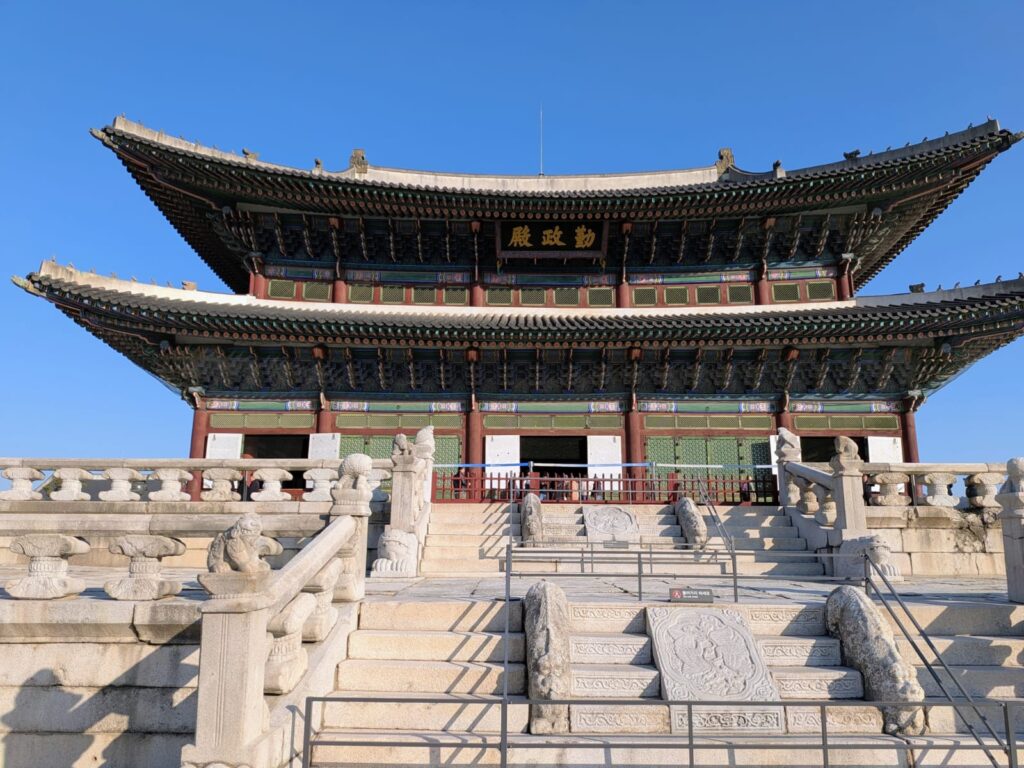
At the northern edge of Seoul, protected by Mount Bugaksan and facing the wide Han River, rises Gyeongbokgung Palace (경복궁) — “The Palace Greatly Blessed by Heaven.” Built in 1395 by King Taejo, the founder of the Joseon dynasty (1392–1897), it was not just a royal residence: it was the cosmic center of a new nation grounded in Confucian philosophy, moral governance, and harmony with nature.
For more than five centuries, the Joseon rulers shaped Korea’s identity through Neo-Confucian philosophy, elevating scholarship, etiquette, and moral discipline above luxury.
Their palaces were designed as moral diagrams rather than monuments to wealth — each gate, courtyard, and hall aligned with heaven’s geometry. Gyeongbokgung became the spiritual and political center of this vision: a city within a city, where architecture embodied virtue.The palace stands on a site chosen through pungsu-jiri, Korea’s interpretation of feng shui.
To the north, Mount Bugaksan protects like a guardian wall; to the south, the Han River carries life and prosperity; to the east rises the Blue Dragon (vitality), to the west the White Tiger (strength).
This balance between mountain and water, shadow and flow, was thought to harmonize the cosmic forces that sustained the realm.Constructed from Korean red pine and granite, the palace reflects quiet strength. Its beams are painted in dancheong — patterns of mineral reds, greens, blues, yellows, and whites — each color with purpose: red for dignity, green for renewal, blue for harmony, yellow for balance, white for purity.
Under morning light, the pigments shimmer like living calligraphy against the grey stone.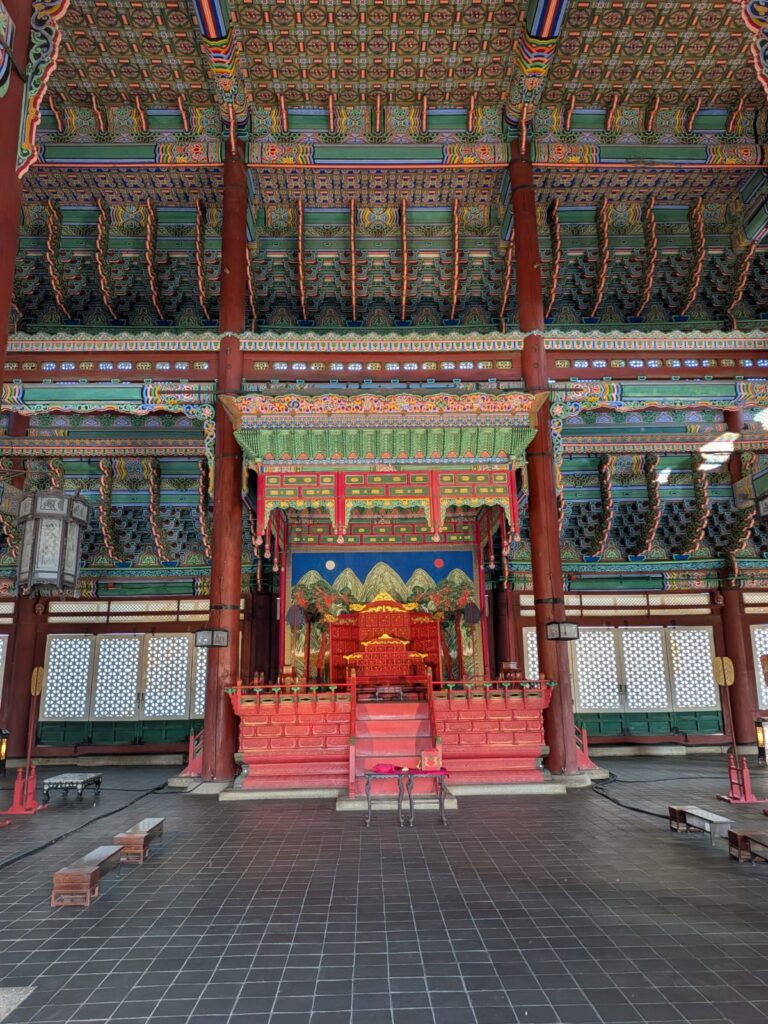
Passing through Gwanghwamun Gate, visitors enter the vast courtyard of Geunjeongjeon Hall, the throne room and first original building of the palace.
The stone pavement is uneven by design — scattering the sun’s glare during ceremonies and reminding all that perfection belongs only to the heavens.
Every axis draws the gaze from earth to mountain, reinforcing the Confucian ideal that the ruler is a bridge between the two.The palace’s tranquility was shattered in 1592, when Japan invaded during the Imjin Wars and burned almost everything to ashes.
It remained in ruins until 1867, when King Gojong ordered its grand reconstruction — more than 400 buildings and 7 000 rooms reborn from stone foundations.
But tragedy returned under Japanese occupation (1910–1945): most halls were again demolished, and the massive Government-General Building was erected before the main gate to dominate Korea’s symbol of sovereignty.
After independence, restoration became an act of national healing. The colonial structure was torn down in 1995, exactly six centuries after Gyeongbokgung’s founding, and the palace slowly reclaimed its horizon.West of the throne hall stands Gyeonghoeru Pavilion (경회루), completed in 1412 under King Taejong — the second major building of the complex and one of the few to survive the centuries.
Built above an artificial pond on 48 granite pillars, it was the stage for royal banquets and receptions. Its reflection doubles in still water, symbolizing the perfect harmony between heaven and earth.Inside, the doors hang from the ceiling, not the floor, lifted or lowered with ropes to control breeze and light — an ingenious design centuries ahead of its time.
When opened, the pavilion dissolves into air and water, its pillars mirrored by rippling lotus leaves; at night, the lanterns transform it into a floating constellation.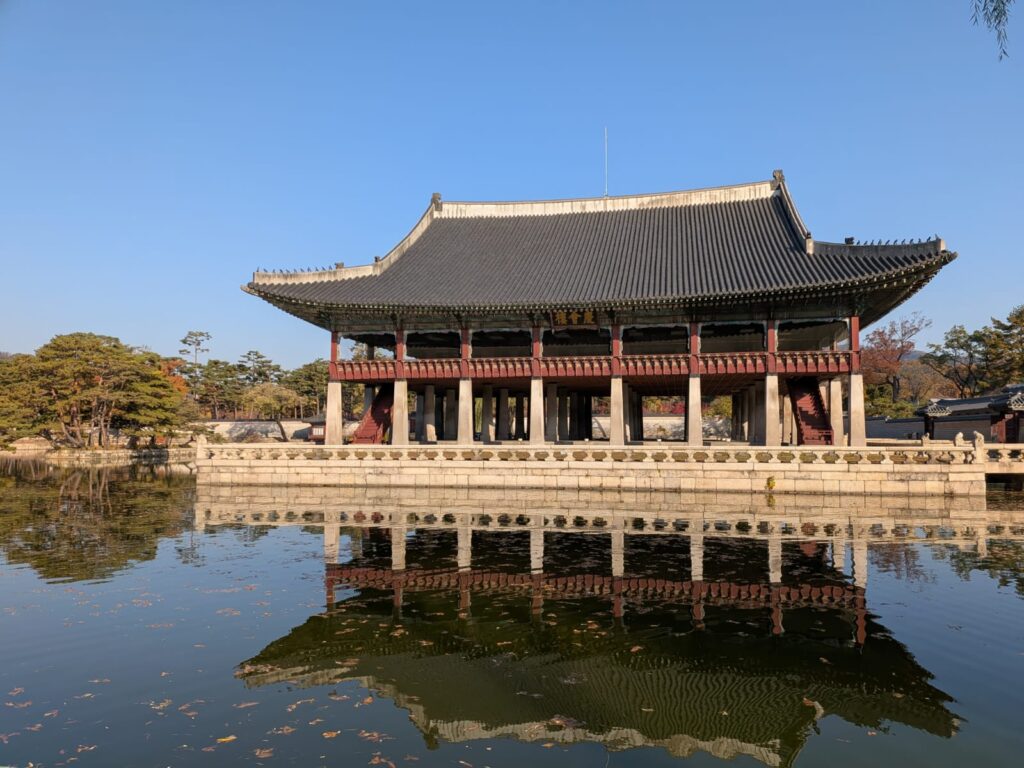
Behind the ceremonial courtyards lies Gangnyeongjeon Hall (강녕전), the king’s living quarters — a faithful reconstruction of the originals.
The residence was divided into three wings for the seasons: a south-facing suite with heated ondol floors for winter, a cool northern wing for summer, and a central set of rooms for spring and autumn.Despite his title, the king lived with almost no privacy. Attendants and scribes surrounded him day and night. His bed was plain wood, his workspace minimal — a writing table, scrolls of the Confucian Classics, and little else.
The ground outside was covered in gravel, so that every footstep produced a crunch, alerting guards to intruders in the night.
Even meals carried symbolism: the king ate with brass chopsticks, believed to change color on contact with poison — a quiet ritual of vigilance.There was no toilet inside the chambers. Instead, the king used a porcelain or brass vessel, which the court physician examined each morning to assess his health.
Afterward, the contents were used to fertilize a small plot within the palace grounds where the “royal rice” was grown — grain imbued, it was said, with the vitality of the sovereign himself.
Today, Gyeongbokgung has reawakened.
Every morning and afternoon, the Changing of the Guard ceremony unfolds at Gwanghwamun Gate — soldiers in crimson and cobalt robes march to the beat of great drums, horns echo off granite walls, and banners of phoenix and tiger rise against the skyline.
It is a reconstruction, yet it feels profoundly real — a gesture of continuity, the echo of an empire that measured time in rituals, not clocks.Gyeongbokgung endures as more than a monument. It is a breathing map of Korean history — of balance, discipline, and rebirth.
Walk its uneven stones, listen to the gravel whisper behind the royal chambers, and watch the reflection of the pavilion tremble in the pond.
Here, between mountain and river, Seoul still remembers how to align with the heavens.Dongdaemun Design Plaza — Where Seoul Curves Toward the Future
If Gyeongbokgung embodies the symmetry and order of the past, the Dongdaemun Design Plaza (DDP) expresses the pulse of the future.
It stands on sacred historical ground — the former site of Heunginjimun, the “Great East Gate,” one of the four gates that once enclosed the old capital.
For centuries, this was the city’s threshold: merchants, scholars, and travelers entered Seoul through this very point.
Now, the DDP rises in its place like a comet fallen to earth — a seamless fusion of design, memory, and technology.Designed by the late Zaha Hadid, whose visionary curves reshaped contemporary architecture, the DDP was inaugurated in 2014 as Seoul’s new icon of creativity.
Its organic form — fluid, continuous, almost alive — is built from 45,000 unique aluminum panels, each one digitally modeled and fitted using Samsung’s advanced engineering systems.
The result is a metallic skin that bends light like silk, a building that appears to move even when it stands still.Beneath the surface lies another layer of history.
During excavation, workers unearthed long-buried sections of the original Joseon-era fortress wall, fragments of Seoul’s ancient boundary. Instead of covering them, the architects preserved the stones in situ, integrating them into the Dongdaemun History & Culture Park that surrounds the plaza.
Here, the city’s medieval foundations literally support its futuristic architecture — the perfect metaphor for Seoul itself, a place where the past is never erased, only transformed.The DDP also carries more recent ghosts.
During the Japanese colonial period (1910–1945), this very site hosted the Dongdaemun Stadium, where baseball and athletic events were held under occupation.
Those stadiums — symbols of both imported culture and political control — were demolished to make way for the new plaza, turning a site once marked by domination into one dedicated to imagination and art.
Even today, traces of the old stands remain beneath the walkways, a quiet reminder of how deeply history layers itself under every Seoul street.Inside, the building unfolds like a living organism: galleries, design studios, and fluid exhibition spaces connected by gently sloping ramps.
A baseball training area was even installed inside during the building’s early tests — a playful nod to the site’s past and to the precision of its acoustics.
As you move through it, the walls curve without angles, and the light seems to pour rather than shine.At sunset, the DDP becomes a spectacle.
Its aluminum surface reflects the fading sky, shifting from pearl grey to violet, and finally to deep cobalt under the city lights.
Around it, the park glows softly, and the surviving stones of the Joseon wall appear suspended between centuries — the old gate illuminated behind a building that belongs to tomorrow.The Art Hall is the heart of the DDP, a monumental, open space that hosts rotating exhibitions of art, fashion, and technology.
It’s a building designed not just to display creativity, but to be creative — light glides across curved walls like brushstrokes, and shadows themselves become part of the show. Major exhibitions have ranged from avant-garde fashion retrospectives to immersive digital art. The acoustics are so refined that, during construction, engineers famously tested them with a baseball field installed inside — a surreal yet perfectly Seoul-like image, blending play and precision. Walking through, you feel suspended between sculpture and atmosphere: sound softens, reflections bend, and the city outside seems to dissolve into light. Beneath the sweeping exterior lies the Design Lab, the beating heart of the complex. Here, designers, startups, and students share workspaces where ideas move faster than daylight.
The building’s open-plan concept encourages collaboration — 3D printers hum beside hand-drawn sketches, and exhibition booths transform daily into new experiments of Korean creativity. Next to it, the Design Market operates almost 24 hours a day, a luminous bazaar of books, crafts, home décor, and concept products. It’s half gallery, half night market — the perfect place to feel the city’s nocturnal energy.
From here, you can step directly into the world of Seoul’s young creators: graphic designers, ceramic artists, and architects who treat the DDP as both workplace and muse.
When construction began, archaeologists discovered remnants of the original Joseon-era fortress wall buried under the site. Instead of removing them, the architects wove them into the new complex — a gesture of profound respect.
Walking through the Dongdaemun History & Culture Park, you see centuries overlap: granite stones from the 15th century resting under LED lights, fragments of the old city walls displayed beside the glass façade of Hadid’s design. This ground carries deeper echoes.
During the Japanese colonial period (1910–1945), the same site was home to Dongdaemun Stadium, where baseball and athletic competitions took place under occupation.
The stadium was later demolished to make way for the DDP, turning a place once tied to domination into one of imagination — from control to creativity.
A few traces of the old stands remain, like quiet fossils under the plaza’s modern walkways.Bukchon Hanok Village — Time Suspended Among Wooden Roofs
From the futuristic shimmer of Dongdaemun, the path winds back toward stillness — to Bukchon Hanok Village, where Seoul slows down and exhales.
Perched on a hill between Gyeongbokgung Palace and Changdeokgung Palace, Bukchon is a labyrinth of narrow alleys lined with hanok — traditional Korean houses built in wood, clay, and stone. Their curved tiled roofs rise and fall like waves frozen in time, a landscape that feels more like memory than city.The name Bukchon means “Northern Village”, and for six centuries this has been home to Seoul’s nobility: high-ranking scholars, ministers, and courtiers of the Joseon dynasty.
Unlike the reconstructed palace or the futuristic plaza, Bukchon is alive and inhabited — a real neighborhood where residents hang laundry under eaves carved centuries ago, and the scent of pine mingles with the sound of schoolchildren’s footsteps on stone.
Each hanok follows the principles of pungsu-jiri, the same geomantic harmony that shaped the royal palaces.
Wooden beams breathe with the seasons; heated ondol floors warm the interiors in winter; open courtyards catch breezes in summer.
From certain alleys, the tiled roofs frame the skyline — a surreal blend of past and present, with the spires of modern Seoul rising gently beyond the ancient ridges.Inside some of the preserved houses, visitors can glimpse fragments of daily life: calligraphy brushes laid beside rice-paper windows, lacquer bowls glinting in soft light, a quiet rhythm of tea being poured.
Many hanok now host craft studios, galleries, and tea houses, allowing guests to step inside without disturbing the families who still live next door.
The experience is deeply tactile — the scent of warm wood, the echo of your steps on uneven stones, the faint hum of a fan behind a paper door.Bukchon is also a place of silence and respect.
Signs gently remind visitors to whisper, as most homes remain private dwellings. The balance here is delicate — beauty coexisting with the ordinary.
Even the air feels slower, as if the city itself pauses in reverence.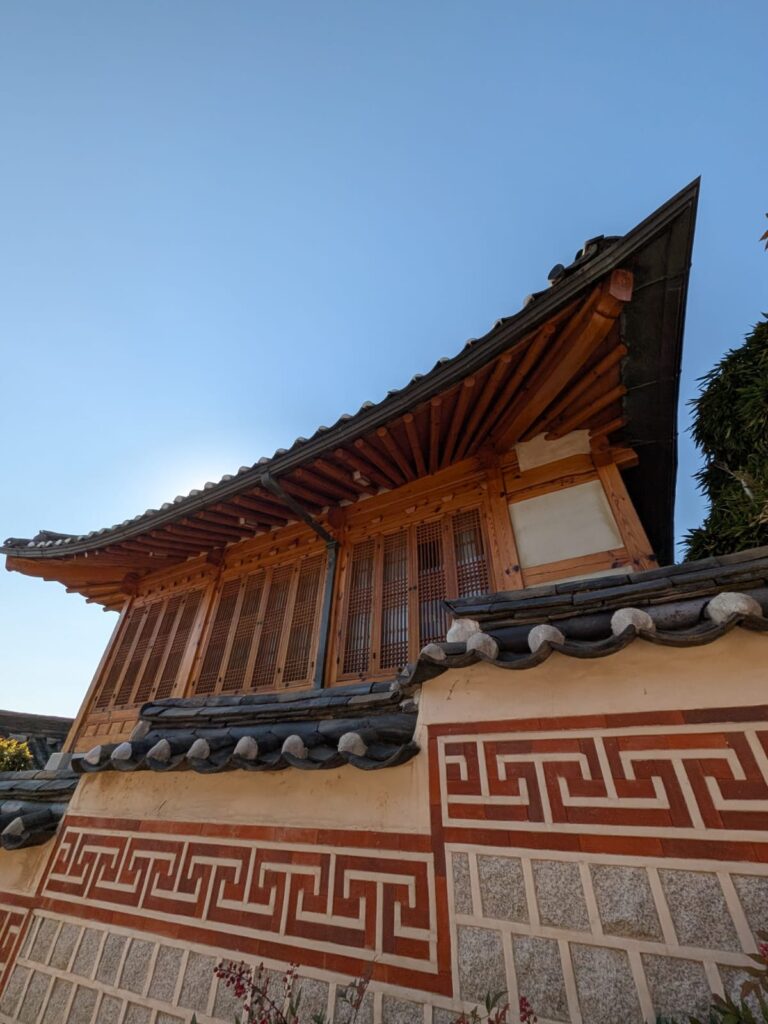
Gangnam — The Pulse of Modern Seoul
As daylight fades, the city crosses the river — literally.
South of the Han, Seoul becomes a different world: glass towers replace tiled roofs, traffic hums like electricity, and neon veins light up the skyline.
This is Gangnam (강남, “south of the river”) — a symbol of South Korea’s transformation from post-war austerity to global modernity.In just a few decades, Gangnam evolved from farmland into one of the most futuristic cityscapes in Asia.
Wide boulevards lined with flagship stores and tech headquarters announce the ambitions of a nation that rebuilt itself not just quickly, but brilliantly.
It’s a district where fortune, fashion, and innovation converge — and yet, beneath the surface, you can still feel the same Confucian rhythm that ordered Gyeongbokgung: precision, discipline, and an obsession with harmony, now translated into glass, steel, and data.The streets around Gangnam Station pulse with energy — commuters, students, and travelers moving in every direction, screens glowing like lanterns.
Cafés spill onto sidewalks, K-pop beats echo from every corner, and digital billboards flash faces more famous than kings.
This is the Seoul of now — endlessly connected, eternally awake.A short walk from the main avenue, COEX Mall stretches like a city beneath the city: a maze of restaurants, boutiques, art spaces, and the iconic Starfield Library, where thousands of books climb toward a ceiling of light.
Nearby, the SMTOWN complex celebrates the country’s pop culture empire, while sleek electric cars glide silently along the broad avenues.
Even the crosswalks here seem choreographed — the choreography of a city that’s always performing itself.But Gangnam is not all noise and glass.
Step a few streets away and you find quiet alleys lined with minimalist cafés, boutique design studios, and rooftop bars where the skyline reflects in every window.
From there, you can look north across the river — toward Gyeongbokgung, Bukchon, and the mountains beyond — and realize that Seoul is not two cities, but one story told in two directions:
the past written in wood and stone; the future in light and motion. -
Spain
June 25, 2025 / -
Rio de Janeiro
June 25, 2025 /Rio de Janeiro isn’t just beaches and samba. It’s a spectacular city where nature collides with urban life in the most dramatic way—mountains plunging into the sea, jungle meeting pavement, and colonial facades framed by graffiti and bougainvillea. In just four days, you can capture the essence of the Cidade Maravilhosa, from sunrise on mountaintops to nights dancing in centuries-old streets.

To really appreciate Rio de Janeiro, you have to picture it first. The city unfurls along Brazil’s southeastern coast in a spectacular tangle of granite mountains, golden beaches, and deep tropical forests. The southern part of Rio is where most visitors spend their time: neighborhoods like Copacabana, Ipanema, and Leblon hug the Atlantic shoreline, framed by dramatic peaks like the Dois Irmãos and Pedra da Gávea. Between the mountains, a narrow river was dammed to form the Lagoa Rodrigo de Freitas, a mirror-like lagoon ringed by bike paths and overlooked by the towering Christ the Redeemer.
To the north lies the historic city center, the Centro, where colonial churches, financial buildings, and samba bars crowd together. Nearby, the massive Maracanã Stadium rises like a temple to Brazilian football. On the eastern edge of the city, Sugarloaf Mountain (Pão de Açúcar) juts out into the bay like a giant sentinel, offering some of the most iconic views in South America.
And across the 13-kilometer-long Rio–Niterói Bridge, you reach Niterói, a quieter, charming city with beaches, modernist architecture (including Oscar Niemeyer’s spaceship-like museum), and a spectacular view looking back at Rio’s skyline—one of the rare places where you can actually see all of Rio at once.
Founded by the Portuguese in 1565 as a strategic port to defend against French colonists, Rio later became the capital of the Portuguese Empire in exile, and then Brazil’s own capital until 1960. But more than political history, what defines Rio is its energy: vibrant, chaotic, sensuous. The rhythm of samba pulses beneath your feet, even when the streets are still. Over the next four days, we’ll explore its peaks and promenades, beaches and backstreets—always with music in the air and ocean at your side.
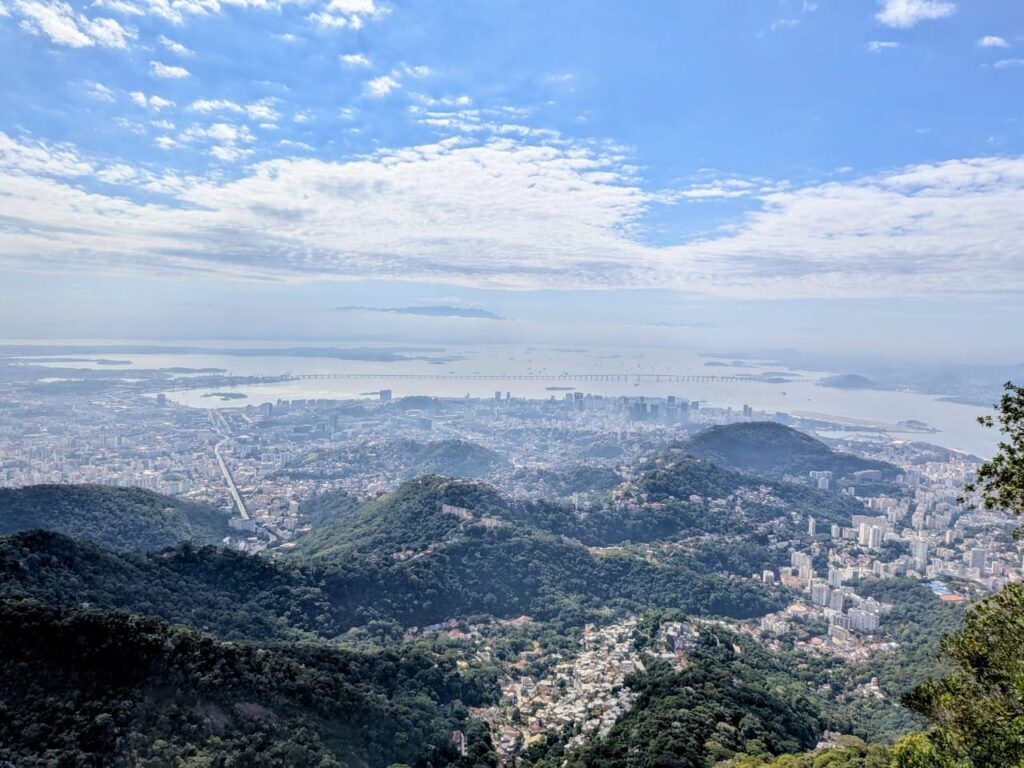
North Rio 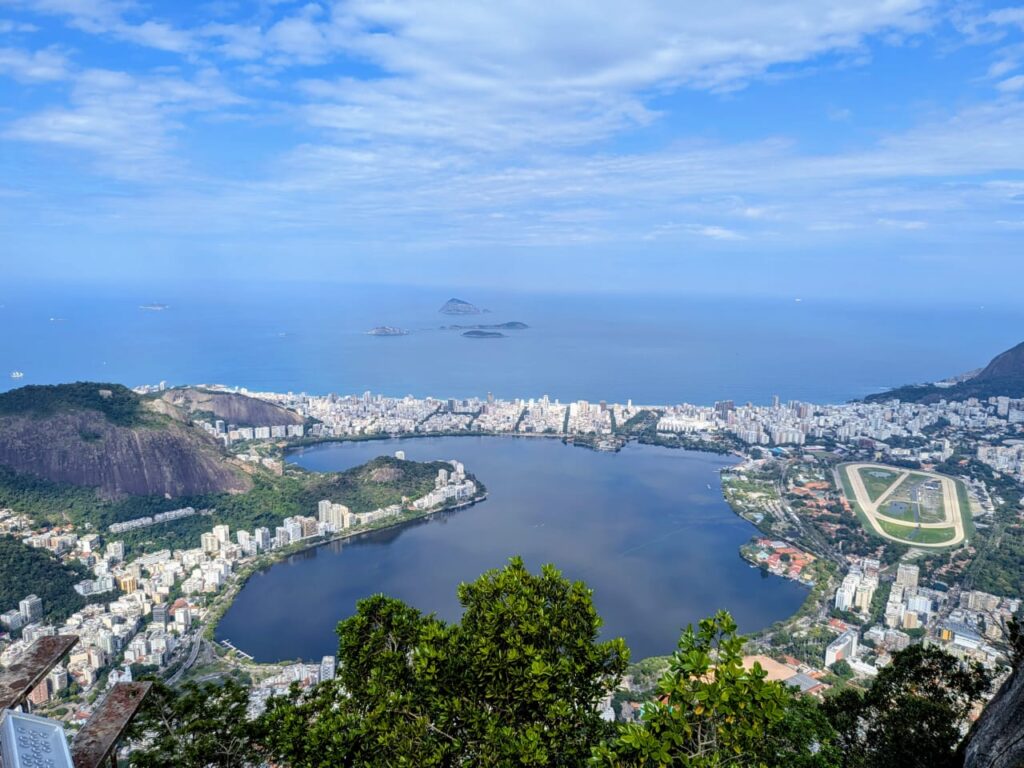
South Rio Day 1 - Postcards and Promenades: Sugarloaf and the Beaches
Your first morning in Rio starts with one of the city’s most iconic sights: Sugarloaf Mountain (Pão de Açúcar). The name dates back to colonial times when blocks of refined sugar were shaped like rounded cones—just like this towering granite peak. Two separate cable cars take you first to Morro da Urca and then to the summit, where the city stretches out beneath you: beaches, favelas, jungle, sea. It’s especially magical in the early morning light, before the crowds and the haze roll in.
After descending, head toward Copacabana. The long curving beach, with its classic black-and-white tiled promenade, is pure Rio. You’ll see locals jogging, playing beach volleyball, or sipping fresh coconut water at street kiosks. Continue west and you’ll hit Ipanema—stylish, elegant, with art galleries tucked between modernist apartment buildings. If time allows, end the day at Posto 9, where locals gather to watch the sun set behind the Dois Irmãos hills. The sky turns pink, music drifts on the breeze, and the rhythm of the city starts to slow.
Day 2 - Christ the Redeemer and Colonial Corners
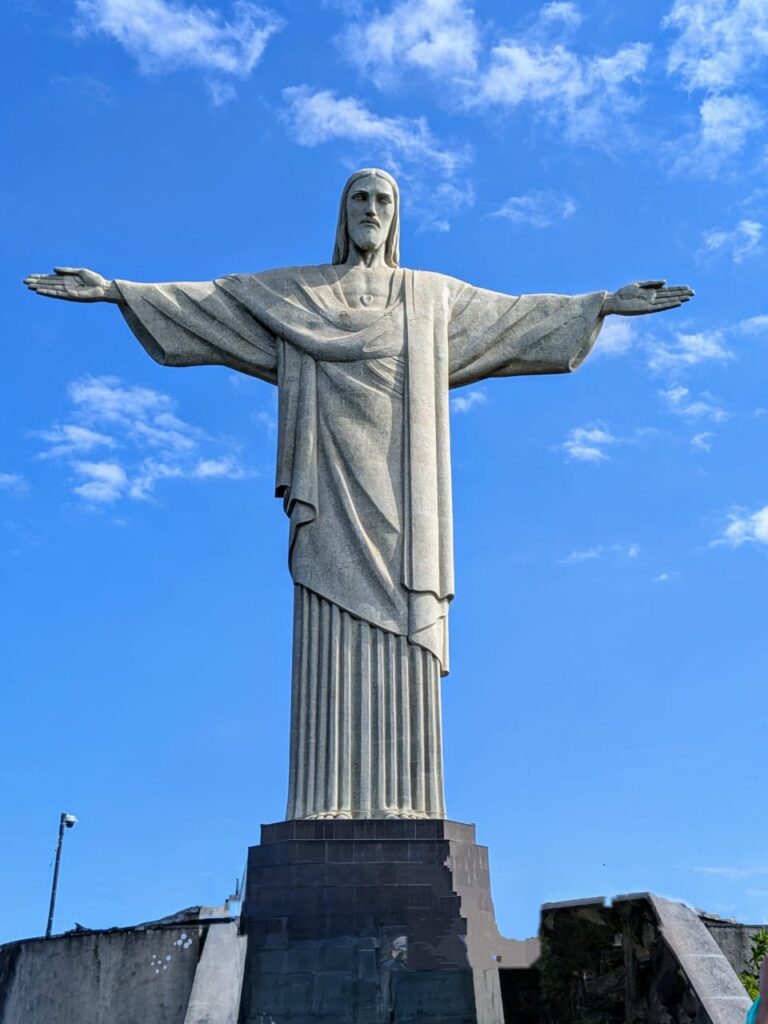
No journey through Rio would be complete without visiting Christ the Redeemer, nestled atop Corcovado within Tijuca National Park, the largest urban forest in the world. The best route is the charming cog train that travels through dense rainforest—this historic rail, originally built in the late 19th century, became a gateway to the statue once slaves were freed, intended as a gesture of gratitude to Christ .
Construction of the monument began in the 1920s and it was unveiled in 1931. It’s built of reinforced concrete, covered entirely in soapstone tiles mined in Minas Gerais. Interestingly, the head and hands were sculpted in France under sculptor Paul Landowski’s direction—and it’s said the hands were modeled after a Brazilian woman’s, bringing a touch of local humanity to the piece.
Today, you ride through the heart of the forest, glimpsing the lush canopy restored during Emperor Pedro II’s era—reforested by freed slaves to protect the city’s water sources between 1861 and 1887—and now alive with waterfalls, monkeys, and toucans.
From the summit, you stand beneath the vast arms of Christ and gaze upon all of Rio—from sparkling beaches to the tangled hills speckled with favelas. It’s a powerful fusion of human history, engineering, nature, and faith. For safety, stick to the train path, avoid hiking the trail after dark, and skip quieter paths that edge into less secure areas.
After your morning at Christ the Redeemer, spend the afternoon wandering through Santa Teresa, a bohemian enclave perched on the hills above downtown Rio. The neighborhood originated in the 1750s around a Carmelite convent built on Morro Desterro, named in honor of St. Teresa of Ávila. In its early days, the area attracted upper-class families seeking refuge from yellow fever—elegant French-inspired villas still line the winding, cobbled streets above lush valleys .
Santa Teresa’s charm comes alive with the iconic bonde tram, the historic yellow streetcar that, since the late 1800s, has climbed over the majestic Carioca Aqueduct (Arcos da Lapa) and snaked through the neighborhood along ancient tram lines. The aqueduct itself once carried clean water to the city but eventually became obsolete—and even turned into a source of sewage overflow—until repurposed for urban transport.
By the mid-20th century, Santa Teresa declined, but in the 1970s and 1980s a new generation of artists, poets, and musicians began buying up the grand villas. Their studios and galleries turned the area into “Rio’s Montmartre,” a creative pulse that still beats today in places like Parque das Ruínas, where a once-abandoned mansion now hosts concerts framed by sweeping city views.
One of the neighborhood’s cultural treasures is the Glória Maria Municipal Park, formerly known as Parque das Ruínas. Once the grand mansion of socialite and Belle Époque patroness Laurinda Santos Lobo, the estate became a gathering place for artists and intellectuals in the early 1900s. The house was later abandoned until the 1990s, when the city restored the ruins and reimagined them as a cultural center with galleries, concert spaces, and an open-air theater.
This spot is more than a ruin—it’s a panoramic vantage point offering sweeping views of Guanabara Bay and the Centro, framed by the skeletal remains of ornate walls and contemporary steel beams. In 2023, it was renamed in honor of beloved journalist Glória Maria, and now features walls painted by Brazilian street artist Kobra, a vibrant homage that blends past and present in technicolor.
After your morning at Christ the Redeemer, spend the afternoon wandering through Santa Teresa, a bohemian enclave perched on the hills above downtown Rio. The neighborhood originated in the 1750s around a Carmelite convent built on Morro Desterro, named in honor of St. Teresa of Ávila. In its early days, the area attracted upper-class families seeking refuge from yellow fever—elegant French-inspired villas still line the winding, cobbled streets above lush valleys .
Santa Teresa’s charm comes alive with the iconic bonde tram, the historic yellow streetcar that, since the late 1800s, has climbed over the majestic Carioca Aqueduct (Arcos da Lapa) and snaked through the neighborhood along ancient tram lines. The aqueduct itself once carried clean water to the city but eventually became obsolete—and even turned into a source of sewage overflow—until repurposed for urban transport.
By the mid-20th century, Santa Teresa declined, but in the 1970s and 1980s a new generation of artists, poets, and musicians began buying up the grand villas. Their studios and galleries turned the area into “Rio’s Montmartre,” a creative pulse that still beats today in places like Parque das Ruínas, where a once-abandoned mansion now hosts concerts framed by sweeping city views.
After visiting Parque Glória Maria, make your way downhill toward one of Rio’s most astonishing—and emotional—works of public art: the Escadaria Selarón. This 125‑meter staircase of 215 steps connects Lapa and Santa Teresa, its every tile a story.
Chilean-born artist Jorge Selarón began tiling the steps in 1990 as a modest tribute to his adopted home, Brazil, splashing the steps in green, yellow, and blue—the colors of the Brazilian flag. Neighbors scoffed, but Selarón, who had already roamed more than 50 countries, remained devoted. Sourcing broken tiles from local dump heaps and discarded building sites, he first covered his doorstep, then steadily expanded—never stopping, declaring his work “a crazy and unique dream” that would only end the day he died.
Over time, visitors began donating tiles from around the world. The steps now feature over 2,000 distinct tiles from more than 60 countries, a living mosaic that evolves as Obsessively as the city itself. Selarón continually replaced tiles—breaking and rearranging sections—to keep the installation fresh, likening it to a living artwork with “never complete” status.
Among the most haunting motifs are nearly 300 hand-painted tiles of a pregnant Black woman. The image first appeared in his paintings from 1977 and carried into the steps, a figure Selarón said represented “a personal problem from my past”. Some scholars connect this image to his late wife, who died while pregnant—an echo of grief embedded in mosaic.
Selarón lived at the base of the steps and became part of the scene: painting by day, chatting with visitors by night. He funded his work by selling portraits—often of the pregnant woman—and postcards, fueling his obsession with color and narrative. In 2005, in recognition of his cultural contribution, the city officially declared the stairs part of Rio’s heritage and made him an honorary carioca.
Tragically, on January 10 2013, Selarón was found dead on his own stairs, burned—some suspecting suicide, others suspecting foul play after he’d received threats. His final act, it seems, was closing the full circle of his “never‑ending” creation—and as he predicted, the staircase did end the day he died.
Today, the steps pulse with life: tourists hunting for tiles from their countries, musicians filming videos (U2, Snoop Dogg), and locals stepping through color and memory. This is no static monument—it’s a testament to devotion, memory, diaspora, and grief… and an unforgettable, surreal Rio moment.
Day 3 - A Tropical Jungle Within the City
Few cities in the world can boast a rainforest within city limits, but Rio can. The Tijuca National Park is a miracle of reforestation—once cleared for coffee plantations in the 19th century, today it’s a thriving ecosystem and the lungs of the city. You could spend an entire day hiking here. One popular route leads to Pedra Bonita, a rocky summit with sweeping views of the beaches and the statue of Christ in the distance.
Along the way, you might encounter waterfalls, howler monkeys, or flashes of bright toucans. For those who prefer something less strenuous, a guided jeep tour offers a comfortable but immersive option. Later in the day, cool off at the Jardim Botânico, founded in 1808 by the Portuguese king João VI. With its towering imperial palms, orchid pavilions, and giant water lilies, the garden is a peaceful escape from the heat and traffic—a place to slow down and breathe.
Day 4 - Football, Museums, and a Final Sunset
Begin your final day at Maracanã, one of the most storied football stadiums in the world. Even if you’re not a sports fan, the tour is worth it—walk through the locker rooms, stand at pitch-side, and imagine the roar of 78,000 fans. It’s not just a stadium, but a temple to Brazilian identity.
In the afternoon, if you’re in the mood for more culture, head to the futuristic Museum of Tomorrow (Museu do Amanhã), built on the former docks with sweeping lines and science-driven exhibits on climate, cities, and the future of humanity. Or if you prefer something slower, explore the refined streets of Leblon, the city’s most upscale neighborhood, where you can browse bookstores, sip a quiet espresso, or do some last-minute shopping.
As the sun begins to sink, join locals at Mureta da Urca. It’s not a formal bar or even a restaurant—just a stone wall by the bay where people gather with cold beer, conversation, and a view of the boats bobbing in the harbor. It’s humble, authentic, and oddly perfect—just like Rio.
New Orleans